

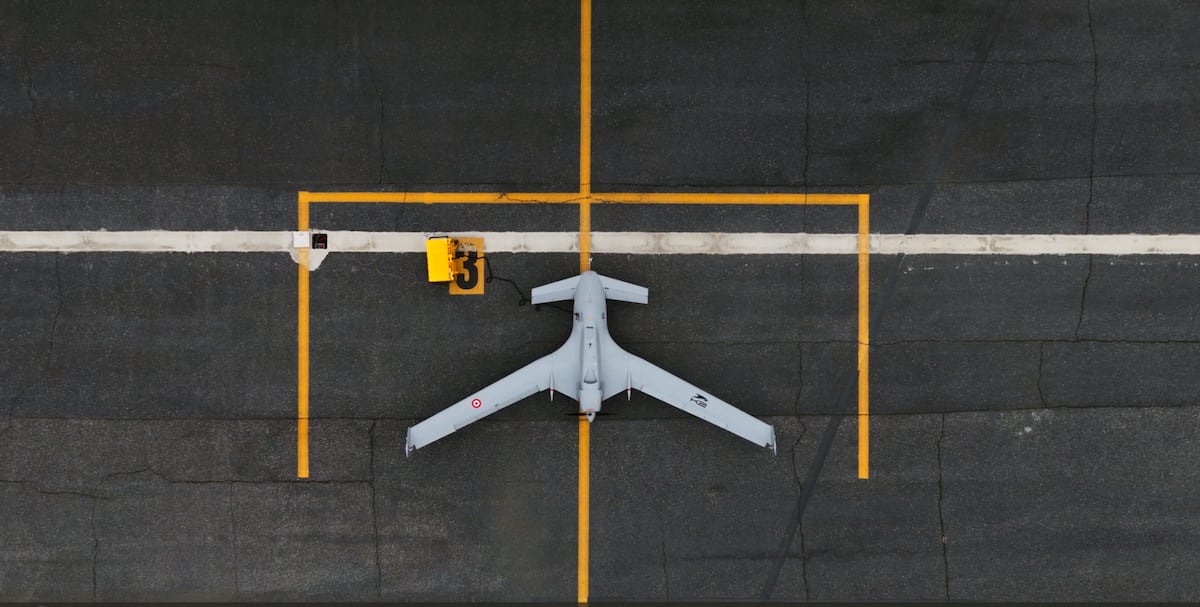
ISTANBUL — Turkish defense company Baykar announced flight tests of its K2 loitering munition, releasing footage and performance data showing an autonomous swarm formation flying and navigation in GPS-denied environments.
The K2 is a fixed-wing loitering munition measuring 5.1 meters in length and 2.1 meters in height, with a wingspan of 10 meters. The maximum take-off weight is 800 kilograms, of which 200 kilograms is allocated to the warhead payload.
Baykar states that the K2 has a maximum range in excess of 2,000 kilometers, a cruising speed of over 200 km/h, and an endurance exceeding 13 hours.
The K2 carries an electro-optical and infrared gimbal camera, providing day and night reconnaissance and surveillance capability alongside a visual target lock-on function for terminal guidance.
RELATED
The K2’s navigation architecture is designed to function in conditions where global navigation satellite systems are unavailable or subject to jamming. The platform supports coordinate-based targeting and visual lock-on engagement. Datalink architecture includes both line-of-sight and beyond-line-of-sight satellite communications.
The platform uses terrain-referenced visual navigation — scanning ground features through its gimbal and underside cameras — to derive positional estimates without reliance on external satellite signals.
This approach has become a stated design requirement across a growing number of loitering munitions programs, driven by the prevalence of GPS jamming and spoofing observed in Ukraine and other recent conflicts.
According to Baykar, in the test scenarios, five K2 platforms operating with AI-assisted swarm synergy, used their artificial intelligence, sensors and software to determine their position relative to other aircraft in the swarm, maintaining their place within the formation without error and successfully completing all assigned tasks
Baykar has marketed the K2 as a relatively inexpensive strike option for military forces, with unit cost low enough to permit large-scale fielding and reduce dependence on more expensive precision munitions
Cem Devrim Yaylali is a Turkey correspondent for Defense News. He is a keen photographer of military ships and has a passion for writing about naval and defense issues. He was born in Paris, France, and resides in Istanbul, Turkey. He is married with one son.
Read the full article here
