

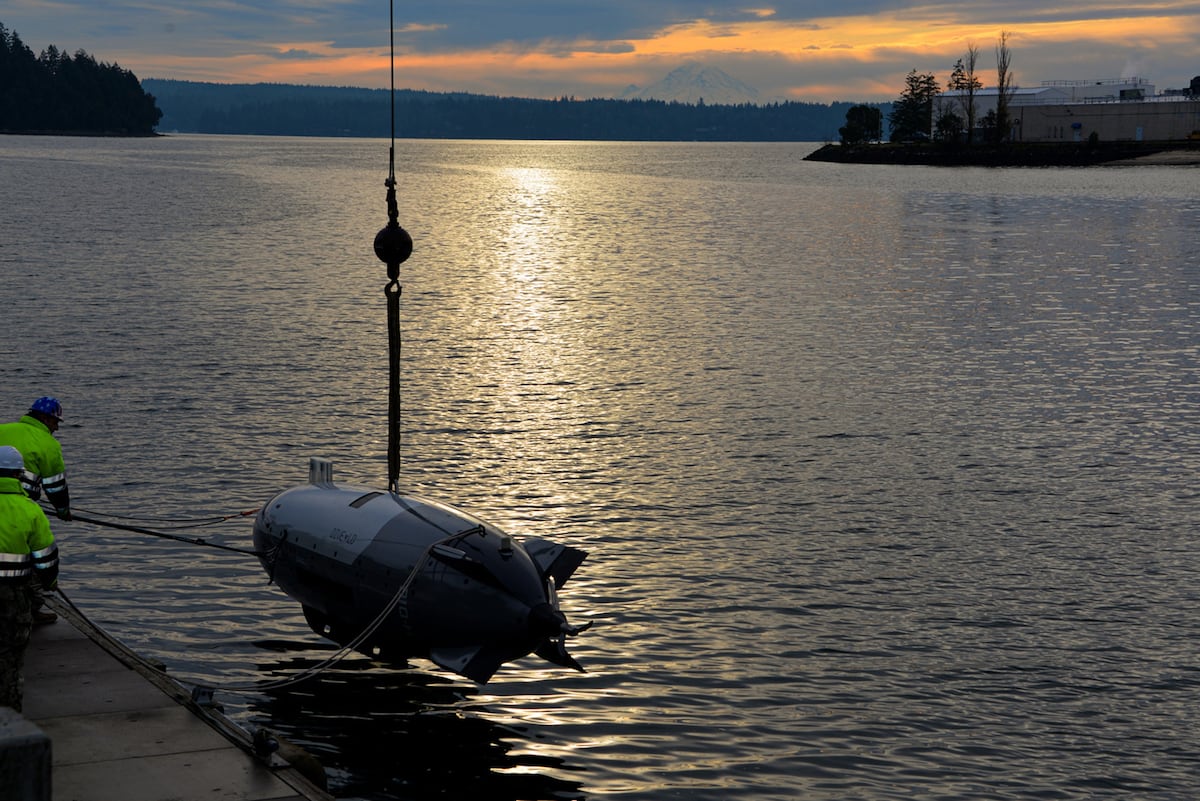
America and Britain are joining forces to tackle the threat of underwater drones to ports and other critical infrastructure, according to a solicitation by the Pentagon’s Defense Innovation Unit.
The two nations are seeking a comprehensive suite of commercial systems that can detect and destroy a variety of undersea robots, including unmanned underwater vehicles, remotely operated vehicles and semisubmersibles.
“Current solutions are fragmented, expensive, and limited in number,” warned the solicitation. The primary focus of the Robotic Exclusion and Engagement Framework, or REEF, project is to protect “ports and harbors from underwater threats of varying size and sophistication, while the broader goal is to protect all U.S. critical waterways.”
DIU envisions using off-the-shelf sensors, edge processing, active and passive sensors, sensor fusion, decoys and other technologies to create a stand-alone solution that can be quickly deployed as needed. This can include fixed systems such as moored buoys and buried cables, or mobile systems such as USVs, UUVs, UAVs and drifting buoys.
Sensors should be able to utilize artificial intelligence to discriminate between hostile undersea drones, versus nonthreats such as marine life, cargo ships and fishing vessels.
“The system must provide sufficient detection-to-response time for human in-the-loop decision-making such that underwater threats can be safely interdicted or neutralized,” the solicitation noted.
The system will employ kinetic and nonkinetic approaches to stop drones. Nonkinetic methods can include rapidly deployable nets, bubble curtains and synthetic barriers. Kinetic defenses can include kinetic payloads, acoustic directed energy and physical coupling devices.
Preference will be given to nonkinetic solutions, the solicitation said.
REEF will emphasize decoys to protect waterways and critical infrastructure. “Capabilities to confuse adversarial underwater craft are of high interest. These can be low-cost attritable systems or more technologically advanced systems that use signals to act as a decoy to prevent the successful completion of the adversary’s mission,” according to the solicitation.
REEF should require little training to operate, and use AI to provide users with suggestions. It must be compatible with existing U.S. command-and-control systems and common operating pictures.
Cooperation with the U.K. will be eased by a 2024 Department of Commerce interim final rule that allows some controlled items to be shared with Britain. British companies are eligible for export control relief under General Export Authorization No. 001.
Michael Peck is a correspondent for Defense News and a columnist for the Center for European Policy Analysis. He holds an M.A. in political science from Rutgers University. Find him on X at @Mipeck1. His email is [email protected].
Read the full article here
