

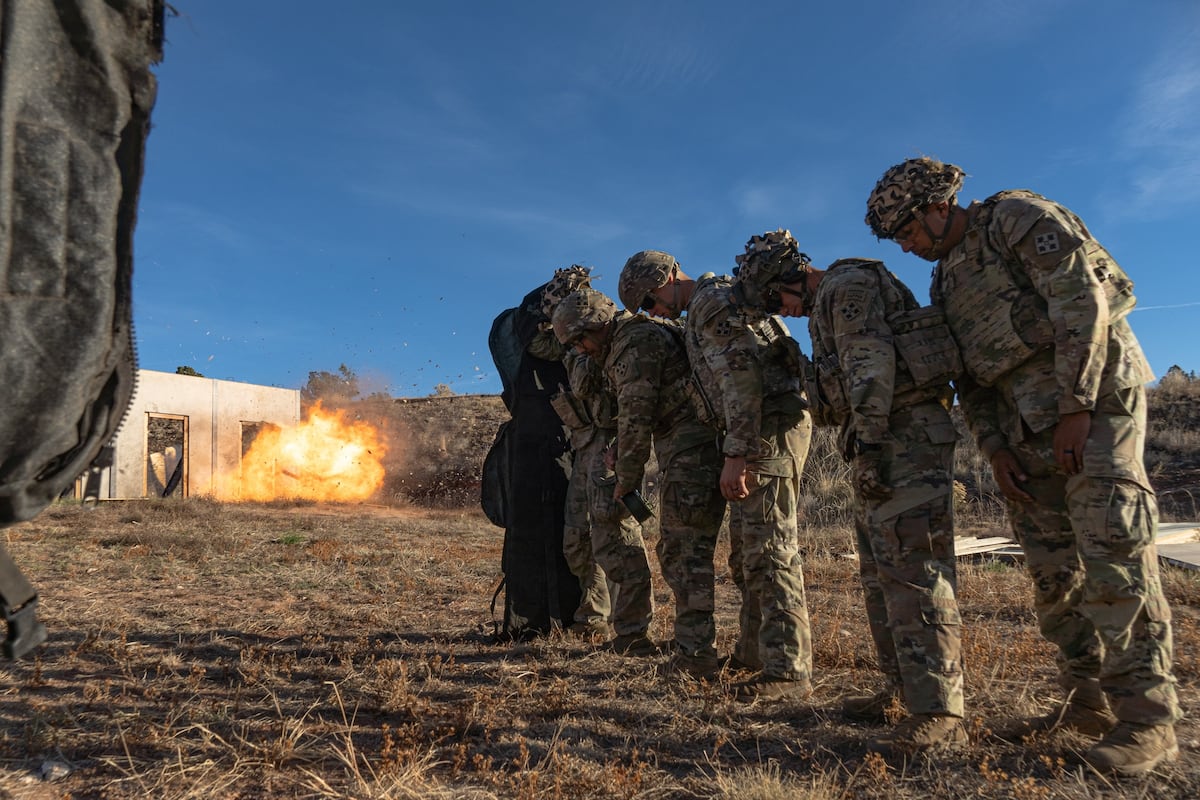
As conflicts around the world deplete stockpiles and strain munitions production, the United States wants to create a research and manufacturing center to boost the production of explosives.
The facility, which will be located at Blue Grass Army Depot, Kentucky, will be a “comprehensive, modern, and efficient ‘Center of Excellence’ (CoE) for scale-up and production of current and emerging explosives,” according to the Army’s Sources Sought notice, which has a deadline of April 15.
The Army wants this facility quickly. The notice calls for “rapid acceleration of this capability with completion prior to 2031.” The center doesn’t even need to be in one location. “The Government’s preference is for a single, integrated campus model, but will consider distributed or networked concepts,” the Army noted.
The Army aims to establish a site that will “serve as a focal point within the organic industrial base using traditional or non-traditional production processes for Research Department Explosive (RDX) and High Melting Explosive (HMX).” In addition, the Army is also considering a pilot facility to research and produce next-generation emerging explosives.
Contractors are asked to provide a variety of information, such as their design for a facility that could include “[research and development] labs, pilot-scale production, full-rate production lines, analytical testing, packaging, waste treatment, and administrative/support functions.”
Also desired is an estimated “price per pound for RDX and HMX components and current RDX- and HMX-based formulations the CoE could produce, assuming five and ten years of fixed prices and no government direct funding during operations.”
Companies should also describe how they plan to fund themselves for the project, and how much money they are willing to invest. They should also consider whether private- or government-funded projects — either at DOD or non-DOD sites — can be moved to Blue Grass Army Depot to “optimize the operational viability of the CoE.”
The Army also seems concerned about providing explosives to U.S. allies. “Due to the urgency of this requirement, the Government intends to release a follow-on Sources Sought notice to award a non-competitive, sole-source, Undefinitized Contract Action (UCA)” for contracts related to Ukraine, Taiwan, and Israel, according to the notice.
With conflicts in Ukraine and the Middle East devouring munitions at a ferocious rate, and many nations beefing up their armed forces, there are already shortages and production bottlenecks of everything from howitzer shells to air defense missiles.
The global shortage of explosives will only exacerbate that problem, especially because factories that make explosives are not popular with the local citizenry. Environmental concerns led to the closure in the 1980s of the last domestic plant in the U.S. for producing TNT. Shortages have become so acute that even commercial miners lack blasting charges.
In addition, nations are hoarding explosives. Major exporters of TNT include Russia and China, which have halted sales to America. Poland — the biggest TNT manufacturer in NATO — has been a major supplier to the Pentagon. However, Polish explosives output has been diverted to Ukraine, or retained for the Polish military. Polish manufacturer Nitro-Chem recently announced it is expanding production.
Michael Peck is a correspondent for Defense News and a columnist for the Center for European Policy Analysis. He holds an M.A. in political science from Rutgers University. Find him on X at @Mipeck1. His email is [email protected].
Read the full article here
