

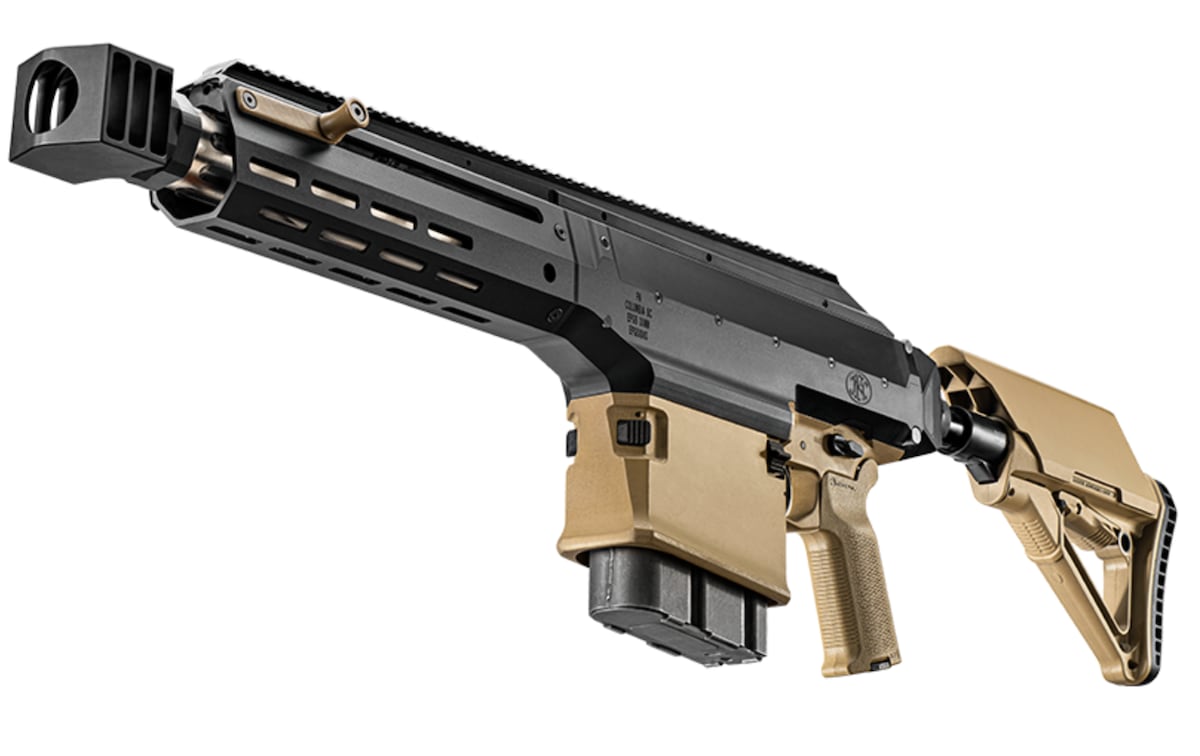
After two decades of searching for a new grenade launcher, the U.S. Army appears to be zeroing in on a choice.
The Army is seeking prototypes for the Precision Grenadier System, which will replace the M203 and M320 grenade launchers.
In a nod to modern battlefield conditions, the PGS will incorporate drone-killing tech in addition to offering troops the capability to engage targets behind defilade such as walls.
The PGS “will be a man-portable, target engagement system that enables the squad to organically incapacitate enemy personnel targets in defilade, in close quarters battle and unmanned aerial systems with quick and precise fire,” according to the Army solicitation, which is due by May 11.
The solicitation calls for prototype submissions that include 16 weapons, fire controls systems and around 25,000 rounds of ammunition, with a mix of counter-defilade, counter-drone, close quarter battle and training rounds.
The Army plans to award two Other Transaction Agreements for prototypes. The ultimate goal is to issue two grenade launchers per rifle squad.
The hunt for a next-generation grenade goes back to the 2008 Small Arms Capabilities-Based Assessment, which examined combat lessons from the Afghanistan and Iraq wars.
Among the findings was that the Army needed a grenade launcher that can hit targets in defilade out to 500 meters. The current 40mm M203, and its successor the M320, have an effective range of 350 meters.
“Warfighters lack the ability to achieve desired accuracy and incapacitating effects against personnel targets in defilade [protected from hostile ground observation and flat projecting fire by an obstacle, such as a wall or hill], at ranges out to 500 meters,” the small-arms study noted.
For a time, the solution appeared to be the 25mm XM25 “Punisher.” But that program was canceled in 2018 amid cost and performance concerns, leaving troops to rely on the older grenade launchers firing airburst rounds, as well as the Carl Gustaf 84mm recoilless rifle.
An RFI for the Precision Grenadier System in 2020 listed a variety of desired capabilities. In particular, it sought a breaching capability capable of blasting “solid wood doors 1.5 inches thick, windows, and gates, at 50 meters.”
It also asked for an armor-piercing round “capable of a hitting a lightly armored vehicle out to a minimum engagement distance to 500 meters day or night with an armor penetration of between 1.0 to 2.0 inches at 90 degrees rolled homogenous armor.”
The 2026 solicitation doesn’t mention breaching or anti-armor capabilities. It does call for hitting “enemy combatants, their personal equipment, and thin-skinned targets in defilade positions, while limiting collateral damage.”
Michael Peck is a correspondent for Defense News and a columnist for the Center for European Policy Analysis. He holds an M.A. in political science from Rutgers University. Find him on X at @Mipeck1. His email is [email protected].
Read the full article here
