

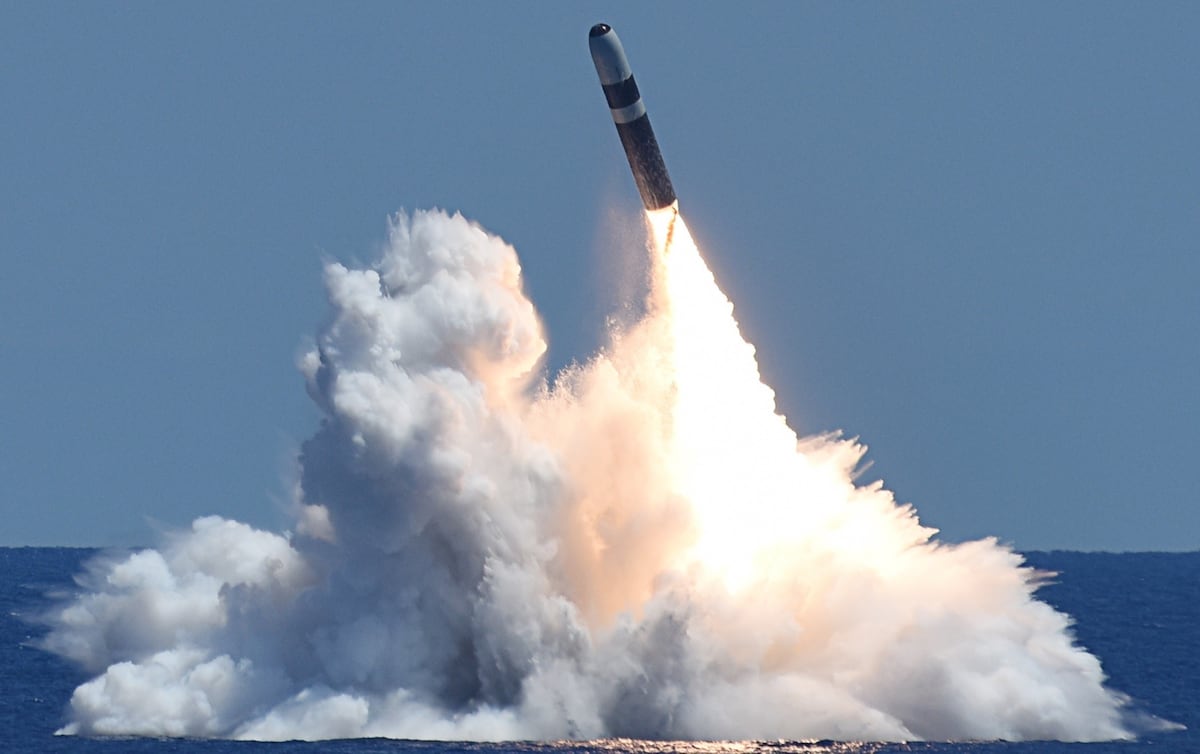
The U.S. Navy wants a special railroad car to transport unarmed ballistic missiles, according to a recent request for information.
The problem is that existing railcars are almost 50 years old, and will soon be retired. But the Navy still has a need to transport Active Inert Missiles, which are dummy rockets used to practice tasks such as loading missile tubes.
Currently, the Navy uses the DODX 40000, a 150-ton flatbed designed by the U.S. Army in 1981 to carry cargo such as tanks, and which is slated to be demilitarized in 2031.
“The Fleet Ballistic Missile (FBM) program initially procured these flatcars for the transportation of Active Inert Missiles (AIMs) between facilities,” according to the Navy RFI published Nov. 24. “However, the current 3-axle, 6-wheel truck design is now obsolete, and the American Association of Railroads (AAR) will not grant an extension of their service life.”
While the RFI did not provide specific requirements for the next-generation railcar, the DODX 40000 is 68 feet long, and has a maximum loading capacity of 140 tons. It is designed to carry two M1 Abrams tanks, and can haul cranes, shipping containers and other large items.
In recent years, the Navy has sought other rail improvements. Navy Munitions Command Atlantic plans to replace its 200-strong fleet of boxcars and flatcars that haul munitions.
“Critical brake system components are no longer manufactured, requiring cannibalization of parts from decommissioned railcars to keep the fleet operational,” noted Military News. “Several railcars have recently been retired due to structural frame cracks and issues caused by accelerated wear, gradually reducing the fleet size.”
Meanwhile, the Navy and the Department of Energy have collaborated to design armored railcars to transport spent nuclear fuel and radioactive waste. The Atlas system includes a 12-axle railcar to carry nuclear material. Riding shotgun is the Rail Escort Vehicle, which will carry security guards, cameras and communications equipment.
The impending retirement of the DODX 40000 is just one more strain on the military rail system, which remains the most efficient and economical mode of transports for tasks such as moving heavy equipment from bases to training ranges or to ports for overseas assignments. A 2021 GAO report on Army rail found numerous problems that are hampering the network.
“Although the Army moves the majority of what it needs for a large-scale combat operation over its rail network in CONUS [continental U.S.], much of that track is in ‘red’ or poor condition,” Diana Moldafsky, an acting director of GAO’s Defense Capabilities and Management Team, told Defense News. “Additionally, DOD hadn’t figured out how many rail operating crews it needed to support this type of movement and lacked elements of a quality assurance and quality control program for conducting its inspections.”
“We didn’t focus on the flatcars specifically, but the issue of using aging flatcars was brought up as a challenge as well,” Moldafsky added.
While the 2021 study only looked at Army rail, the Navy will face the same obstacles.
“Due to the condition of the rail track, any designing of special rail cars to transport items such as dummy ballistic missiles would require a number of considerations to ensure the safe movement of those type of loads,” Moldafsky said.
David Clarke, a retired professor of engineering and railroad expert, said designing a rail car to carry missiles on the U.S. rail system shouldn’t be too difficult as long as the cargo is less than 90 feet long (a Trident D5 ballistic missile is 44 feet long).
“Rail cars haven’t changed much since 1981,” he told Defense News.
Read the full article here
