

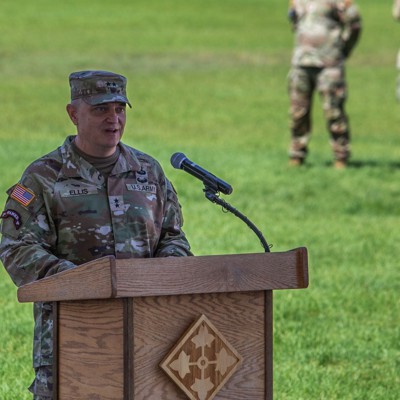
HUNTSVILLE, Alabama— Nine months ago, the 4th Infantry Division’s commander told an audience that he would be perfectly happy to take a piece of tech that does 60 percent of what the Army needs and let his soldiers’ feedback inform the remaining 40. On Wednesday, he said he’d like to switch those ratios.
Gen. Pat Ellis and his soldiers have been helping the Army develop its next-generation command-and-control software as the service tries out its new approach to acquisition, taking existing technology and putting it into the field as developers stand by to integrate soldier feedback.
“We’ll go 40 percent,” Ellis said at the AUSA Global Force Symposium. “We don’t want the product to be perfect. The soldiers actually want to be active participants in the development process.”
That approach wouldn’t necessarily work everywhere, he added, but it makes sense for software development at least.
The Army is doing something similar with its M1E3 Abrams tank and XM-30 Mechanized Infantry Combat Vehicle: delivering the bones of the vehicles to soldiers, whose feedback will inform what they need in terms of software, sensors and weapons.
It’s a drastic departure from the Army’s past acquisitions model, which involved long lists of requirements and a “black eye” if a company didn’t deliver exactly what the Army had asked for, the service’s Portfolio Acquisition Executive for C2/counter-C2 said.
“And so a test report that may say that it’s not effective or effective with limitations, I mean, this was a significant emotional event for a lot of programs, and I think we’ve really kind of like short-circuited that,” Joe Welch said.
There’s no longer an expectation of perfection out of the gate, Welch added, and the Army is working hard with vendors to communicate that an offering that still needs work is no longer going to put them out of the running.
“In fact, you know, as you just heard, there’s a preference that it’s that it’s not,” Welch said. “Because perfect, in some ways, means that, well, then you’re done iterating on it. You’re done making it better.”
During 4th ID’s Ivy Sting series to test out NGC2, Ellis said, he has convened so-called “solution summits” to talk about challenges and next steps with soldiers, vendors and even potential vendors.
“We bring everybody in and say, let’s talk about this problem. Some folks are on the contract. Some folks are not,” he said. “We just talk about, ‘Hey, look, we’ve done airspace management, we’ve done chat functionality, we’ve done maps, we’ve had a lot of these challenges that we’re seeing.’ And this lets everybody kind of talk about and kind of hear where the industry partners will go in that space.”
Read the full article here
