
The Schutzstaffel was a fascinating mob. Few organizations were more reviled during WWII than the feared SS. Universally feared on the battlefield while being justifiably vilified for their well-documented atrocities, Himmler’s black-clad storm troops were history’s original jack-booted thugs.
First-Person Impressions of the MP35
I had a friend who has since passed who landed on Omaha Beach at 1400 hours on 6 June 1944. He said that, by the time he hit the beaches, most of the machine guns had been silenced. However, the German mortars and artillery still took a terrible toll. However, this paled in comparison with what was to come.

By war’s end, this man had seen it all. He slogged all the way across Western Europe, slugging it out with the Wehrmacht, the Fallschirmjagers and the vaunted SS. During the precious time I had talking with this amazing guy, he consistently conflated the SS with the Gestapo. Conversationally, he referred to Waffen SS combat troops as, “those Gestapo men.” When I asked his opinion of the SS in combat, he matter-of-factly said, “We never took those Gestapo men prisoner.”
Anatomy of a Monster
The SS was a product of the weird cult that was Hitler worship during WWII. Originally contrived as a personal bodyguard for Der Fuhrer, the SS eventually evolved into a bizarre elite parallel force that served alongside conventional Wehrmacht formations. Throughout the abbreviated life of Hitler’s private army, the SS struggled to compete for ever-dwindling resources and combat equipment. Despite Hitler’s aggressive patronage, the SS still often had to make do with whatever they could scrounge.

Most modern students of WWII view the SS as a fairly homogenous whole. However, the SS was actually divided into two broad categories and several disparate branches. The Allegmeine SS, or General SS, was tasked with police duties and management of the Nazis’ radical racial policies. The Waffen SS or Armed SS was configured more as an elite combined arms combat formation that included infantry, armor, engineer and panzer grenadier units. Particularly late in the war, the Waffen SS employed untold thousands of foreign volunteers, oftentimes from the occupied territories.
SS units were ably equipped with standard German infantry rifles and machine guns. However, they also make extensive use of captured weapons like the superb Czech ZB-30 light machine gun. Additionally, the SS consumed almost all of the curious MP35/I submachine guns produced by Bergmann company. Not familiar with the MP35/I? It’s unique in the annals of pistol-caliber SMGs.
Bergmann MP35 Origin Story
The Danish company Schultz and Larsen originally produced the MP32 chambered in 9x23mm Bergmann. In 1934, the MP32 was updated into the Bergmann MP34. Curiously, the Steyr MP34 is an entirely different weapon despite carrying the same model designation.

Bergmann designed weapons, but they had limited production capabilities. As a result, the first production run of the MP34 was farmed out to Carl Walther’s Zella-Mehlis facility. This initial lot consisted of around 2,000 weapons. In 1935, the basic MP34 was redesigned yet again into the MP35/I, the definitive model. Walther produced some 5,000 copies between 1936 and 1940.

Live The Armory Life. The latest content straight to your inbox plus an automatic entry to each of our monthly gun giveaways!
Once WWII fully conflagrated, German industry began production of war materiel in earnest. Walther became preoccupied with more pressing stuff, and MP35/I manufacture was moved to the Junker and Ruh Company. These guns were manufactured through 1944 and sported the “ajf” acceptance mark. Before production ceased, Junker and Ruh had built some 40,000 copies, almost all of which went to the Waffen SS. Most but not all of these weapons included tiny SS runes engraved on the side of the receivers.
Details of the MP35 SMG
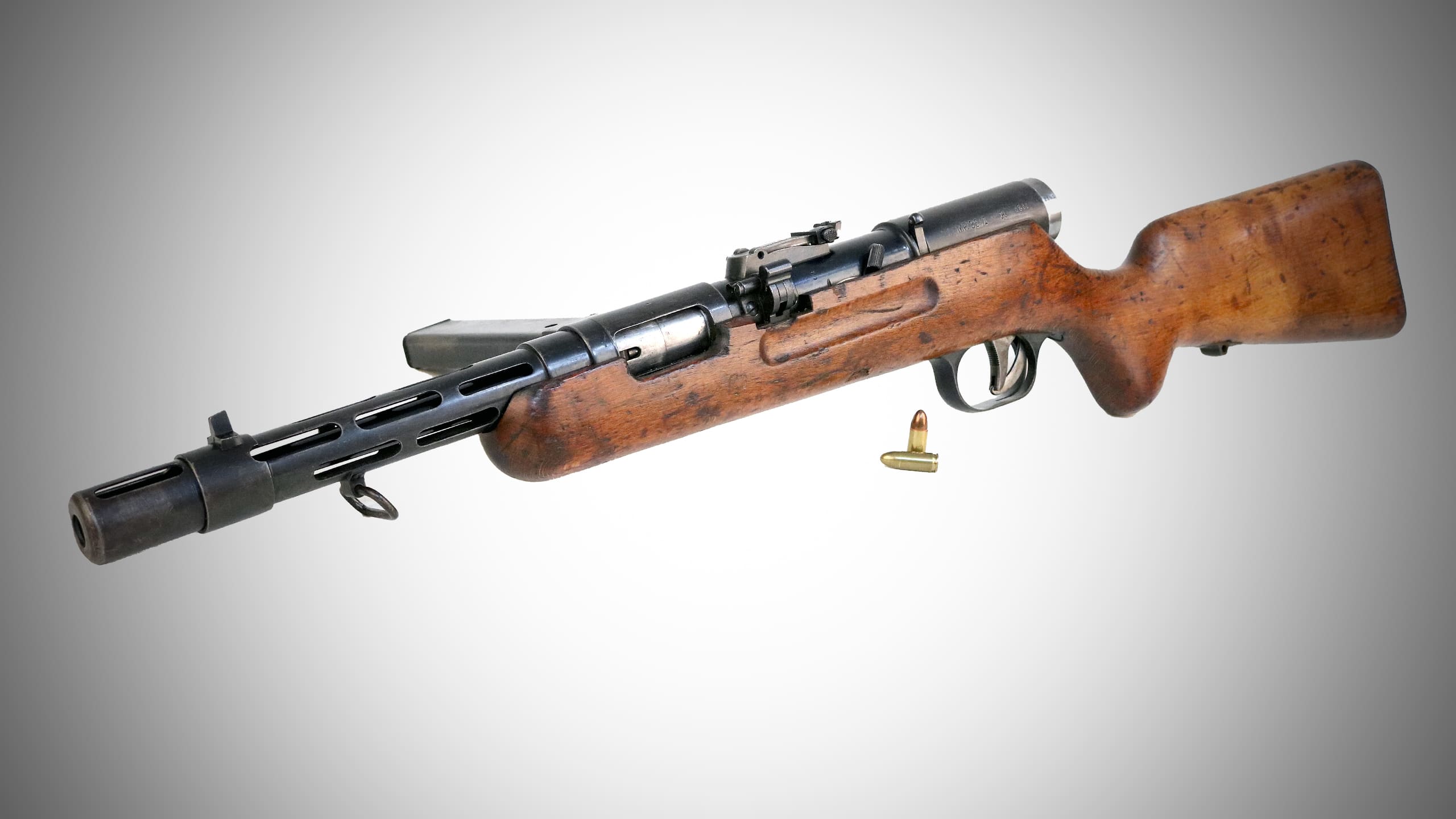
The MP35/I was an archetypal example of the interwar gunmaker’s art. Built around a massive machined steel receiver, the MP35/I incorporated a variety of unusual features. For starters, the side-mounted magazine fed from the right. The gun ejected to the left.

Additionally, the action of the MP35/I was designed to mimic that of the bolt-action rifles of the day. To charge the weapon, you would rotate a charging knob on the right side of the gun up to free the bolt. The operator then retracted the bolt assembly before shoving it forward against spring tension. You then rotated the bolt handle back down to lock it in place. The sear would hold the bolt to the rear. Pressure on the trigger would release the bolt to strip a round from the magazine and fire the gun.
The MP35/I included a complex two-position trigger system. A short pull produced semi-auto fire. A full pull was rock and roll. The gun also included a complicated machined muzzle brake that was integral with the barrel. All of this combined with the mass of the weapon and the modest recoil impulse of the 9mm Para round to make the MP35/I exceptionally controllable.

Early MP35/I’s included two separate safety switches. One was a rotating lever that was easy to manipulate. The other was more of a travel safety that locked the bolt in place in either the open or closed position. This latter component was deleted at some point in the production run.
The MP35/I weighed 9.3 lbs. empty and had a 7.9” barrel. The rate of fire was a fairly comatose 540 rpm. The gun included a complex sliding tangent rear sight optimistically graduated out to 1,000 meters, and it fed from either 24- or 32-round magazines. While the MP35/I mags were unique to the gun, I have read that it would also feed from MP28 magazines as well. However, I have not had opportunity to verify that myself and remain skeptical. Editor’s Note: The MP28 is the German SMG that inspired the British Lanchester submachine gun.
Combat Use
The MP35/I first saw serious action during the Spanish Civil War. It served all the way through to the end of WWII. Most of the guns got chewed up on the Eastern Front as did most of the SS men. Some of the weapons were used by the infamous einsatzgruppen. As a result, the MP35/I will be forever associated with SS atrocities and terror.

At a time when the entire world seemed to have lost its collective mind, the Waffen SS developed an unsettling reputation for being exceptionally capable amoral monsters. The uniquely designed Bergmann MP35/I unfortunately played a small part in all of that.
Editor’s Note: Please be sure to check out The Armory Life Forum, where you can comment about our daily articles, as well as just talk guns and gear. Click the “Go To Forum Thread” link below to jump in and discuss this article and much more!
Read the full article here
