

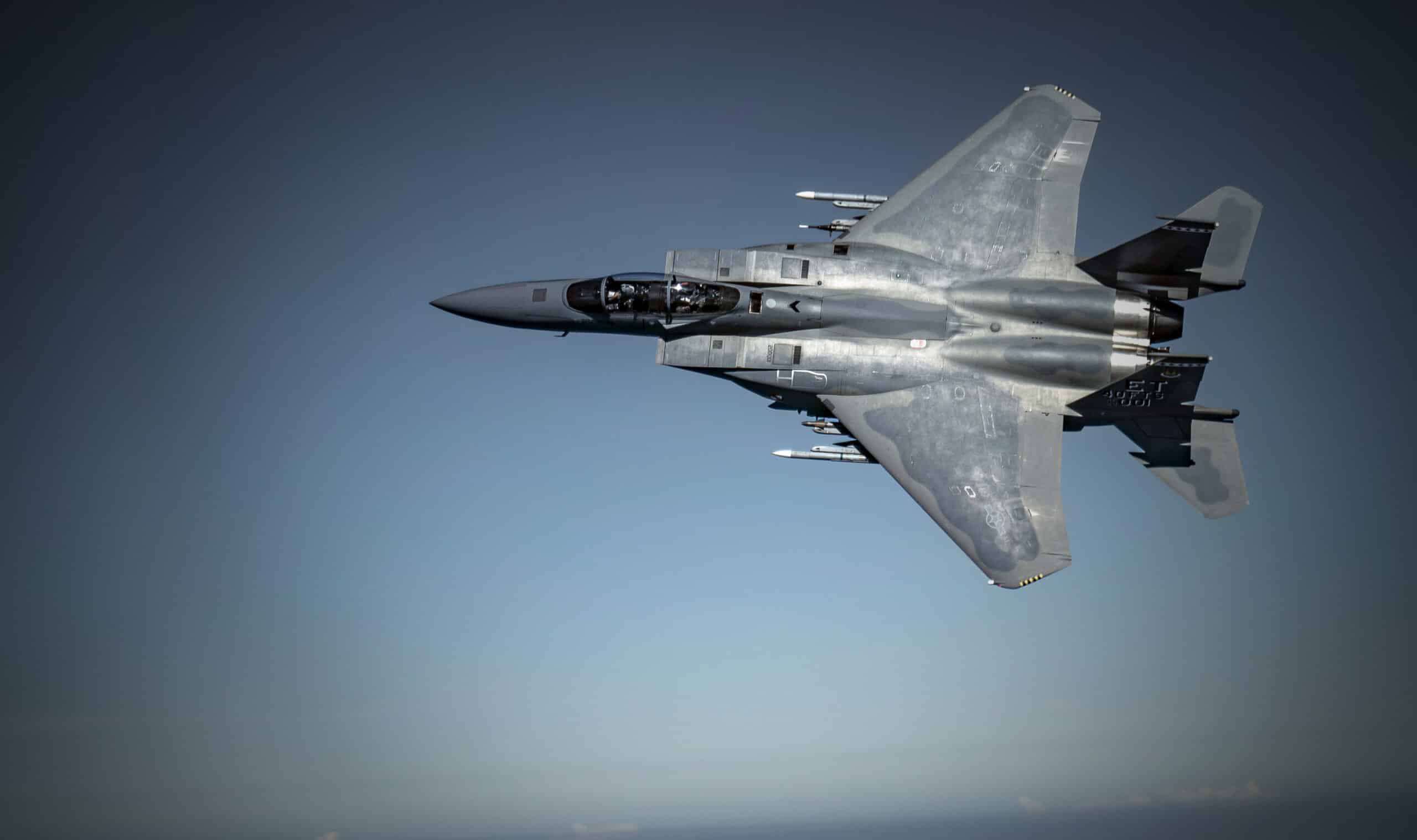
This past June, the Portland Air Guard Station, Oregon, reached a new milestone, receiving its fourth Boeing F-15EX Eagle II just before the first anniversary of the base receiving the first of the modernized F-15 aircraft. The Oregon Air National Guard had been selected to be the first operator of the Eagle II, and with the arrival of the latest aircraft, is making progress towards receiving the planned 18 multirole fighters.
It was also that month that the White House announced that the United States Air Force’s total planned fleet size for the F-15EX could grow to 129 fighters. Aerospace giant Boeing has also leveraged the recent momentum to push for the restoration of the original program of record, which was 144 fighters, after the Air Force had previously reduced the planned acquisition to fewer than 100 fighters.

The debate over the total fleet size is likely to continue, even as Boeing has sought to address rising costs, while questions have been raised about whether the aerospace firm will have the ability to produce the modernized F-15, develop and build the sixth-generation F-47, and still bid for the contract for the U.S. Navy’s F/A-18 Super Hornet replacement. Boeing currently produces that latter aircraft as well.
Modernized F-15
The F-15EX is just the latest chapter in the storied history of the fighter aircraft. The McDonnell Douglas F-15 Eagle, along with its ground-attack derivative, the F-15E Strike Eagle, has the distinction of being the most successful modern combat fighter, scoring more than 100 aerial kills with no combat losses. The twin-engine fighter, developed during the Cold War and entering service in the 1970s, is now in service with more than a dozen nations.

During its service life, the F-15 had been steadily updated and improved, including the development of the F-15E Strike Eagle.
Boeing acquired McDonnell Douglas in August 1997 and continued production of the F-15E, as well as other variants, including the F-15SA for Saudi Arabia, and more recently, the F-15QA “Ababil” for the Qatari Emiri Air Force. The latter variant combined the time-tested platform with 21st-century technology. In 2017, Doha signed a contract for 36 of the fighters, and that could have been the end of the story.

However, it marked the beginning of the aircraft’s next chapter.
Eagle II Is Hatched
The United States Air Force was faced with many of its aging F-15C/D models reaching their end of life. At the same time, the last F-15E Strike Eagle was procured in 2001 and saw some of the benefits that the F-15QA offered, including that it has only around half the cost per flight hour of similar fighter aircraft, while delivering far more payload over greater ranges.

It was also determined that acquiring new models of the F-15 would be more cost-effective than following through with the “Golden Eagle” plan, which called for upgrading the older models.
The U.S. Department of Defense (DoD) and the U.S. Air Force carried out a Cost Assessment and Program Evaluation (CAPE) study in 2018 that indicated the service could affordably recapitalize its fleet with a mix of fourth-generation and fifth-generation fighters. A modernized F-15 was seen to be able to serve alongside the Lockheed Martin F-22 Raptor, the fifth-generation air superiority fighter that saw its program scaled back during the Global War on Terror (GWoT), and the Lockheed Martin F-35A Lightning II, the Air Force’s conventional takeoff and landing (CTOL) variant of the Joint Strike Fighter.

It was quickly determined that the F-15EX, lacking the stealth and other fifth-generation capabilities of the F-22 and F-35, wouldn’t be as survivable against advanced air defenses. Yet, it could supplement both of those aircraft with its standoff weapons and deeper magazine. It can also effectively perform homeland and airbase defense duties, which is why it is being deployed with Air National Guard units.
In 2020, the U.S. Air Force announced it would acquire upwards of 144 of the new aircraft, designated the F-15EX. In July 2020, the Department of Air Force awarded a nearly $1.2 billion contract for the first lot of eight F-15EX fighters.
A 4.5 Generation Fighter
While based on the F-15QA, the F-15EX was developed as a two-seat, all-weather, multirole fighter that offers enhanced capabilities unique to the U.S. Air Force. Boeing has touted it as a fourth-generation plus fighter, which some analysts have referred to as a “4.5 generation” multirole fighter, allowing it to bridge the gap to more advanced aircraft.

The Eagle II was further outfitted with newly adapted technologies, and the platform was designed to be upgradeable, making it a viable, lethal, and high-threat environment-capable attack platform for years to come. Among the key features offered by the Eagle II are its fly-by-wire flight controls, new weapons stations, a new electronic warfare suite, advanced radar and computer, conformal fuel tanks, and a strengthened airframe.
Boeing has stated that the F-15EX can facilitate rapid technology insertion, enabling the platform to be updated with new capabilities. The aerospace firm explained that this will be accomplished via an “Open Mission System Architecture.” Among the advanced features of the Eagle II is the integration of Advanced Battle Management Systems (ABMS) functionality, which will further enable the F-15EX to operate independently while also allowing it to connect to the U.S. military’s Combat Cloud utilized by fifth-generation aircraft.

Live The Armory Life. The latest content straight to your inbox plus an automatic entry to each of our monthly gun giveaways!
In April 2024, the U.S. Air Force completed the Initial Operational Test & Evaluation of the Eagle Passive Warning Survivability System (EPAWSS). The system was touted to enhance the electronic warfare (EW) capabilities of both the F-15E Strike Eagle and F-15EX Eagle II. EPAWSS was developed for upgradeability and rapid capability insertion, enabling the aircraft to defeat current and future electromagnetic threats.
According to BAE Systems, the EPAWSS offers “several instantaneous full-spectrum EW capabilities — including radar warning, geolocation, situational awareness, and self-protection. The contractor further highlighted that this system enabled freedom of maneuver and deeper penetration into battlespaces protected by modern integrated air defense systems.”
Deadly Warbird
The F-15EX was developed to be powered by two General Electric F-110-GE-129 engines, each producing around 29,000 pounds of thrust with afterburner. The engines could enable the aircraft to reach a top speed of Mach 2.5 (two and a half times the speed of sound), or approximately 1,900 mph (3,000 km/h), making it one of the fastest fighter aircraft in service today. In addition, the engines have a proven track record, with reduced maintenance time, which helps improve readiness while being cost-effective.

The F-15EX has also been noted for being equipped with a “deep magazine,” which allows it to carry a significantly larger payload than other fighters, as well as a diverse load of advanced weapons. The Eagle II was developed with a 28% greater payload capability than the F-15E Strike Eagle. In total, the modernized fighter could carry up to 22 missiles, including AIM-9X Sidewinders, which can be used in close-range engagements, as well as the AIM-120 AMRAAMs for beyond-visual-range (BVR) engagements. It could further carry precision-guided munitions, including JDAMs, smart weapons such as the Stormbreaker, and even hypersonic weapons.
The F-15EX was also developed to operate with the RIM-174 Standard Extended Range Active Missile (ERAM), the munition originally designed to be carried by the U.S. Navy’s F/A-18 Super Hornets, and based on the sea service’s Standard Missile 6 (SM-6) surface-to-air missile used on Arleigh Burke-class guided-missile destroyers.

According to U.S. Air Force estimates, the F-15EX Eagle II shares approximately 70% of its parts and key components with the current F-15Cs and F-15E Strike Eagles that it is replacing. That was seen as streamlining supply chain challenges that come with a new aircraft. Boeing has further noted that the original McDonnell Douglas production lines in St. Louis, Missouri, remained operational, allowing for a rapid transition to the manufacturing of the warplane. Additionally, the original aircraft’s training facilities, maintenance depots, and other infrastructure have been reallocated to support the F-15EX.
Moreover, while the Eagle II lacks some of the capabilities of the fifth-generation F-35, the United States Air Force’s Directorate of Operational Test and Evaluation (DOT&E) wrote in its 2024 annual report that the F-15EX had proven to have a significantly higher mission-capable (MC) rate over the F-35 or even the Lockheed Martin F-22 Raptor. The Eagle II was able to achieve an 83.13% mission-capable rate, compared with the Lightning II’s MC rate of 67.15% across all variants.
The Slow Rollout
The Eagle II also serves as a reminder that modern aircraft, even those that share many similarities with older fighters, take time to build. That explains why only a handful of Eagle II have hatched, with just eight manufactured in the initial Lots 1A and 1B, which were completed in the summer of 2024.
With the arrival of the ninth aircraft, EX9, in early 2025, Boeing began Lot 2 production, and with each batch, the aerospace firm announced plans to deliver additional aircraft.
Defending the Keystone of the Pacific
In July, the first two F-15EX Eagle II multirole fighters arrived at Kadena Air Base, Japan, having flown to the base from Eglin Air Force Base (AFB) in Florida. The deployment of the 85th Test and Evaluation Squadron’s aircraft was to prepare for “integration and familiarization training with local units and joint partners,” the U.S. Air Force announced shortly after the Eagle IIs arrived.

The two are the first of the planned three dozen Eagle IIs that will touch down at Kadena next spring. The F-15EX will be permanently based on the Japanese island of Okinawa at Kadena. The island, and more specifically the base, has earned the nickname “Keystone of the Pacific” due to its strategic location for US military operations in the Indo-Pacific. It has remained the largest and most active US Air Force base in the region.
The final F-15C Eagle departed from Kadena on January 24, 2025, marking the end of 45 years of flight operations from the base on Okinawa.
Foreign Military Sales of the F-15EX
The United States Air Force is likely to remain the primary operator and testbed for the F-15EX, but already multiple nations have lined up to acquire the modernized Eagle.

That has included Saudi Arabia, with Riyadh expressing intent to purchase as many as 54 of the aircraft to upgrade its fleet of F-15SA fighters to the EX standard. Other nations that are now considering an acquisition of the Eagle II include Egypt, Indonesia, Poland, Qatar, Singapore, South Korea, and Thailand.
The Israeli Air Force (IAF) currently has a program of record for 25 aircraft, designated the F-15IA, and that order could be increased to 50. The deal, valued at as much as $18.81 billion, also included mid-life upgrades for the IAF’s fleet of F-15I Ra’am fighters, the Israeli-specific variant of the F-15E Strike Eagle.
As with other IAF fighter variants, the F-15IA features Israeli-specific systems, including a Joint Helmet-Mounted Cueing System, and is equipped to carry an array of Israeli-made munitions.

The United States Defense Security Cooperation Agency, which is tasked with overseeing foreign military sales (FMS), has announced it is committed to maintaining Israel’s qualitative military edge over its neighbors, while the adoption of the Eagle II would enhance Israel’s interoperability with U.S. systems and bolster Israel’s aerial capabilities to meet current and future enemy threats, strengthen its homeland defense, and serve as a deterrent to regional threats.
Future EW Aircraft
Beyond its integration of the EPAWSS, in July 2024, Boeing announced it was studying whether the F-15EX Eagle II could serve in a role similar to the EA-18G Growler, the EW variant of the U.S. Navy’s F/A-18 Super Hornet. As Boeing already produces the Super Hornet and Growler, it wouldn’t be a great leap for the aerospace firm.

The study was reported to be in the “nascent” stage a year ago, but with F/A-18E/F production set to come to an end in 2027 and no orders for the EA-18G, Boeing may seek to add features to keep the manufacturing lines running. It could also offer a low-cost alternative to foreign partners, providing an EW aircraft for operations that don’t require stealth, which is often a feature of the more expensive fifth-generation options.
Editor’s Note: Please be sure to check out The Armory Life Forum, where you can comment about our daily articles, as well as just talk guns and gear. Click the “Go To Forum Thread” link below to jump in and discuss this article and much more!
Read the full article here
