
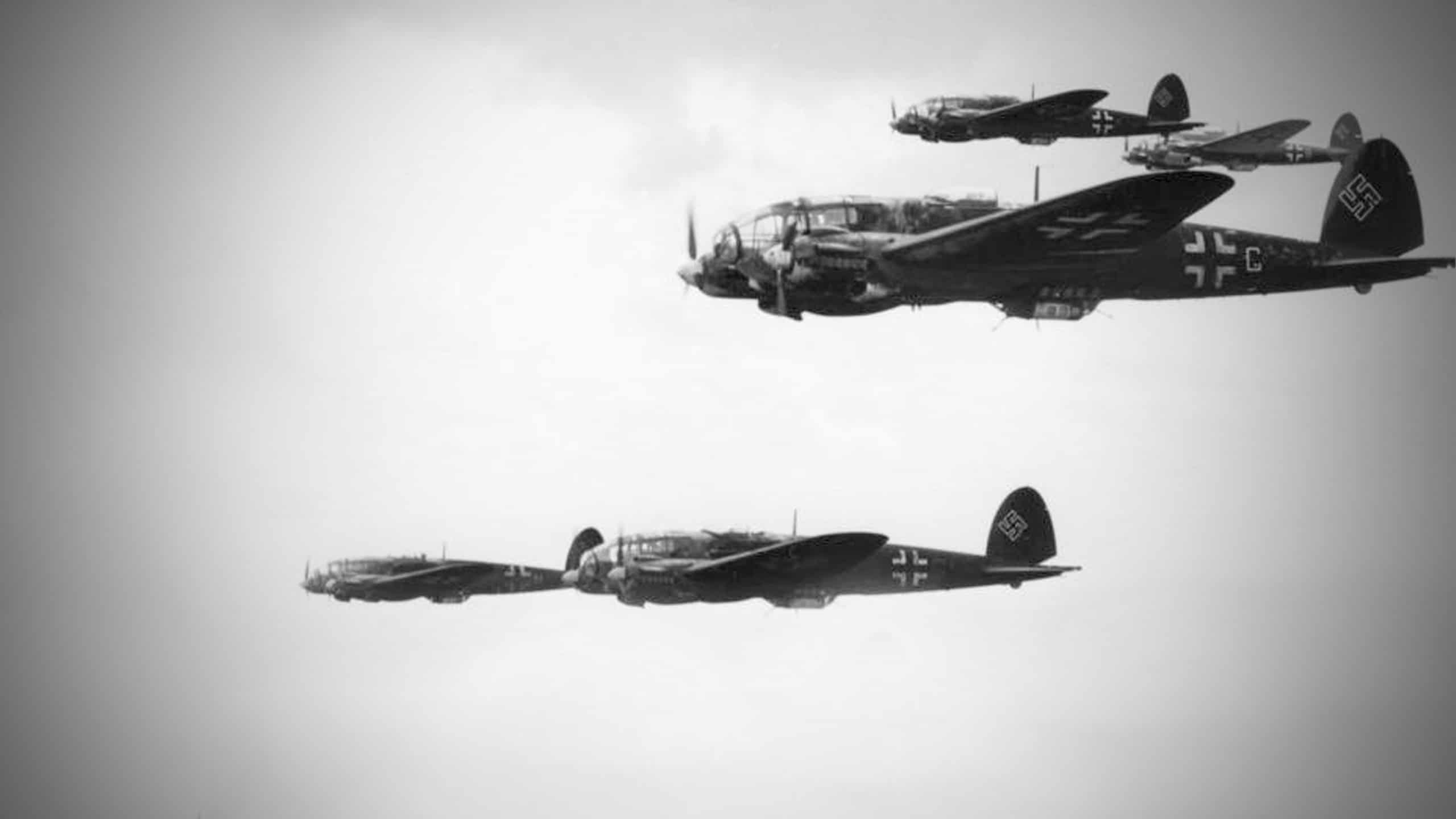
Editor’s Note: In today’s article, Dr. Will Dabbs examines the versatile Heinkel He 111 in World War II. The German medium bomber became one of the most recognizable Luftwaffe aircraft of the war. Originally designed as a civilian airliner, the He 111 evolved into a versatile combat aircraft that participated in every major campaign.
Lt. Mikhail Petrovich Devyatayev was a Russian P-39 Airacobra pilot during World War II. The peculiar mid-engine P-39 offered fairly poor high-altitude performance and was subsequently relegated to second-line duties by the US Army Air Corps. However, the Russians desperately needed a nimble ground attack plane. The massive 37mm cannon that fired through the Airacobra’s propeller hub was just the ticket. The Soviets gratefully received 4,773 of the little planes under Lend-Lease.
Lt. Devyatayev had a successful combat career. He flew some 180 combat missions during the war, downing a Stuka dive bomber as well as an Fw 190 in the process. However, in the summer of 1944, his luck ran out. Shot down near Lviv, Ukraine, Devyatayev was taken prisoner by the Germans.
A Hard, Brutal World
Life on the Western Front during World War II was horrible. The fight between the Germans and the Russians in the East was absolutely feral. The Western Front was a fight for domination. The Eastern Front was a fight for extermination. At 27 years of age, Lt. Devyatayev ended up in the Sachsenhausen concentration camp.

Had the Germans in the camp discovered that Devyatayev was a fighter pilot, they would have killed him outright. As a result, the resourceful young flyer took the identity of a Soviet infantryman who died in the camp and successfully passed himself off as a conscript. In this capacity, he was shipped to Peenemünde to work as slave labor building V2 missiles for the Germans.

Administered by the SS, the German slave labor program consumed millions of lives. Russian POWs were maintained on starvation rations and then worked until they died. Realizing that he and his mates were doomed if they didn’t do something drastic, Devyatayev began actively looking for a way out. He found it at an airfield adjacent to their work site.
Their Ticket Home
The Luftwaffe flew Heinkel He 111 bombers out of the nearby airfield. Lt. Devyatayev had never flown a twin-engine bomber and had never seen the inside of a He 111. However, one day when the sentries broke for lunch, Devyatayev and a handful of his mates killed a German guard with a sharpened crowbar and stole his uniform. One of the Russians then donned the dead man’s bloody clothes and proceeded to march his fellow prisoners across the tarmac. The Luftwaffe ground crewmen took little notice.

The first He 111 they came to was locked and had no batteries. Devyatayev and his friends pried the door open while one of their group secured a ground power unit. In the process, they encountered another small group of Russians and invited them to come along. With a total of 10 Russian POWs packed into the plane, Lt. Devyatayev got busy.
The desperate Russian aviator did get the big plane cranked, but he had no idea what he was doing. He inadvertently spun the aircraft around the parking apron before getting it roughly pointed in a takeoff direction. On his first attempt, he failed to attain flying speed and had to abort. Snapping the big plane around, he tried again and finally broke ground.

Devyatayev successfully avoided a Ju 88 launched to intercept them, as well as Russian fighters they encountered en route. Upon landing in Russian-held territory, Devyatayev and his men were arrested as traitors by the NKVD. When they related all they knew about the V2 program, they were eventually released.

Lt. Devyatayev was finally recognized as a Hero of the Soviet Union in 1957. He died in 2002 at age 86. The German medium bomber that spirited him and his buddies to safety formed the backbone of the Luftwaffe’s bomber fleet early in the war.
The Machine
The He 111 was originally designed in 1934 nominally as a fast airliner. The Germans were still pretending to be constrained by the Versailles Treaty, which ended World War I and restricted their military aspirations. However, the sleek, fast, twin-engine Heinkel was clearly a warplane. What had begun as a mandate to create the world’s fastest passenger airplane soon morphed into an overtly military project.

The twin-engine He 111 evolved from the single-engine Heinkel He 70 Blitz (Lightning). The He 70 was also considered a passenger aircraft. Powered by a 599-horsepower BMW VI engine, the He 70 would carry four passengers and sported a maximum speed of 240 mph. The He 70 pioneered the characteristic elliptical wing that was eventually used in the larger He 111.
The He 111 was a fairly big machine. With an overall length of 57 feet and a wingspan of 74 feet, the production version of the He 111 packed as many as seven 7.92mm machineguns and 4,400 pounds of bombs internally. A further 7,900 pounds’ worth of bombs could be included on external racks. However, when fully loaded, the He 111 typically required rocket-assisted takeoff units to get aloft.
Details
The He 111 sported a fairly unconventional layout. The He 111 was a single-pilot airplane with the pilot sitting on the left per custom. The corresponding right seat was reserved for the bombardier/navigator. This crewman was expected to leave his seat and slide forward into the nose when it was time to drop ordnance. The control column was arranged on a pivoting mount that could be rotated over to the navigator position in the event the pilot was incapacitated. Three other crewmembers operated the radios and defensive machine guns.

The wide, glazed nose offered superb visibility…under certain circumstances. The pilot’s position had no floor so as to provide an unobstructed view. The rudder pedals were mounted on arms so the pilot could see the terrain below. The engine controls were mounted above the pilot’s head, also to keep them out of the way. All that was great, but the rounded Plexiglas panels glared badly in bright sunshine. Some of the bottom transparent sections were removable so as to allow rapid egress in an emergency.
Live The Armory Life. The latest content straight to your inbox plus an automatic entry to each of our monthly gun giveaways!
Bombs rode in the bomb bay in magazines held vertically nose up. This made them easy to load and maximized space in the streamlined fuselage. Once deployed, the slipstream caught the tail fins on these devices and upended them in short order. He 111s were fitted with a variety of different defensive armament options during the course of the plane’s operational history.
Variations
Most He 111 planes were used as medium bombers. In this capacity, the He 111 played an outsized role in pummeling the UK during the Battle of Britain. However, this workhorse of an airplane did a lot of other stuff as well.

The He 111 was adapted to deliver aerial torpedoes for use in the North Atlantic. The plane was also used to emplace sea mines from the air. Experiments were undertaken using the He 111 to launch V1 buzz bombs in-flight as well.

The Germans developed a truly bizarre version of the He 111 called the He 111Z Zwilling (“Twin”), in which two standard fuselages were mated along a common central wing section. The resulting plane carried five engines and was used as a tow aircraft for the massive Me 321 glider. The single set of pilot’s controls was located in the port-side fuselage. Despite the bodged-together nature of the design, the pilots who flew these machines said they were a dream in the air.
Ruminations
A total of 6,508 Heinkel He 111 planes rolled off the assembly lines before production was curtailed in 1944. By then, the He 111 was badly obsolete. As a result, the plane was used primarily for transport duties until the end of the war. In a world liberally populated with Mustangs, Thunderbolts, Typhoons, Spitfires, and Lightnings, the lumbering He 111 was easy meat.

Of those 6,508 machines, five German versions and twelve Spanish-built Casa copies survive today. None of them are flyable. The classic 1969 British war film Battle of Britain has some awesome aerial footage of these Spanish He 111 copies in action.
Sleek, cool, rugged, and versatile, the He 111 served the Luftwaffe on all combat fronts during WWII. It was also adequate to spirit 10 resourceful Russians away from their slave labor camp and almost certain death. In so doing, the Heinkel He 111 became an iconic part of World War II history.
Editor’s Note: Please be sure to check out The Armory Life Forum, where you can comment about our daily articles, as well as just talk guns and gear. Click the “Go To Forum Thread” link below to jump in and discuss this article and much more!
Read the full article here
