

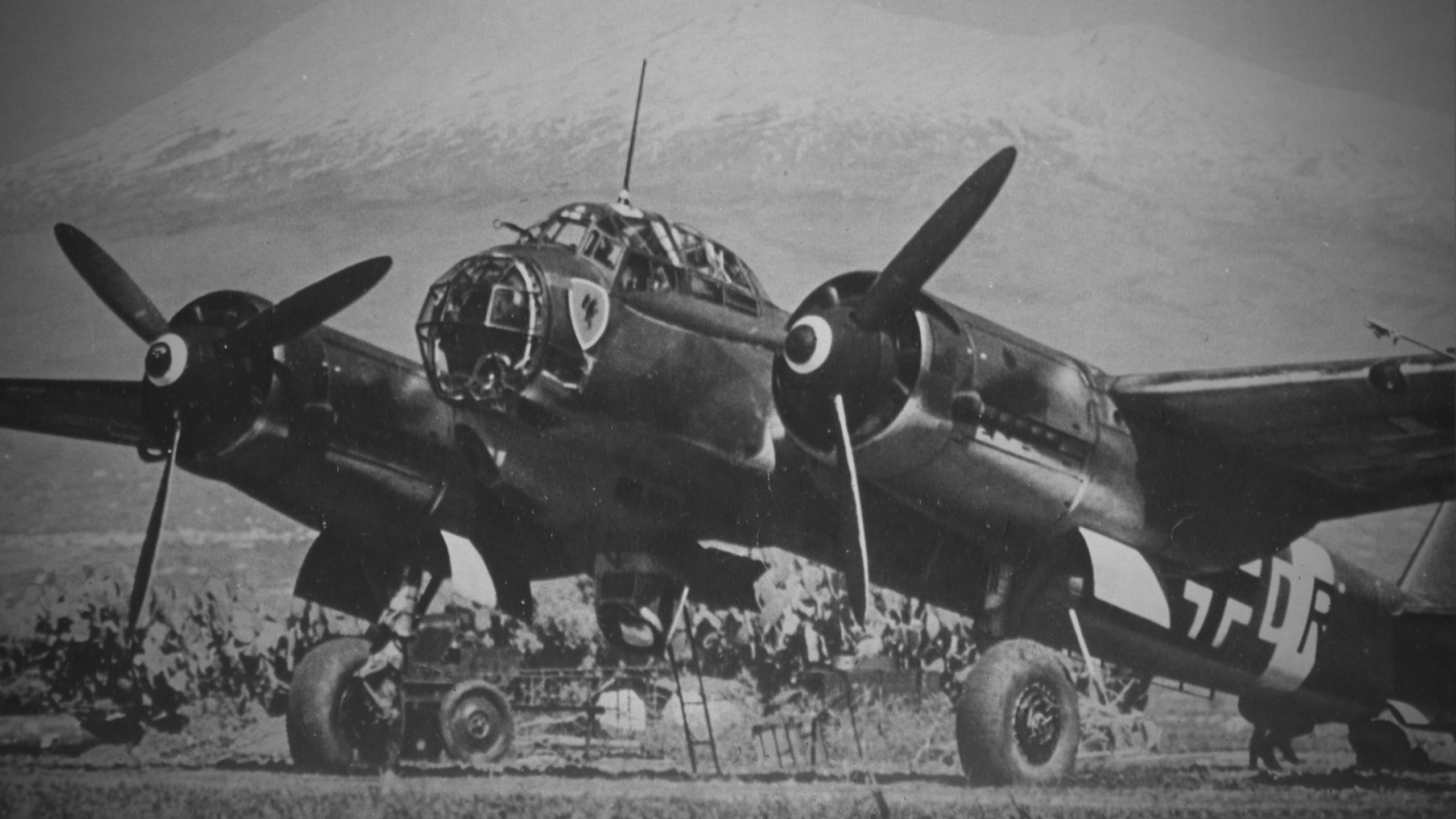
In the collection of the National Museum of the United States Air Force at Wright-Patterson Air Force Base, Dayton, Ohio, is just one of two surviving Junkers Ju 88 airplanes that saw service during the Second World War. Displayed with its Romanian Air Force markings, it is a former long-range, photographic reconnaissance aircraft. It had previously been on display outside with German markings before being restored and repainted with the same insignia it was adorned with during the war. The other intact Ju 88 is now at the Royal Air Force Museum outside London. It was built as a model Ju 88A bomber, but was later converted to a model R-1 fighter variant.
Approximately 16,000 Ju 88s were produced and, though none survive in the original bomber configuration, the two remaining aircraft serve to highlight how the Junkers Ju 88 proved to be one of the most versatile warplanes ever built. Although it couldn’t actually match a fighter in a dogfight, the Ju 88 was a capable night fighter, and it performed a variety of other missions.
During the Second World War, the twin-engine aircraft was employed by Germany’s Luftwaffe and other Axis powers in various roles, including bomber, escort fighter, night fighter, tank buster, torpedo bomber, transport, and reconnaissance platform, among others. Apart from the Royal Air Force’s (RAF’s) Mosquito, no aircraft of the war served in so many roles.

In each role, the Ju 88 was never the absolute best, yet it was noted for being fast, tough, and reliable. The bomber variant served in all theaters of the war in Europe, from the desert to the Arctic. It proved to be the Luftwaffe’s most capable tactical bomber, and even when it became apparent that Germany was losing the war, Ju 88 bombers continued to fly “lone-wolf” raids against British cities.
Origins of the Junkers Ju 88
Producing what was to be such a versatile aircraft certainly wasn’t the original goal when the German Air Ministry began development of the Ju 88 program in 1935. Instead, it simply sought to double the range of existing aircraft. The “Schnellbomber” (Fast Bomber) project required a bomber that could cruise at 500 km/h (311 mph) and carry a bomb load of 800 kg (1,764 pounds).

Junkers Flugzeug- und Motorenwerke AG (Junkers Aircraft and Motor Works) went all in to win the air ministry’s competition, and that included hiring two designers from the United States who were experts in stress-skin construction. However, even as they lent their expertise, Junkers had already moved to traditional corrugated skin structures.
The firm had found itself competing against offerings from Henschel and Messerschmitt, and sought as much insight as possible from outside sources.
The Ju 88 Takes Shape
Junkers began work on two prototypes; the first was the dual-finned Ju 85, while the second was the single-finned Ju 88. The latter aircraft had its first flight on December 21, 1936. It was powered by two Daimler-Benz DB 600Aa 12-cylinder engines, each rated at 1,000 hp (746 kW), which were housed in annular cowlings.

That gave the engines the look of radials, although they were not.
Testing of the aircraft prototype went well, and it was noted for its speed and handling. However, it was lost in a crash in early 1937.
A third prototype, featuring a single fin with a raised canopy line, was introduced. It was powered by a Junkers Jumo 211A engine, which offered similar power output. The aircraft also performed well, to the point that the air ministry called for three additional prototypes, while considerations were made for mass production.

Development of what became the Ju 88 continued. Yet, fewer than 20 aircraft, two in two squadrons, were in service when Germany launched its invasion of Poland on September 1, 1939, igniting World War II. Though initially designed to serve as a tactical dive bomber, it would serve in numerous roles by the end of the conflict.
Adaptable Design
The Ju 88 was operated by a crew of four, who were all housed forward of the wing. The pilot sat offset to the port, with the bombardier behind and to the starboard. From that position, the bombardier could access the ventral cupola for bomb-aiming. The pilot also had access to an MG-15 machine gun mounted on the starboard side of the windscreen.

Directly behind the pilot sat the flight engineer, facing rearward, which allowed him to operate the upper machine gun. Alongside the engineer was the radio operator, who had access to the ventral gun located in the rear of the cupola. The layout was refined by adding two MG-15s to the ventral position, while further weapons were fitted to fire laterally from the cockpit sides.
It wasn’t the most effective crew positioning, resulting in cramped conditions. Even three-man versions employed later in the war were considered far from spacious.

Live The Armory Life. The latest content straight to your inbox plus an automatic entry to each of our monthly gun giveaways!
As the Ju 88A was originally designed to be capable of dive-bombing, its wings carried slatted divebrakes as well as the bomb racks. Its landing gear retracted backward, with the wheels designed to swivel through 90 degrees on retraction so that they would lay flat and be easily contained within the aircraft’s thin wing. Its fuselage was entirely metal, featuring an aluminum stressed skin that employed new manufacturing techniques and was riveted directly onto the oval section of the fuselage structure. The wings had two main spars and, like the fuselage, those were covered in flush-riveted stressed aluminum.

Although the aircraft was far from a juggernaut in size, the Ju 88 could carry a bomb load that consisted of 27 110-pound (50 kg) bombs carried in two internal bays in the fuselage, as well as four 220-pound (110 kg) bombs carried externally. In its early wartime configuration, the bomber had a maximum speed of 280 mph (450 km/h).
The Ju 88A-4, the Definitive Bomber
The aircraft had already proven itself capable during the invasion of Poland, but the development of the definitive bomber variant, the Ju 88A-4, only began in early 1940. It was powered by a more robust Jumo 211F and 211J engines, while the wingspan of the warplane was expanded by more than five feet. That combination significantly improved the load carrying, while new ailerons were employed to strengthen the undercarriage.

Other changes included the installation of the 7.82mm MG-81 machine guns, replacing the earlier MG-15s, along with the 13mm MG-13, which enhanced the aircraft’s defense capabilities.
The Ju 88A-4 appeared in large numbers in late 1940, and all subsequent variants were based on the A-4 airframe.
From Fighter to Attack Aircraft and More
As it offered speed and agility, the Ju 88 proved successful as a day and night bomber; however, early on, its potential for serving in a fighter role was also recognized. At the time, the Luftwaffe had an excellent heavy fighter in its Messerschmitt Bf 110, but the Ju 88C variants were adopted to fill the roles of fighter-bomber and night fighter.

These aircraft were initially converted from the original A-1 models, outfitted with Jumo 211 engines, while production versions received the BMW 801 powerplants.
Armament was increased, and included two MG FF cannons mounted in the ventral gondola, while prodded guns were also carried under the wings. The major C variant, the Ju 88C-6, was equipped with additional armor. The Ju 88C-6b was also outfitted with the FuG 202 Lichtenstein B/C radar for its role as a night fighter. However, the increase in equipment to improve its capabilities also put a burden on the aircraft, requiring modifications to the BMW engines and to the tail surfaces.

That resulted in the Ju 88G models, which also served in the night fighter role. It was followed by further engine upgrades, which enabled the Ju 88 to continue serving in that role through the end of the war. In addition, to further take advantage of all of its capabilities, the Ju 88Gs were routinely employed as fighter controllers, guiding the less well-equipped Messerschmitt Bf 109 and Bf 110s to their target. In late 1944, some Ju 88Gs were also converted to day ground attack roles in a largely futile attempt to halt the advance of the Red Army.
As World War II progressed, the Ju 88 airframe was further developed to serve in other roles, including photographic reconnaissance, anti-armor, long-range ocean patroller, and high-altitude pathfinder.

Attempts to fit the aircraft with a Nebelwerfer six-barreled recoilless rifle showed no promise, but a small batch of Ju 88P-1s were built that were armed with a 75mm PaK 40 or BK 7,5 cannon. It entered service in 1943 and saw limited service on the Russian Front, where it was credited with destroying Soviet Red Army tanks, including the infamous T-34. It was far from an instant success. The cannon’s low rate of fire was seen as an issue, and smaller-caliber weapons were introduced in further Ju 88P variants.
The P-2 models were fitted with a pair of 37mm BK 37,7 cannons mounted offset to the port. It proved more resilient in a fight, but was further modified as the P-3, which added additional crew protection. The final anti-armor model, the P-4, carried a single 500mm BK-5 cannon. Ju 88P-2s and Ju 88P-4s were also evaluated to serve as day and night bomber-destroyers, but their sluggish performance meant they were ill-suited for such a role.
However, the Ju 88 saw more success as a reconnaissance aircraft, where its forward bomb bay was replaced with a fuel tank. The dive brakes and wing racks were removed, and instead, cameras were mounted in the heated central fuselage.

The Ju 88Ds in the reconnaissance role retained a crew of four, but defensive armament was reduced to just three MG 15 machine guns. Cameras included a high-altitude Rb 50/30 and low-altitude Rb 20/30. Approximately 1,500 Ju 88Ds were produced, with deployments in all theaters of the European conflict.
A unique Ju 88H variant was produced in tiny numbers. Each was built with a stretched fuselage and modified wings, allowing it to carry extra fuel and achieve a range of 3,200 miles (5,150 km). These aircraft were used for reconnaissance over the Atlantic, but it is unclear why none were considered for a bomber role.
The final variant that deserves mentioning was the Ju 88S, which served as a high-altitude pathfinder. First flown in late 1942, it carried a crew of three. It was employed to guide other bombers to their target, but it was a risky business as it generally lacked forward-firing or ventral armament.
The Ju 88 in Wartime
The Ju 88A was among the aircraft employed in the invasion of Poland, serving with the newly formed I. Gruppe/Kampfgeschwader 25, which was later redesignated the I./KG 30. After Poland, it went on to see service in the Battle of Norway and the invasion of the Low Countries and France. Although the German military used the aircraft during the Blitzkrieg campaign, it suffered high losses.

Yet, it was further employed in the Battle of Britain, and later in the campaigns in the Balkans and Greece.
Ju 88s had the distinction of striking the Royal Navy’s aircraft carrier HMS Ark Royal in the Mediterranean. The carrier survived the attack but was later torpedoed and sunk by a German U-boat. The bomber was subsequently used to carry out attacks on the island of Malta and was used to strike Allied shipping.
The aircraft also proved effective as a torpedo-bomber against Allied convoys supplying arms and supplies to the Soviet Union. Operating from airfields in Norway, Ju 88s sank thousands of tons of British shipping in the icy-cold Arctic waters, especially in the summer months when convoys proved vulnerable nearly 24 hours a day.

The Ju 88A also saw service with the air forces of Germany’s allies, including Finland, Hungary, Italy, and Romania. In one of the strange twists of the Second World War, some of those aircraft went on to carry out strikes against the Germans. After Finland signed the Moscow Armistice with the Soviet Union in September 1944, which resulted in fighting breaking out between Finland and Germany, the former used its Ju 88s in air support roles against German forces. Likewise, Romania also flew the Ju 88 against the German military in the final months of the war, after Romania switched sides and became a co-belligerent against the Nazi regime.
Free French Forces also utilized a small handful of Ju 88s that were captured from the retreating Luftwaffe. The aircraft had been left at the Toulouse repair depot in southwestern France and handed over to the French. Some of those aircraft remained in service with the French Navy in the early post-war years.

The RAF captured at least five of the bomber variants, which were evaluated by the No. 1426 (Enemy Aircraft) Flight of the RAF Squadron. Nicknamed the “Rafwaffe,” the unit examined and tested captured Axis aircraft. The surviving Ju 88 in the RAF Museum was also captured and evaluated after its crew defected and landed in Scotland in May 1943. Following the war, it was later transferred to the famed aviation museum; just one of two of the versatile aircraft that served in so many roles.
Editor’s Note: Please be sure to check out The Armory Life Forum, where you can comment about our daily articles, as well as just talk guns and gear. Click the “Go To Forum Thread” link below to jump in and discuss this article and much more!
Read the full article here
