

As a filmmaker, photographer, and lifelong shooter, I gravitate toward gear that meaningfully enhances the shooting and hunting experience. The firearm and outdoor industries are full of accessories that promise to make life easier in the field, yet only a small number rise above novelty and truly deliver.
When a product makes you more efficient, improves how you interact with your optics, or elevates your ability to document training or the hunt, it earns a permanent place in the kit. That is exactly where the Ollin brand lands. Their products are built with real intent, shaped by backcountry experience, and designed to function seamlessly alongside high-quality optics.
The Process
Before the rise of modern digiscoping tools, capturing images or video through spotting scopes or binoculars was a tedious exercise in improvisation. Anyone who tried holding a smartphone up to an eyepiece knows the frustration of misalignment and inconsistent imaging. Ollin’s founders knew that challenge firsthand. Their brand story traces back to long days glassing in the mountains of the West, where they wanted to share what they were seeing with family and friends without breaking the rhythm of the hunt.

Early prototypes took shape on a garage 3D printer, driven by one principle: keep the process simple. That pursuit of simplicity, paired with craftsmanship and a clear respect for the outdoors, is still evident in the production models today.
Range Time
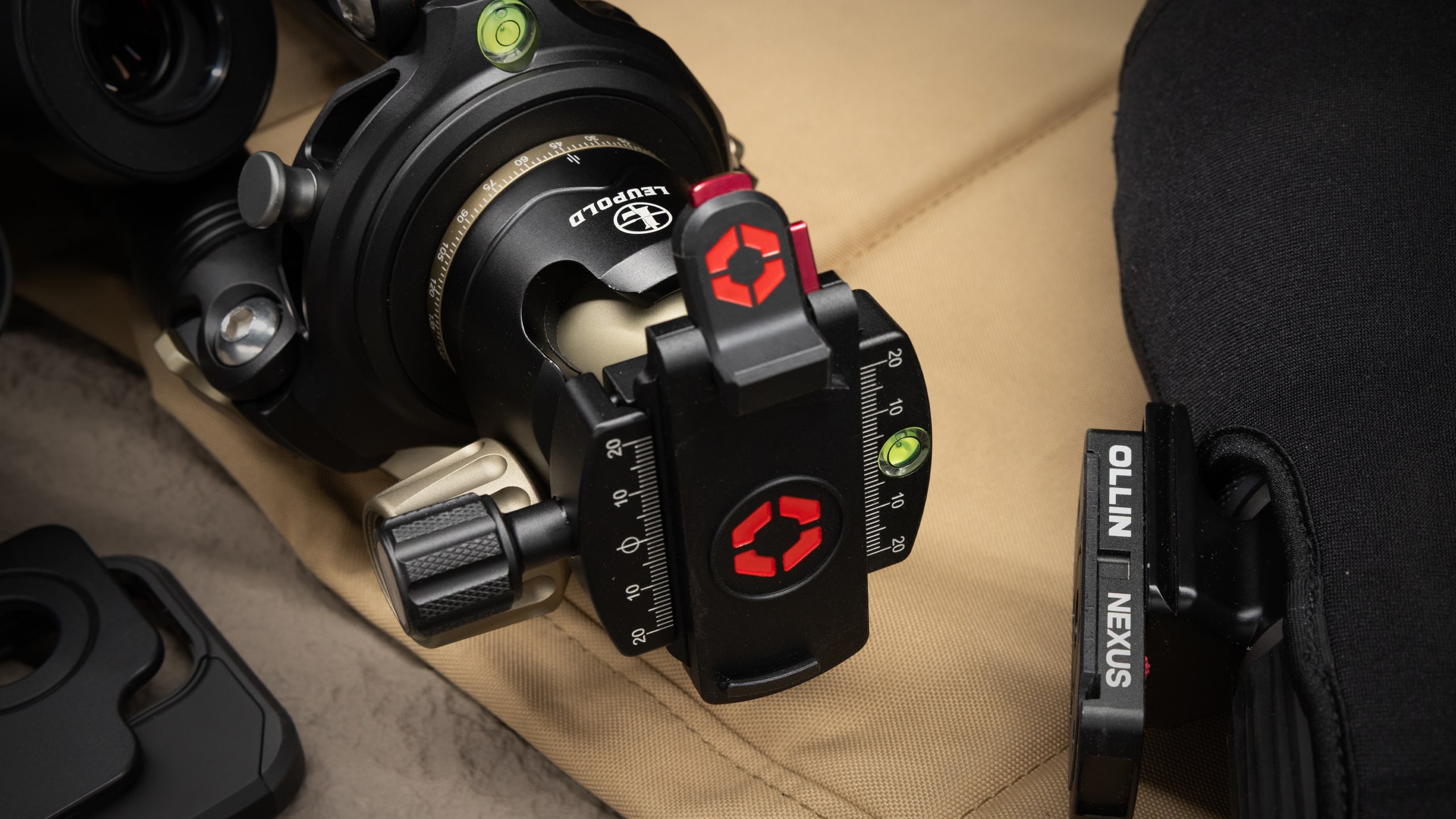
For this review, I integrated several Ollin components into my existing Leupold setup. This included the Snapshot Spotter Adapter mounted to a Leupold SX-5 Santiam HD spotting scope, the Snapshot SnapCase for my iPhone 15 Pro, the Snapshot Bino Adapter for my Leupold BX-5 8×42 binoculars, and the Ollin Nexus Base and Nexus Plates mounted across my optics and paired with a Leupold Mark 5 CF-455 Tripod. Each piece shared the same design identity: rugged, intuitive, low-profile, and engineered to operate as part of a functional ecosystem rather than as a mix of unrelated accessories.

I began my testing at the range while helping fellow The Armory Life contributor Jeremy Tremp work through a zeroing session. I installed a Nexus Plate onto the Leupold spotting scope and secured the Nexus Base to the tripod.

As soon as the two components came into close proximity, the magnetic interface guided the optic into alignment and seated it firmly. A simple rotational movement locked it. Removing the optic was equally straightforward through the built-in release mechanism, followed by a twist. The process was quick, secure, and predictable, which is precisely what you want in the field.
The Process
Once the spotting scope was mounted, attaching my iPhone through the Snapshot system was immediate. The Snapshot Spotter Adapter compresses onto the eyepiece and the Snapshot SnapCase, with its embedded magnetic array, centers itself automatically the moment it approaches the adapter. The phone locks into place with confidence, and the sight picture appears instantly and perfectly centered. There is no hunting for the “sweet spot” or adjusting the phone to eliminate vignetting. The patented self-centering design does the work, and it does it well.

Live The Armory Life. The latest content straight to your inbox plus an automatic entry to each of our monthly gun giveaways!
Throughout our range time, the system allowed Jeremy to review his shot placement easily between strings. One benefit that stood out is how effective this system would be for a solo shooter. If you are zeroing alone, you can place the tripod so that the phone’s display sits within your natural line of sight, allowing you to confirm impacts without leaving the shooting position. This level of efficiency is not achievable with traditional spotting workflows.
In the Field
I continued my evaluation during archery practice and on a scouting and hunting trip in the Arizona wilderness. Long periods behind glass can take a physical toll, particularly on the neck. Being able to observe through a large phone screen instead of pressing into the optic provided noticeable comfort during prolonged glassing sessions. With the Snapshot mount in place, I could adjust the phone to any viewing angle without disturbing the optic.

The transition from scanning terrain to filming wildlife was seamless, and I captured excellent footage of elk in the distance with minimal effort. The clarity through the Leupold SX-5 combined with the iPhone’s camera quality made the images crisp and clean. The system required no fine-tuning or adjustments as lighting and distance changed. It simply continued to work.
The Snapshot Bino Adapter mirrored this experience on my Leupold binoculars. It installs quickly, stores easily in a pocket, and functions identically to the spotting scope adapter. Hunters who move frequently between bino glassing and long-range spotting will immediately appreciate the unified system and the consistency of user experience.

While the Snapshot system addresses the digiscoping challenge, the Ollin Nexus system solves another real-world problem by streamlining the process of mounting and swapping equipment on a tripod.
After days of working with the Nexus Base and Plates, the magnetic alignment and locking action proved to be exceptional. Moving between optics, cameras, and other gear took only seconds and required no tools or adjustments. In rugged terrain or fast-moving environments, where time and stability are critical, this mounting speed becomes a major advantage. There is no excess movement, no searching for alignment points, and no delicate hardware to contend with. Everything is clean, silent, and reliable.
Conclusion
In every scenario, the Ollin ecosystem felt like equipment shaped by real outdoor experience. The design reflects their brand story, which emphasizes craftsmanship, simplicity, and the belief that gear should enhance — not interrupt — the moment. Nothing about their products feels gimmicky or fragile. Instead, they carry the polished, dialed-in sensibility of tools built by people who have spent years in the backcountry and wanted something better for themselves and for anyone who relies on glass.

After extensive use on the range, during scouting, and throughout a hunt, the entire system delivered. It improved documentation, simplified workflow, eased the strain of long glassing sessions, and allowed me to share observations instantly. The Snapshot system is an outstanding solution for shooters, hunters, wildlife observers, and outdoor content creators seeking a reliable, intuitive way to integrate their smartphone with their optics. The Nexus system further enhances that efficiency by making tripod-based transitions fast and effortless.
Ollin’s founders set out to create tools that bring people closer to the outdoors by allowing them to capture and share the views they experience through their optics. Their gear accomplishes exactly that. It is rugged, fast, well-engineered, and proven through thoughtful design. These are reliable, purpose-built tools that elevate the entire field experience, and I highly recommend them to anyone who spends serious time behind spotting scopes or binoculars.
Editor’s Note: Please be sure to check out The Armory Life Forum, where you can comment about our daily articles, as well as just talk guns and gear. Click the “Go To Forum Thread” link below to jump in!
Read the full article here
