

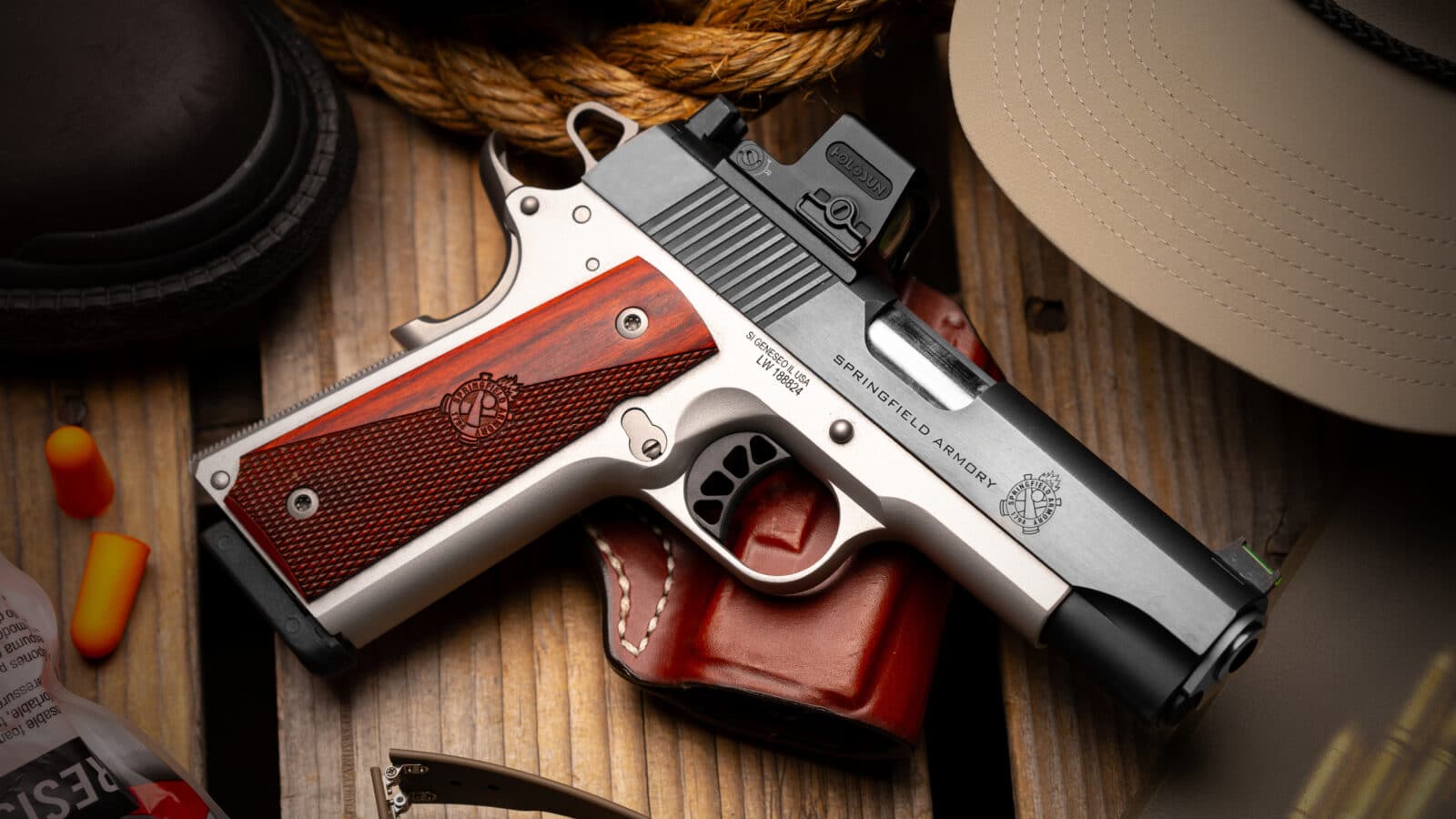
More than a century after the debut of John Browning’s most celebrated handgun design, the year 2020 marked the beginning of Springfield Armory’s most recent 1911 makeover. Long known as a premium purveyor of the .45-caliber, two-time World War champ, Springfield’s catalog of 1911s had grown through the decades to include myriad caliber options, frame sizes and trim levels. The time had come for the company to update its model offerings and feature sets, and the Ronin was the first of a new generation of handgun families to be introduced.
Striking for its retro styling, the two-tone Ronin line was widely acclaimed for its blued-over-stainless aesthetics. Polished flats and checkered wood stocks solidified its timeless custom-inspired appearance, while sub-$1,000 price tags ensured the pistol platform would be accessible for all. Ultimately offered in .45 ACP, 10mm and 9mm, as well as 5” full-size, 4.25” compact and 9mm-only EMP configurations, the Ronin family of 1911s quickly became a cornerstone of Springfield Armory’s handgun catalog.
Agency Optic System
Within a couple of years of the Ronin’s introduction, Springfield unveiled the 1911 DS (Double Stack) Prodigy. Not only did the Prodigy provide the company entrée to the growing double-stack 1911 market, it represented Springfield’s first effort at mounting red-dot optics to single-action pistols. It was a masterstroke.
Although pistol-mounted optics have become standard fare, legacy firearm designs — particularly those with narrow slides — continue to represent a challenge. Limited surface area restricts options for milling and drilling. Too, the traditional location of mechanical necessities in the design, such as sear and firing pin assemblies, don’t offer much depth for adding lugs or sinking mounting screws. While slide assemblies and internal parts on newer handgun models like Springfield Armory’s Echelon are designed with optic mounting in mind, adding modern tech to century-old machines requires creative solutions.

Despite commanding considerable engineering resources in its own right, Springfield Armory wisely collaborated with the slide-milling and optic-mounting experts of Agency Arms to develop and implement the Agency Optic System (AOS) on the Prodigy pistols. An intuitive yet sophisticated plate system, the AOS meets the challenge of securely affixing a mounting plate to the firearm’s slide while also ensuring the optic will mount equally securely to the plate. The sight-specific AOS mounting plates accommodate true micro optics such as the Shield RMSc, as well as larger red dots like the Aimpoint ACRO, Leupold DeltaPoint Pro and Trijicon RMR — plus other popular optics that utilize those footprints.
Also, the AOS plates incorporate an appropriately sized rear sight to facilitate use of irons through most optics’ lenses, should the electronics fail for any reason. It’s not a perfect solution as some red dots have taller deck heights than others, but the mid-height front sight offers a one-size-fits-most solution. Overall, the inclusion of serviceable backup iron sights is a thoughtful addition to the well-engineered mounting system.

Prior to their public release, I was able to review the 1911 DS Prodigy pistols for Guns & Ammo, and I remember asking company representatives if we could expect the AOS optic system to proliferate through Springfield Armory’s single-stack 1911 offerings. The catalog’s overhaul that began with Ronin had grown to include several purpose- and aesthetic-inspired trims by that time. I assumed the answer was yes, though I recall a reasonably expected non-committal response. However, confirmation came in 2024 when Springfield unveiled AOS-equipped Emissary, Operator and Ronin 1911 pistols.
Evaluating the 1911 Ronin AOS
It is the Ronin AOS pistols we are considering here today. The Ronin offerings are made up of four models in two chamberings. They are .45 and 9mm versions in either 5” all-steel models or 4.25” lightweight models with forged aluminum frames. Apart from the cover plate with integral rear sight, you would be hard-pressed to tell them apart from the original non-AOS Ronin offerings.

My evaluation pistol for this article was the full-size 5” 1911 Ronin AOS chambered for 9mm. Without writing an entire article about my affinity for this configuration, suffice it to say that shooting a full-size 9mm 1911 is an experience without fault or flaw. For me, it’s as fun as shooting suppressed .22s, with the added benefit of being a practical option for personal defense. The smaller-sized 4.25” 1911s in 9mm are not far behind in terms of shootability, and can be even more discreet for concealed carry applications. In short, without disrespect to the venerable .45 ACP, I am a fervent ambassador for the utility of 9mm 1911s.
Feeding from the included nine-round magazine, or commonly available 10-round units, the Ronin’s stainless-steel, match-grade barrel features a fully supported ramp to enhance reliability. In terms of construction, the AOS models follow the Ronin blueprint. The frame is forged stainless steel and retains a satin-like stainless finish. The slide is forged carbon steel with a hot salt blued finish. Both major components are polished on the right- and left-side flats, giving the gun an upscale appearance that belies its price tag. Checkered and engraved laminate wood stocks tie the whole ensemble together.

Live The Armory Life. The latest content straight to your inbox plus an automatic entry to each of our monthly gun giveaways!
In terms of controls, classically styled cocking serrations front and rear come standard on full-size models, though the front serrations are deleted on the shorter slides of the 4.25” guns. A skeletonized black trigger pairs with a memory-pad-and-beavertail grip safety and a left-side-only thumb safety. The Ronin AOS is a traditional 1911 in that it utilizes a barrel bushing and can be disassembled without tools in the same manner as John Browning’s original.

The only change from non-AOS models is the addition of the optic mounting system and tweaks to the iron sights necessitated by the AOS upgrade. Keen eyed observers will notice that both sights are slightly taller than their counterparts on non-AOS Ronins. This is to enable co-witnessing of the irons through the lens of a slide-mounted optic. Too, the front sight of AOS variants comes standard with a green fiber optic pipe, rather than line-up’s usual red front sight. This seemingly insignificant change is quite useful, as it should keep shooters from being confused by dueling red dots in their sight picture.
Springfield 1911 Ronin AOS Specifications
| Chambering | .45/9mm |
| Barrel Length | 5″ or 4.25″ |
| Weight | 29.5-41 oz. |
| Overall Length | 7.9″-8.6″ |
| Sights | Fiber optic front, serrated black rear |
| Grips | Wood laminate |
| Action | Single-action |
| Finish | Blued/stainless |
| Capacity | 8+1/9+1 (one magazine included) |
| MSRP | $967 |
Undeniable Shooting Results
Time at the range with the Ronin was a blast. As mentioned, I’m an unabashed believer in 9mm 1911s for their easy-to-shoot demeanor, and the addition of a red dot only improved the experience. For testing, I used a Vortex Defender-ST micro red dot with a 3 MOA reticle. I would call this a standard-size optic, and the 3 MOA red dot reticle is my preferred sighting solution for mid- and full-size guns. It’s big enough to see quickly, but fine enough to maximize the gun’s accuracy potential. Over the course of two range sessions and several hundred rounds, I put the Ronin AOS through its paces for accuracy and in defensive-style shooting drills.

During my initial break-in run with the gun, I experienced a failure to return to battery issue. The remedy was simply a thorough cleaning and lubrication. In my experience, all-metal guns like the 1911 can exhibit behavior like this early on as the metal parts “wear in.” After giving the gun a once-over, it ran without issue for the duration of the test. In fact, everything from the slide to the trigger continued to smooth out and lighten up as testing continued.

Although I keep up with my iron sight practice, I’m primarily a red-dot shooter because of the improved accuracy potential — not the gun’s mechanical capability, by my ability to consistently perform with precision. With a slide-mounted optic, there is no need to align multiple sights and focal planes; simply put the dot on the target and press the trigger. The accuracy advantage was apparent during my testing as the Ronin AOS posted neat, round groups both from the bench and from the holster. The Vortex optic contributed greatly to this effort, but it’s really a combined effect that includes the 1911’s familiar — and near-perfect — ergonomics, as well as its single-action trigger. The test gun’s trigger averaged 4 lbs., 8 oz., with a Lyman digital gauge and exhibited a very discernible and predictable wall, followed by a crisp break.
Full results are published here, but the Ronin performed admirably with both range and defense ammunition. Formal testing, measuring three five-shot groups at 15 yards, included Federal Gold Medal Action Pistol 147-gr. FMJ, Hornady American Gunner 115-gr. XTP, and Nosler Match Grade Handgun 124-gr. JHP (now discontinued). The Nosler load really stood out, posting the best group of the test, 0.69”, and the best three-group average, 0.87”.
Final Considerations
I would like to make a point about the AOS system and holster selection. It’s true that holster options for optic-equipped 1911s are rapidly increasing, but it’s worth noting that the mounting systems being used by manufacturers are hardly standardized. For example, some 1911 makers are restricting optics compatibility to the smallest of micro red dots — only those that will fit within the dimensions of the pistol’s narrow slide.

Other mounting systems, like Springfield’s AOS, accommodate a wider range of optics, but utilize plates that may overhang the edges of the slide. Such pistols require larger openings or relief cuts to accept plate-equipped slide assemblies. The bottom line is that despite many 1911-pattern holsters being compatible and interchangeable with pistols from many manufacturers, holsters for optics-equipped 1911s may be much more specific to make and model.
Finally, I must return to one of my favorite refrains, which is to encourage shooters to consider 1911s, and especially 9mm 1911s. There is a reason the pistol design has endured, and it’s not just about nostalgia. The handguns are proven, the ergonomics are superior, and even a “rough” 1911 trigger is generally going to trump anything found on a striker-fired pistol. The reduced recoil and increased capacity of 9mm 1911 variants also offer an inviting segue to shooters who aren’t ready to give up the practicality of their polymer wonderguns, but who are curious about the most dominant handgun design of the 20th and now, 21st centuries.
Along those lines, the Ronins offer exceptional value thanks to their quality materials, careful construction and excellent appearance. Regardless of size or caliber, the Ronin AOS models are all priced to move at $967. Be sure to check them out.
Editor’s Note: Please be sure to check out The Armory Life Forum, where you can comment about our daily articles, as well as just talk guns and gear. Click the “Go To Forum Thread” link below to jump in!
Read the full article here
