

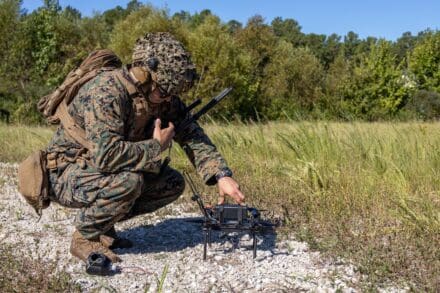
Kudos to the Marine Corps for consolidating the training for the raid expansion of attritable drones across the force. Last week they released MARADMIN, “Approved Training Requirements for Small Unmanned Aerial Systems” which announces six courses open to all Marines:
Basic Drone Operator (BD-O) Course: “Provide the foundational skills required to assemble, maintain and operate both full-acro and stabilized non-lethal drones in an operational environment.”
Attack Drone Operator (AD-O) Course: “Provide the foundational skills required to tactically employ lethal attack drones.”
Attack Drone Leader (AD-L) Course: “Provide the instructional understanding of Fire Support Plan integration, threat assessment, system capabilities and coordination with maneuver and fires.”
Payload Specialist (PS) Course: “Provide the foundational skills and basic knowledge for safe explosive handling and preparation of pre-fabricated warheads used to arm lethal drones in an operational environment.”
Attack Drone Instructor (AD-I) Course: “Provide the instructional skills required to administer and certify Marines in the BD-O, AD-O, and AD-L courses.”
Payload Specialist Instructor (PS-I) Course: “Provide the instructional skills required to administer and certify Marines in the PS course.”
There is also additional training which is MOS specific. Finally, the message offers some details about types of drones hitting the fleet.
We’ve included the whole MARADMIN at the jump. Please note, we have redacted all contact info for POCs.
MARADMINS : 624/25
R 221500Z DEC 25
MARADMIN 624/25
MSGID/GENADMIN/CG TECOM QUANTICO VA//
SUBJ/APPROVED TRAINING REQUIREMENTS FOR SMALL UNMANNED AERIAL
SYSTEMS//
REF/A/SECDEF MEMO 10 JUL 2025//
REF/B/MARADMIN 416/25//
REF/C/NAVMC 3500.107D//
REF/D/MCTOG ATTACK DRONE EMPLOYMENT PAMPHLET 3-01//
REF/E/MCO 3570.1D//
REF/F/MCO 5100.29//
REF/G/ MCO 1553.2D//
REF/H/MARADMIN 537/25//
NARR/REF A IS THE SECRETARY OF DEFENSE MEMORANDUM: UNLEASHING U.S. MILITARY DRONE DOMINANCE.
REF B IS THE NEROS ARCHER FIELDING GUIDANCE.
REF C IS THE TRAINING AND READINESS MANUAL FOR UNMANNED AIRCRAFT
SYSTEMS (GROUP 1 AND 2).
REF D IS THE ATTACK DRONE EMPLOYMENT PAMPHLET TO HELP THE OPERATING FORCES EFFECTIVELY INTEGRATE AND SYNCHRONIZE ATTACK DRONE CAPABILITIES.
REF E IS THE MARINE CORPS RANGE SAFETY ORDER.
REF F IS THE MARINE CORPS SAFETY MANAGEMENT SYSTEM.
REF G IS THE MARINE CORPS TRAINING AND EDUCATION PROGRAM.
REF H IS THE UPDATE TO SMALL UNMANNED AERIAL SYSTEMS POLICY IN ACCORDANCE WITH
SECRETARY OF WAR GUIDANCE.//
POC #1/
POC #2/
POC #3/
POC #4/
1. To meet an immediate operational need and address a critical unfunded requirement, the service is rapidly fielding commercial-off-the-shelf attack drones, which necessitates an increase in trained operator capacity. Marine Corps Warfighting Laboratory (MCWL) has initiated delivery of the Neros Archer attack drones to Marine units. In addition to these ongoing efforts, the Office of the Secretary of War’s Drone Dominance Program plans to rapidly field a variety of attack drones valued at over one billion dollars across Service Components, starting in March 2026 and continuing over the next 2.5 years. These developments highlight the urgent need for standardized training, doctrine, and force-wide capacity building.
1.a. While the immediate focus is meant to support lethal attack drone delivery, the Marine Corps must also prepare for a rapidly expanding and diverse sUAS portfolio. To meet this broader
requirement, from 18-21 November 2025, Training and Education Command (TECOM) led the Drone Training Symposium which brought
together key stakeholders to focus on standardizing sUAS training and developing courses of action for central and regional training
hubs. Commanding General (CG), TECOM subsequently made a series of decisions, standardizing training for sUAS operators. This MARADMIN promulgates those decisions and defines the official courses and
certifications required to enable the execution of sUAS missions within the authorities granted by reference (h).
1.b. Definitions. For the purposes of this message:
1.b.1. SUAS refers to a Group 1 or Group 2 Unmanned Aircraft System (UAS) that is either Program of Record (POR) or Non-Program of
Record (NPOR). These systems may vary in payload, control method, and mission profile. They are fielded either by a program office or
through rapid acquisition pathways, the Blue UAS List, Service experimentation efforts, or local purchase. In this context, SUAS includes all POR systems such as the Black Hornet 4, Skydio X2D, R80D Skyraider, RQ-20 Puma, TRV-150 TRUAS and VXE 30 Stalker, but also includes any NPOR systems, including but not limited to, Neros Archer, ModalAI Seeker Vision, Parrot Anafi (USA, UKR, etc.), PDW C-100, and Quantum Systems Vector. The Small UAS Schoolhouse and
Training and Logistics Support Activities (TALSA) will continue to be the primary training cadre for Group 1 and 2 POR systems until directed otherwise.
1.b.2. Basic Drone refers to any SUAS employed for non-lethal purposes, including but not limited to, non-live fire training, reconnaissance, surveillance, and target acquisition (RSTA), or
logistics mission sets. The basic drone may be a fully Acro Style First Person View (FPV) Drone or it may be a system that has varying levels of autonomy. Basic drone courses and certifications will enable entry-level training for other mission specific sUAS types and capabilities or meet a variety of operational mission requirements.
1.b.3. Attack Drone refers to any sUAS capable of delivering a lethal payload. This includes, but is not limited to, FPV fixed-wing (FW) or vertical takeoff and landing (VTOL) sUAS (e.g., Neros Archer) equipped with a lethal payload or approved surrogate trainer, as well as FW or VTOL sUAS with explosive-dropping capability (‘droppers’) using a lethal payload or approved surrogate trainer.
1.c. TECOM has established provisional pilot programs, covering both basic and attack drone employment. Course content, prerequisites,
duration, and structure are expected to evolve over time as experimentation efforts continue to generate operational experience, training feedback, and lessons learned.
1.c.1. It is acknowledged that this initial training framework was developed to meet immediate operational needs, particularly the rapid fielding of FPV and High-Volume Multi-Mission Attritable Precision (HMAP) systems. While this framework establishes the baseline for future Programs of Instruction (POIs), the intent behind these courses is to provide fundamental operator skills for platform agnostic systems (armed and unarmed). The Marine Corps will refine and incorporate training for additional optionally
lethal SUAS (via mechanisms such as droppers), One Way Attack (OWA), Organic Precision Fires (OPF) Systems, and emerging capabilities, as
those systems enter the force and service experimentation validates their employment concepts.
2. Standardized Training. A total of six pilot courses and eight certifications will be implemented to standardize training for
Marines. These pilot courses serve as initial programs designed to certify Marines, test instructional methods, curriculum prerequisites, and course length, with the goal of identifying the most effective approach for training and certification. Feedback from these pilot courses will be used to refine them into full POIs and validate the certifications required for standardized implementation across the Marine Corps.
3. Six Approved Pilot Courses.
3.a. Basic Drone Operator (BD-O) Course.
3.a.1. Initial Prerequisites.
3.a.1.a. Any MOS can attend this course.
3.a.1.b. Must be basic unmanned qualification (BUQ) level 1 complete. This is a self-paced, computer-based training module
available at https://suasman.josce.mil.
3.a.1.c. Must complete 20 hours of self-paced simulator experience on a TECOM-approved “Acro mode” simulator (see paragraph 5.f for the
initial list), of which at least 10 hours must be conducted using FPV goggles.
3.a.2. Initial Course Duration. 10 Training Days or
80 training hours.
3.a.3. Purpose of Instruction. Provide the foundational skills required to assemble, maintain, and operate both full-acro and stabilized non-lethal drones in an operational environment.
3.b. Attack Drone Operator (AD-O) Course.
3.b.1. Initial Prerequisites.
3.b.1.a. Any MOS can attend this course.
3.b.1.b. Certified as a BD-O within Marine Corps Training Information Management System (MCTIMS).
3.b.2. Initial Course Duration. 15 Training Days or
120 training hours.
3.b.3. Purpose of Instruction. Provide the foundational skills required to tactically employ lethal attack drones.
3.c. Payload Specialist (PS) Course.
3.c.1. Initial Prerequisites.
3.c.1.a. Any MOS can attend this course.
3.c.2. Initial Course Duration. 5 Training Days or
40 training hours.
3.c.3. Purpose of Instruction. Provide the foundational skills and basic knowledge for safe explosive handling and preparation of
pre-fabricated warheads used to arm lethal drones in an operational environment.
3.d. Attack Drone Instructor (AD-I) Course.
3.d.1. Initial Prerequisites.
3.d.1.a. Any MOS can attend this course.
3.d.1.b. Certified as an AD-O and as a PS within MCTIMS.
3.d.1.c. 100 hours of simulator experience on a TECOM-approved “Acro mode” simulator (see paragraph 5.f for the initial list),
plus 25 hours of live flight.
3.d.2. Initial Course Duration. 10 Training Days or
80 training hours.
3.d.3. Purpose of Instruction. Provide the instructional skills required to administer and certify Marines in the BD-O, AD-O, and AD-L courses.
3.e. Payload Specialist Instructor (PS-I) Course.
3.e.1. Initial Prerequisites.
3.e.1.a. Any MOS can attend this course.
3.e.1.b. Certified as a PS within MCTIMS.
3.e.2. Initial Course Duration. Currently in development.
3.e.3. Purpose of Instruction. Provide the instructional skills required to administer and certify Marines in the PS course.
3.f. Attack Drone Leader (AD-L) Course.
3.f.1. Initial Prerequisites.
3.f.1.a. Any MOS can attend this course.
3.f.1.b. Must hold a rank of E5 or above.
3.f.2. Initial Course Duration. 2 Training Days or
16 training hours.
3.f.3. Purpose of Instruction. Provide the instructional understanding of Fire Support Plan integration, threat assessment, system capabilities, and coordination with maneuver and fires.
3.g. The following organizations will be considered Regional Hubs to support this effort and immediately have the authority to execute
the approved pilot courses outlined above. Until a longer-term solution is identified, these pilot courses will be unit-funded and these organizations will be required to provide consistent feedback to the Central Hub that will support POI refinement and development. The following organizations include:
3.g.1. 1st MARDIV Schools – Primary POC:
3.g.2. 2d MARDIV Unmanned Systems Center of Excellence – Primary POC:
3.g.3. III MEF EOTG – Primary POC:
3.g.4. SOI-East – Primary POC:
3.g.5. SOI-West – Primary POC:
3.g.6. TTECG – Primary POC:
3.g.7. MARSOC – Primary POC:
3.h. All course material can be found at:
https://usmc.sharepoint-mil.us/sites/TECOM_WTBN/MCADT/.
3.i. All costs associated with attending pilot courses will be unit funded. Marines requesting to attend these pilot courses must coordinate through their unit operations sections, which will
contact the nearest Regional Hub to confirm course dates and seat availability. Course dates and allocations will be determined at
the discretion of the Regional Hubs.
4. Eight Approved MCTIMS Certifications.
4.a. BD-O.
4.a.1. Requirements. Completion of a BD-O Course administered by a certified AD-I or Attack Drone Instructor Trainer (AD-IT) using the
approved BD-O course material.
4.a.2. Authorization. BD-Os are authorized to conduct non-lethal drone operations for non–program-of-record systems in accordance
with NAVMC 3500.107_ and local range regulations.
4.b. AD-O.
4.b.1. Requirements. Certified as a BD-O and completion of an AD-O Course administered by a certified AD-I or AD-IT using the approved AD-O course material.
4.b.2. Authorization. AD-Os are authorized to tactically employ lethal drone operations for non–program-of-record systems in accordance with references (c), (d), and (e) as well as
local range regulations.
4.c. AD-I.
4.c.1. Requirements. Certified as both an AD-O and PS and completion of an Attack Drone Instructor Course administered by a certified
AD-IT using the approved Instructor course material.
4.c.2. Authorization. AD-Is are authorized to provide instruction and certification for the BD-O, AD-O, and AD-L courses using the approved course’s material.
4.d. AD-IT.
4.d.1. Requirements. Certified as an AD-I and currently working at an approved Central or Regional Hub. Additionally, must have
co-taught one Attack Drone Instructor Course under the supervision of a certified AD-IT.
4.d.2. Authorization. AD-ITs are authorized to provide instruction and certification for the BD-O, AD-O, AD-L, and AD-I Courses using
the approved course’s material.
4.e. PS.
4.e.1. Requirements. Completion of a PS Course administered by a certified PS-I or Payload Specialist Instructor Trainer (PS-IT)
using the approved PS course material.
4.e.2. Authorization. PSs are authorized to arm lethal drones for non–program-of-record systems in accordance with references (c), (d), and (e) as well as local range regulations.
4.f. PS-I.
4.f.1. Requirements. Certified as a PS and completion of a Payload Specialist Instructor Course administered by a PS-IT using the approved Payload Specialist Instructor Course material.
4.f.2. Authorization. PS-Is are authorized to provide instruction and certification for the PS course as written and approved by the Central Hub.
4.g. PS-IT.
4.g.1. Requirements. Must hold the primary MOS 1371 Combat Engineer or 2336 EOD Technician. Certified as a PS-I and currently instructing at an approved Central or Regional Hub with a High Risk Training Safety Officer (HRTSO) program as required by references (f) and (g). Additionally, must have co-taught one Payload Specialist Instructor Course under the supervision of a certified PS-IT.
4.g.2. Authorization. PS-ITs are authorized to provide instruction and certification for the PS and PS-I courses using the approved course’s material.
4.h. AD-L.
4.h.1. Requirements. Completion of an AD-L Course administered by a certified AD-I or AD-IT.
4.h.2. Authorization. AD-Ls are authorized to plan, resource, and incorporate attack drones into unit scheme of maneuvers.
4.i. It is acknowledged that Marines throughout the force may have existing qualifications, experience, or training that align with the standards required for grandfathered certifications.
Accordingly, TECOM is soliciting a Service-wide call for Marines who may qualify for these certifications. All exception to policy requests shall be submitted to the Weapons Training Battalion Commander, with CG, TECOM retaining final approval authority.
Regional Hubs are also authorized to certify Marines against Performance Evaluation Checklists (PECL) which will be provided and updated by the Central Hub.
4.i.1. Grandfathered exception to policy requests must be routed through the unit’s first O-6 in the chain of command. Requests will be reviewed and decided upon in an expedited manner. Additional coordinating instructions and example request submissions can be found at: https://usmc.sharepoint-mil.us/sites/TECOM_WTBN/MCADT/.
4.j. Once a Marine has completed all requirements associated to the specified certifications, the Marine’s Unit Training Chief, or a designated MCTIMS administrator, will verify completion and submit the appropriate certification in MCTIMS Individual Marine Management (IMM). Units will assign Marines to the appropriate certification based on operational and mission requirements. The following MCTIMS certification codes apply:
4.j.1. D1 – Attack Drone Instructor (AD-I).
4.j.2. D2 – Attack Drone Operator (AD-O).
4.j.3. DC – Basic Drone Operator (BD-O).
4.j.4. DD – Payload Specialist (PS).
4.j.5. DE – Payload Specialist Instructor (PS-I).
4.j.6. DG – Attack Drone Instructor Trainer (AD-IT).
4.j.7. DH – Attack Drone Leader (AD-L).
4.j.8. DL – Payload Specialist Instructor Trainer (PS-IT).
5. Amplifying guidance.
5.a. This message supersedes all training outlined in reference (b).
Any courses, certifications, or training procedures specified in reference (b) are now replaced or updated by the directives and guidelines presented in this message.
5.b. Weapons Training Battalion, Quantico will serve as the interim central training hub until a long-term solution is established. This role requires additional tasking to the unit:
5.b.1. Effective immediately, the Marine Corps Attack Drone Competition (MCADC) schedule is revised as follows to align with global force management training priorities and to assist with the delivery of pilot course instruction that builds initial fleet-wide capacity. The new schedule is:
5.b.1.a. MCADC West (CPEN): Jan 5 – 23.
5.b.1.b. MCADC Pacific (MCBH): Feb 23 – Mar 13.
5.b.1.c. MCADC East (CLNC): Mar 30 – Apr 17.
5.b.1.d. Championships (MCB Quantico): April 20 – 24.
5.b.1.e. MCADC 29 Palms (MAGTF-TC): May 4 – 22.
5.b.2. NLT 1 July 2026, the Central Hub will develop formal POIs for the Basic Drone Operator Course, Attack Drone Operator Course, Payload Specialist Course, Instructor Course, and Attack Drone Leader Course.
5.c. Commands with the capability and interest to support execution of pilot courses may request designation as a Regional Hub. Such requests should be routed through the points of contact identified within this message for review, assessment of capability, and formal designation.
5.d. TALSA, with the exception of TALSA-MARSOC (TALSA-M), bears no responsibility for NPOR sUAS including training, logistics support, or sustainment. All matters related to training coordination, curriculum validation, and fielding support should be coordinated through a local Regional Hub and passed to the designated Central Hub. TALSA will continue to be the primary training cadre for Group 1 and 2 POR sUAS.
5.e. Range safety guidance for Group 1 and 2 NPOR sUAS, including all Neros Archer variants, will be updated through revisions to existing Safety of Use Memorandums (SOUMs). These revisions will reflect the standards and requirements established in this message and will remain in effect until formally incorporated into reference (e). Reference (d) will continue to guide attack drone employment tactics, techniques, and procedures until updated or replaced by a formal publication. These SOUMs are accessible on the Marine Corps Range and Training Area Management System (MCRTAMS) at https://rtam.tecom.usmc.mil/rm/. Range controls and units should routinely check MCRTAMS for updates. Implementation into the Range Managers Toolkit (RMTK) is planned and a message will announce its release. Units retain responsibility for scheduling ranges and verifying personnel training prerequisites as laid out by this message.
5.f. Simulators are essential for building initial flight proficiency, and the underlying technology is evolving rapidly. TECOM is providing enterprise resourcing for several simulation capabilities delivered via the Marine Common Virtual Platform (MCVP) at local Battle Simulation Centers—including DART 2.0, the JVT FPV module, and FlowState—to provide a service-wide training solution. At the same time, high-quality commercial simulators such as TRYP, Velocidrone, and LIFTOFF remain available for local purchase. To ensure standardization and enable quality control, the Central Hub will maintain a validated list of TECOM-approved simulators, inclusive of both enterprise-resourced and commercially available options. This list can be found at:
https://usmc.sharepoint-mil.us/sites/TECOM_WTBN/MCADT/. Regional
Hubs and units shall rely on this endorsed list when conducting prerequisite simulator training, and the list will be updated as new capabilities mature.
5.g. TECOM acknowledges the current lack of an enterprise solution for managing simulator and live-flight training data. Until a formal tracking mechanism is developed and published, units will record and retain Marines’ simulator hours and live-flight hours in their individual record jackets to ensure training histories remain verifiable and accessible.
6. Release authorized by Lieutenant General Benjamin. T. Watson, Deputy Commandant for Training and Education.//
You can skip to the end and leave a response. Pinging is currently not allowed.
Read the full article here
