
I have a great friend named Sario who captured some of the first Kalashnikov rifles encountered in Vietnam. Sario just happened to be one of the first Green Berets in the Army. While today he’s a fit, vibrant, jovial man in his 80s, back in 1965, he was a Special Forces advisor running patrols with the Montagnards against the Viet Cong during his first of three combat tours downrange.
On one particularly memorable outing, Sario’s patrol was ambushed. His vicious tribesmen fought their way out of the kill zone and overran the enemy positions. Along the way, they picked up a pair of brand new AK-47 rifles.

AK’s are background clutter nowadays, most anywhere in hot zones where people are trying to kill each other. Back in 1965, however, they were still pretty exotic. So much so that General Westmoreland himself choppered in with his entourage to take possession of the captured weapons. Westmoreland’s aide promised to get the guns back to Sario and his mates. However, as expected, they never heard from them again.
The Guns
The AK-47 came as a shock to American troops in Vietnam. We were accustomed to having the best of everything when it came to combat equipment. However, here we had insurgents packing a select-fire rifle that was hard-hitting, maneuverable and practically unkillable in the field.

At the time, Sario carried either an M2 Carbine or an M3 Grease Gun in action. His Montagnards wielded WWII-surplus weapons as well — Garands and lighter M1 Carbines, mostly. The M16 had not yet made its way out to his Special Forces camp. Those AK-47 rifles were the shape of things to come.
Origin Story
The Russians called it the Avtomat Kalashnikova Model 1947. The Chinese variants most commonly encountered in Vietnam were the Type 56. Over on this side of the pond, we would designate the gun the Type 3 AK-47. Regardless of what you call it, this seminal rifle — the most-produced firearm in human history — will forever be indelibly linked to one man.
Mikhail Timofeyevich Kalashnikov was born in 1919. He was the 17th of 19 children in a Russian peasant family. Families were big back then to compensate for the simply breathtaking infant mortality rates. Not all of the Kalashnikov kids survived into adulthood. Apparently, young Mikhail’s dad had run afoul of Stalin at some point, so the young man’s early life was spent struggling to survive in Siberia.

Despite leaving school after seventh grade, Kalashnikov actually aspired to become a poet. He ultimately penned six books of assorted verse. After the family’s deportation to Tomsk Oblast in Siberia, young Mikhail used his father’s rifle to hunt game to help feed his family. Kalashnikov remained an avid hunter well into the 1990s.
World War II meant something entirely different to the Russians than to us. The Western Front was ghastly, but the Eastern Front was unimaginable. By war’s end, one in every seven Russians had been killed. That’s just tough to get your head around. This likely shapes (and distorts) the Russians’ weird geopolitical behavior to this day.

Mikhail Kalashnikov did his bit fighting the Nazis as a tank crewman on a T-34 tank and was badly wounded fighting the Germans during the Battle of Bryansk. While recovering in the hospital, he purportedly heard his wounded infantry counterparts complaining about the ineffectiveness of their small arms. Kalashnikov subsequently devised the design for a new assault rifle to defend Mother Russia. This radical new gun and the comparably radical 7.62x39mm intermediate cartridge it fired would ultimately fundamentally change human civilization.
Particulars
Kalashnikov’s original rifles orbited around a stamped steel receiver. These early guns were deemed to be insufficiently robust, however, so he developed a milled steel receiver version instead. These guns were ridiculously labor-intensive to produce, but the communists had plenty of laborers. The Soviets turned them out by the literal shiploads.

The Soviets and the Red Chinese have always had a strange relationship. Not unlike Sunni and Shia Muslims, they share a common philosophy, but they still don’t always see eye to eye. During the Cold War, their common hatred of the West made them allies. As a result, in 1956, the Chinese began production of AK rifles themselves. These were the weapons that were most commonly encountered in the latter stages of the Vietnam War.
1956 was a big year for guns in Red China, and they named their weapons based on when they were introduced. As a result, the Chicom SKS, AK and RPD light machinegun were all called the Type 56. Yeah, that’s pretty confusing.
Live The Armory Life. The latest content straight to your inbox plus an automatic entry to each of our monthly gun giveaways!
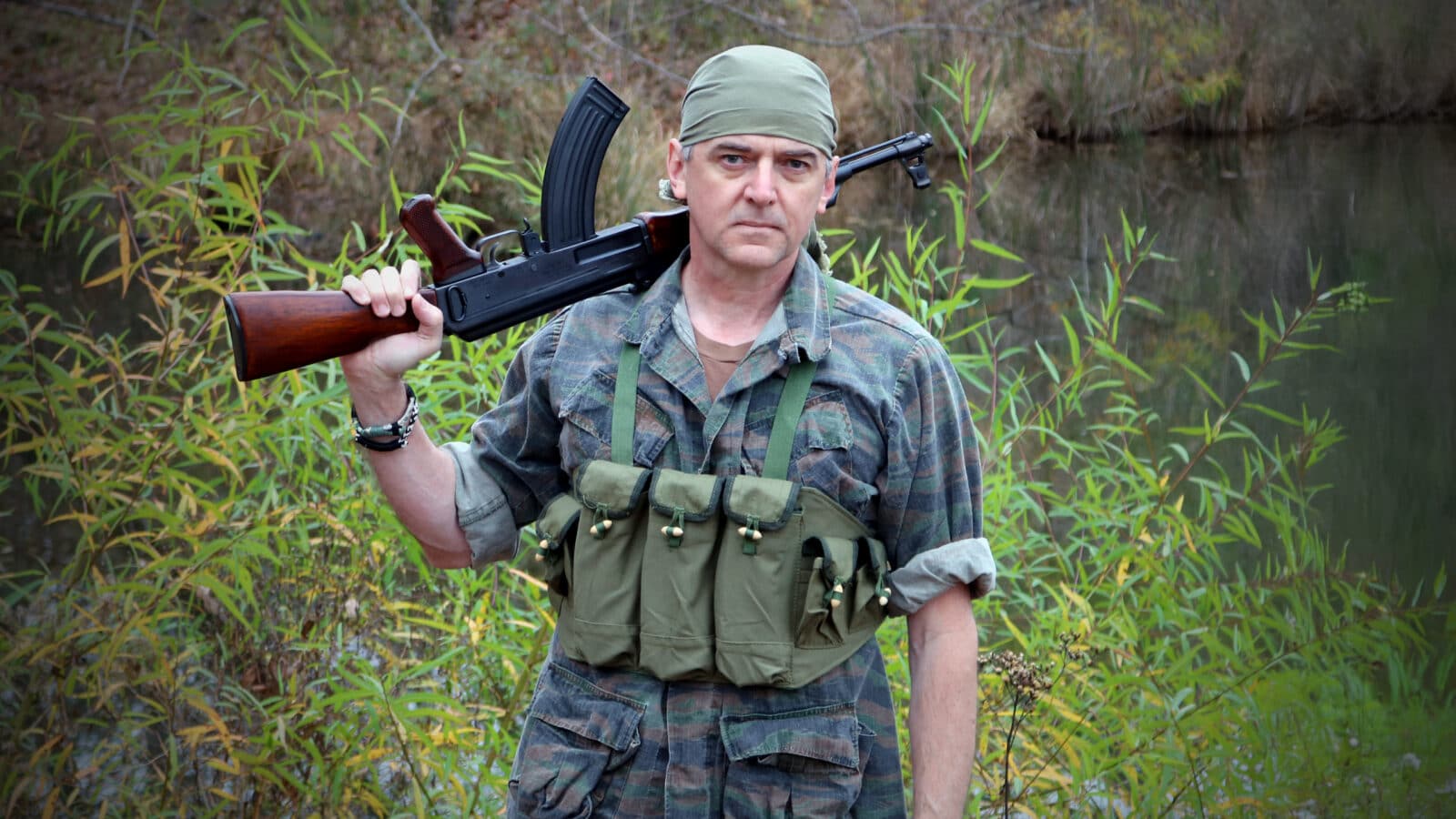
Most of what the world calls an AK-47 is actually an AKM. This modernized stamped steel AK did not enter Soviet service until 1956. Now they’re everywhere. Back during the Vietnam War, however, almost all of the Kalashnikov rifles we encountered in combat were the milled receiver Type 56 sort. It’s easy to tell the difference at a glance.
The machined receivers sported prominent lightening cuts on both sides. The muzzle included a flat muzzle nut rather than the slanted muzzle brake of the later AKM. The rear sling attachment point was located on the left side of the receiver rather than the toe of the stock, and the pressed steel top cover was smooth where that of the AKM was ribbed. Wartime Chicom Type 56 rifles typically sported hard-chromed bolts and bolt carriers, as well as chrome-lined bores. This contributed substantially to the gun’s legendary reliability in the hot, fetid jungle climate.

Type 56 furniture was cut from Chinese chiu wood stained dark. The wooden pistol grip sported some light cross-hatching not found on the later AKM sort. It was a big larger as well. Additionally, the foregrip on the Type 56 was left smooth, whereas that of the AKM included bilateral palm swells. There were some other minor differences, but those were the big ones. The cleaning kit rode inside the buttstock. These guns fed from pressed steel 30-round box magazines with chromed followers.
The real apex predator among Vietnam AKs was the underfolding sort. Originally designed to equip paratroopers, mechanized infantry and the like, they were quite rare in the Vietnam theater. I have been told that these folding-stock AKs were prized among special forces troops and helicopter crews.
The Next Best Thing
Precious few transferable Vietnam bringback AKs made it into the registry before the 1968 cutoff. Possession of one of these vintage guns would be a great start on a decent 401k today. The closest normal people can come to a legit Vietnam-era Chicom AK came from Poly Technologies.

The Chinese firm Poly Technologies made stuff like bicycles back in the 1980s. They also still produced semi-auto versions of Vietnam-standard AK-47 rifles. Their workmanship was frankly amazing, and they were priced accordingly. They were imported under the name Polytech AK47/S Legend.
These guns were made in Factory Number 386 in Long Yan, Fu Jian Province, in Southern China. The number “386” in a circle is stamped into the left side of the receiver. The gun’s milled steel receiver required 105 separate steps to complete. This was the same factory that made these guns during the Vietnam War.

At the time these weapons were being crafted, Factory 386 was a self-sufficient community. The workers lived on the premises, and there were onsite schools for their children. Very little of the plant was automated, so most of these guns were essentially handbuilt. Children of Factory 386 workers were expected to grow up and work in the plant as well. It was communist China, after all.
Back in the 1980s, Polytech offered these guns in both fixed and folding-stock versions. I’ve read that they only imported about 2,000 copies. They were expensive back then, and they are astronomically expensive today. These can be found for sale online, but expect to pay upwards of $4,000 for one. The folders are even worse. These guns originally came with a 6H2 bayonet, sling, cleaning kit, and three magazines, all in a fitted Styrofoam box.
Denouement
The Viet Cong and NVA used whatever weapons they could scrounge, but the classic AK-47 will forever be associated with that protracted decade-long conflict. Some 58,000 great Americans lost their lives fighting in Vietnam. The war touched most everybody in the country.

Nowadays, if you want a decent rendition of the original Chicom AK-47 you’d best have deep pockets. We’re not on the best of terms with the Chinese, so there will never be any more imported. However, just hefting one of these classic Kalashnikov rifles is akin to touching history. It is a tangible connection to a most remarkable time.
Editor’s Note: Please be sure to check out The Armory Life Forum, where you can comment about our daily articles, as well as just talk guns and gear. Click the “Go To Forum Thread” link below to jump in!
Read the full article here
