

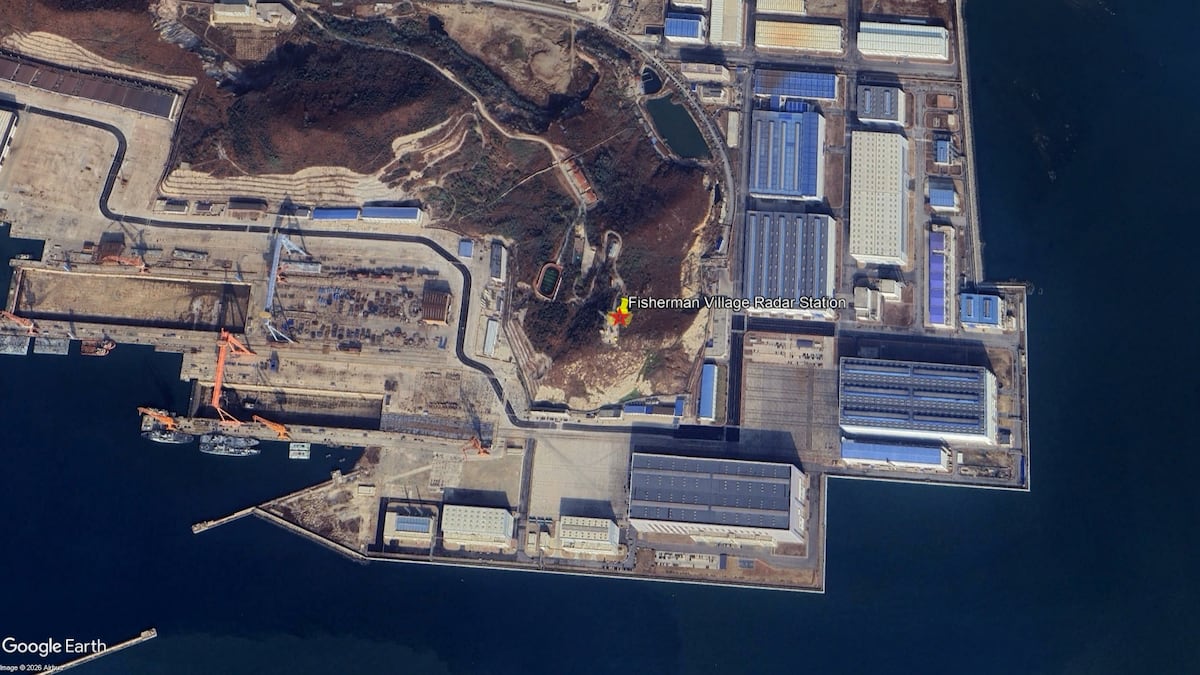
CHRISTCHURCH, New Zealand — Submarines are among the most secretive of China’s military assets, but a new class of nuclear-powered attack submarine – or SSN for short – has shown up in satellite imagery after recently moving to a launch bay at the Bohai Shipyard in Huludao.
The new submarine’s nomenclature is Type 09V, or also commonly referred to as the Type 095. Partially constructed, the boat could launch within the coming year.
After the new submarine showed up in high-resolution satellite imagery, Naval News was first to report it on Feb. 12. Its estimated submerged displacement is 9,000-10,000 tons.
Destined for the People’s Liberation Army Navy (PLAN), the incoming Type 09V platform is emblematic of China’s extensive development efforts and a construction spree of nuclear-powered submarines.
Rick Joe, an expert on the Chinese military, estimates the sea service currently has in service the following SSNs: one to two original Type 091 SSNs if they have not already been retired, plus two Type 09III, four Type 09IIIA and two to three Type 09IIIB attack submarines.
Joe surmises another 5-6 Type 09IIIB SSNs are being fitted out or are undergoing sea trials. This amounts to three new SSNs being launched annually, compared to a rate of 1.1 to 1.3 boats per year in the United States.
As for nuclear-powered ballistic missile submarines (SSBN), the analyst assesses the PLAN has six Type 09IV boats and possibly another one or two being fitted out after being launched in recent years.
Clean-sheet design
Asked to assess the new SSN, Joe noted it is wider than the preceding Type 09III family at around 40 feet (12m) versus 36 feet (11m). He also listed new likely innovations such as X-shaped rudders, hull-mounted and retractable diving planes to improve speed and agility, and a pumpjet propulsor.
The boat is also rumored to be the first Chinese submarine without a double hull; instead it might use either a single or hybrid hull.
The 09V, measuring approximately 360 feet (110m) long, has universal vertical launch system (VLS) cells – estimated to be eight in number. Like the latest American Virginia-class SSNs, each cell is thought to contain all-up round canisters, containing perhaps three missiles each in China’s case.
Flurry of construction
It is difficult to say when the first Type 09V will enter service, but it could be as far away as 2029 after fitting out and extensive sea trials.
China often builds two submarines of a new type before commencing series production, to allow problems to be ironed out. That timing suggests construction of the incumbent Type 09IIIB will continue into the early 2030s.
The U.S. Navy holds an advantage over China when it comes to submarine technologies and anti-submarine warfare. However, as the Type 09V demonstrates, Beijing is working hard to close this gap.
China has sufficient production capacity at Bohai Shipyard. Its Eastern Assembly Hall has space for twelve assembly slots measuring 144m long, while the newer Southern Assembly Hall has eight assembly slots measuring 157.5m long. In theory, these halls could simultaneously accommodate construction of 20 SSN-sized boats.
China’s next-generation Type 09VI SSBN is expected to take a number of technologies from the latest SSN as well.
Accompanying weapons
One new anti-ship missile that could potentially arm the Type 09V is the YJ-19 hypersonic missile unveiled at China’s military parade in September 2025.
Joe described the hypersonic YJ-19 as an “air-breathing scramjet cruise missile sized for submarine torpedo tubes (553mm). It certainly is likely to offer quite a boost in anti-surface strike capability, especially as they don’t have to be launched via VLS, but can in theory be launched from any submarine with torpedo tubes and adequate integration with the combat management system.”
This month, the PLAN revealed that it had accepted the YJ-19 for service on its Type 039B conventional submarines. This makes China the first country in the world to arm diesel-electric submarines with hypersonic weapons.
Gordon Arthur is an Asia correspondent for Defense News. After a 20-year stint working in Hong Kong, he now resides in New Zealand. He has attended military exercises and defense exhibitions in about 20 countries around the Asia-Pacific region.
Read the full article here
