

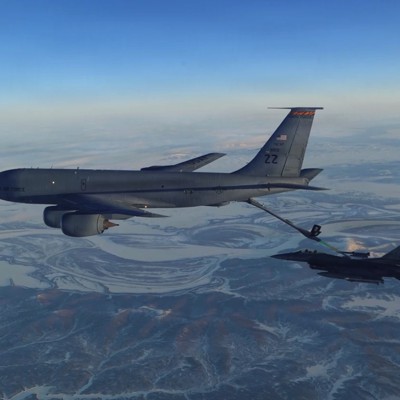
Six crew members killed aboard a KC-135 that crashed in Iraq on Thursday—the most recent casualties of the war on Iran—likely had no parachutes, which were removed from the venerable tanker aircraft nearly two decades ago.
Two aircraft were involved in the deadly incident, one of which returned safely to base. They were supporting the two-week-old Operation Epic Fury, but the incident was not the result of “hostile fire or friendly fire,” U.S. Central Command said in a Friday news release.
The nature of the crashed KC-135’s mission was not immediately clear. The other plane was also a KC-135, according to a U.S. official who talked with the Associated Press on condition of anonymity.
A CENTCOM spokesperson did not immediately respond to questions asking if the crew had access to parachutes. An Air Force spokesperson confirmed to Defense One that KC-135s “do not have parachutes.”
Air Force leaders eliminated parachutes from the tankers nearly two decades ago to save time and money.
“Removing parachutes from military aircraft may sound peculiar, but KC-135s are not like other aircraft. They seldom have mishaps, and the likelihood a KC-135 crew member would ever need to use a parachute is extremely low,” an Air Force press release said in 2008. “However, a lot of time, manpower and money goes into buying, maintaining and training to use parachutes. With the Air Force hungry for cost-saving efficiency under its Air Force for Smart Operations in the 21st Century Program, commonly known as AFSO 21, the parachutes were deemed obsolete.”
Jessica Ruttenber, a former pilot and KC-135 instructor, recalled the decision.
“There was a point when we were concerned about additional weight and not being fuel-efficient,” Ruttenber said. “I think that brought it to the likelihood of us ever needing to use the parachutes versus the weight and the upkeep, [and] the cost.”
After the parachutes were removed, interior harnesses were installed for use when, say, a light indicates that a door is loose.
Ruttenber said that if the crew had parachutes, they’d be in the back of the aircraft where the boom operator is. Given their location, bailing out of a KC-135 would be a safe possibility only under a few scenarios.
“I think the situation that would warrant jumping out of the plane is a low-fuel situation, that you’re not going to be able to make it to a landable surface, or the aircraft no longer has the ability to land,” she said. “If you have an uncontrolled situation that’s rapidly occurring and it’s violent, you’re not going to have time as an option.”
The last deadly KC-135 mishap was in 2013, when a crew of three crashed in the Kyrgyz Republic after the flight control system malfunctioned during a combat aerial refueling mission.
Top Air Force officials have repeatedly called for modernizing the KC-135, the last of which was built more than 60 years ago. Last year, the Air Force weighed keeping the tanker in service past its originally planned 2050 retirement date.
In July, the Air Force cancelled a “bridge buy” for an interim tanker as the service pursued a new-generation refueler in a program called NGAS, which netted just $13 million in the 2026 budget request. Instead, the service decided to buy additional KC-46s, despite the program’s recurring headwinds and mishaps.
“The Air Force is investing in both tanker capacity and capability to enable the Joint Force now and into the future by ensuring an uninterrupted recapitalization of KC -135 aircraft with KC-46 aircraft,” a service spokesperson said.
The identities of the aircrew killed in Thursday’s crash have not yet been released by the Defense Department. In his Friday morning press conference at the Pentagon, the Joint Chiefs chairman asked people to remember the aircrew and those around them.
“Please keep these brave airmen, their families, friends, and units in your thoughts,” Caine said. “In the coming hours and days, our service members make an incredible sacrifice to go forward and do the things that the nation asks of them.”
Read the full article here
