
FORT STEWART, Ga. — A futuristic whirr from the skies cut through the quiet of an unusually cool Georgia afternoon.
In stationary concentration, a soldier moved only his fingers as he steered a small device through plastic pipes arranged into a makeshift obstacle course built to qualify soldiers on a tool that has quickly changed the course of modern warfare: drones.
Unmanned aircraft shape nearly every part of the battlefields today, from reconnaissance and artillery spotting to precision strikes and surveillance.
As the U.S. Army moves to integrate drones into each formation, units across the force are figuring out how to teach, train and test soldiers on rapidly evolving technology.
At Fort Stewart, that effort has morphed into a homegrown schoolhouse that is designed to push drone operators beyond their comfort zone and into a stressful state of sweaty palms and elevated heart rates.
The Marne Unmanned Center of Excellence, which became operational in March, moves soldiers through academic instruction, virtual simulators and increasingly challenging flight tests.
The classroom
The center starts with classroom instruction on airspace rules and flight controls. Before soldiers can send a drone into the air, they spend time at a desk, fiddling with controllers hooked up to laptops. For weeks, instead of shooting rifles, soldiers become engrossed in virtual reality scenes reminiscent of video games.
They learn to toggle the controllers to send their virtual drones through windows and under sallyports. They learn to navigate when the line of sight is lost or video quality diminished. They learn to attack.
Soldiers spend 40 to 50 hours operating virtual drones before touching a real unmanned aircraft.
Fort Stewart also hosts a 60-seat collective trainer, where each individual operates their own laptop while a battlefield view is plastered across a massive screen at the front of the room.
Drones then become a part of the fight and operators must interact with other capabilities, such as artillery and armored vehicles.
The flight line
Once soldiers can send a virtual drone through a gauntlet of obstacles, they go outside to try the real thing under the watchful eyes of an expert.
In a parking lot near the building, one student stood next to his instructor as she looked on.
Spc. Tyler Lee stared at his controller in deep concentration, periodically looking up to check his drone’s location as he maneuvered it down from the sky. A satisfied smile danced on his face after a successful landing.
Lee grew up playing video games, listing first-person games, like Call of Duty, among his favorites. Those games, he said, helping him pick up operating first-person view, or FPV, drones like the one he was flying. He even bought a commercial drone to improve his skills.
Despite completing the academic training and simulators, Lee was modest about his abilities.
“I’m nowhere near proficient,” he said. “I would still consider myself a beginner even though I’ve flown a lot and I’ve got my own [drone].”
Staff Sgt. Nway Nway Lwin, Lee’s instructor, said maneuvering a drone around was just the beginning of becoming an expert.
For individual qualification training, Lwin said she would have a student focus on basic maneuvers: moving right, left, up, down and through, gathering basic information about the surroundings as they go.
Once they master that, Lwin makes things complicated with real-word scenarios.
“You are doing the recon mission,” she’ll tell students. “This is your [Named Area of Interest] and this is where you are setting up — show me the flight plan.”
The sky
Drone operators who have learned basic maneuvering can advance to complicated obstacle courses that are graded on time standards.
They also go into the woods, pushing their skills by flying without being able to see the drone in the sky.
Because of that, Fort Stewart’s drone center has a unique relationship with its air traffic controllers and range control officials. Many drones can reach heights that intersect with crewed aircraft, requiring constant monitoring.
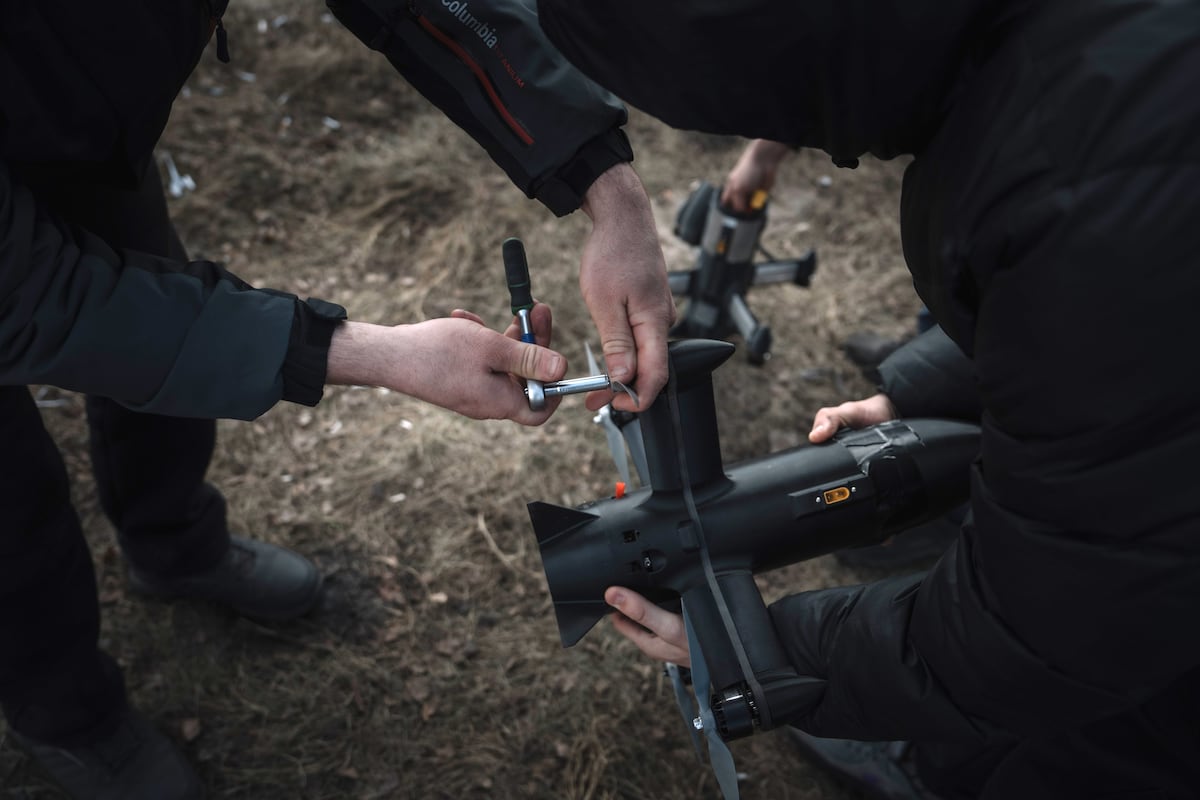
Other drones are built to explode. Some units use Fort Stewart ranges to practice with one-way attack drones designed to carry explosive payloads that detonate when they crash into a target.
One-way drones are already in use in theaters across the world, according to the base’s range control, and are just another unmanned aircraft skill to master.
Chief Warrant Officer 5 Jonathan Morrison, who helped spearhead the base’s drone training program, said his goal is not just to qualify operators.
“You can be qualified, but can you be well qualified?” he asked.
“Can you be super confident with your system? And can you be confident enough to go out there and perform any mission at any time, anywhere at a moment’s notice?” Morrison speculated.
Eve Sampson is a reporter and former Army officer. She has covered conflict across the world, writing for The New York Times, The Washington Post and The Associated Press.
Read the full article here
