

Quantum Space is shooting for the Moon—manufacturally speaking—with plans to build a facility that can rapidly churn out satellites in Tulsa, Okla. But first, the Maryland-based company needs to finish building its first satellite.
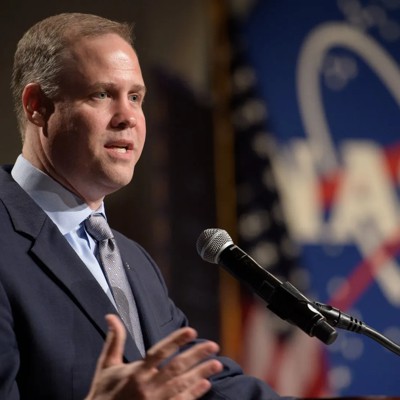
“When we have full production, we’re going to be building 1,000 satellites a year. That’s the vision, that’s the plan,” Quantum Space CEO Jim Bridenstine told Defense One. “Now, that’s not going to happen next year. Right now, next year, what we’re planning to do is launch our first satellite. So that’s the number-one objective: get that satellite airborne.”
Bridenstine said his company already has a government customer for the Ranger Prime satellite, which will maneuver quickly in orbit using technologies currently under development.
“One of them is multi-mode propulsion using the same propellant to do both electric and chemical propulsion for high efficiency and high energy. Another one is pumps in space. Most space vehicles are pressure-fed. This one’s going to have pumps, which is a unique transformational capability, and it’s what’s going to allow us to carry 4,000 kilograms of hydrazine for fuel…the standard today is a whole lot less,” said Bridenstine, who is a former NASA administrator and U.S. congressman for Oklahoma.
Recent years have seen the Pentagon become increasingly focused on contested space operations, including a push for orbital refueling.
“We’re just going to have a much bigger fuel tank. And we’re going to be able to do in-space refueling for ourselves and for others. So those technologies are under development. We’ve got contracts with the government to test all those things. And then, as time goes on, we’re going to be iterating to build the full-scale Ranger spacecraft. And when fully operational, we want to build 1,000 satellites a year.”
The Oklahoma plant, located at the former Spartan Aircraft Company site, is being expanded from 25,000 to 40,000 square feet. It will house equipment for machining, welding, assembly and fabrication, and testing. Initial operation is eyed for early 2027.
“We’re moving stuff there in June, and at first we’re just going to have machines that are going to make parts—and we’re talking about important parts and large parts of satellites. But we’re not going to assemble the satellites there in Tulsa. We’re going to assemble them here in Maryland initially, but eventually we’re going to get to the point where, as we scale, we’re going to grow in Tulsa.”
Quantum Space has contracts with DARPA, the Space Force, and is one of the many vendors listed on the SHIELD contract, which is part of the potential trillion-dollar Golden Dome effort.
Defense One spoke with Bridenstine just days after he took the helm as Quantum Space’s CEO. Here’s our conversation, which has been edited for length and clarity:
D1: Why Oklahoma?
Bridenstine: Oklahoma has an interest in being involved in space. We’re seeing that they’re building a hypergolic test stand in Oklahoma that will be owned and operated by Agile Space Industries—that’s for in-space propulsion. And of course, those are the thrusters that we’re going to use on Ranger and they’re going to be tested there at the hypergolic test facility.
Because if you’re going to sustain maneuver, you’ve got to have high energy thrust to get out of the way of threats to maybe go look at threats to get out of the way of debris. This is what Ranger, our satellite, is capable of: going from low Earth orbit to geostationary orbit [and vice versa]. And we have a satellite that’s refuelable and can refuel others. So all of this means we need the ability to use thrust and we’re going to have thrust in levels and capabilities that others in the market don’t have. And all that thrust has to be tested…in Tulsa at the hypergolic test stand that’s owned and operated by Agile Space Industries.
D1: What about manufacturing?
Bridenstine: Quantum Space has a presence in Rockville, Maryland, and we have a presence in Hawthorne, California. And I think it’s important to note that we’re not leaving those places, and in fact, we’re going to continue growing in those places. It’s also true that if you’re going to do volume manufacturing, we need to go somewhere, where there, where the cost of land is less, the cost of materials is less, the cost of gas is less, the cost of labor is less. And because we’re going to need to hire a significant workforce to do the manufacturing of these satellites. That’s where Oklahoma plays. So not only do they have the high energy thrust testing capability in Tulsa, they also have the most robust aerospace workforce in the country, the American Airlines maintenance base is there. What used to be Spirit Aerosystems, which is now Boeing, is there. They have Nordam, they’ve got Flight Safety International. These are all companies with a major presence in Oklahoma that are doing manufacturing in volumes.
D1: And funding?
Bridenstine: We’re going to raise a lot of capital to go and scale while we’re preparing to fly Ranger prime. And that’s what Tulsa is all about. It’s about scale.
D1: What is your vision for Quantum Space and how does that mesh with the Space Force’s needs?
Bridenstine: We want to be the most maneuverable, highest energy satellite in existence. And so that’s what dynamic Space Operations is all about. And so we have contracts with the Space Force and with the Air Force Research Lab and DARPA to do exactly that.
What we’re building here at Quantum is a company that directly addresses the theory of competitive endurance, and we’re doing it by building satellites that are designed for sustained maneuver, for dynamic space operations.
Every space leader—civilian or military [talks] about sustained maneuver for dynamic space operations. It is so important for this country, as we think about the changing nature of space, that we have a sustained maneuver for dynamic space operations, specifically when you think about what the Space Force has coined, they call it the theory of competitive endurance.
There are three pillars: Number one is to avoid operational surprise, so we don’t want to be attacked without warning. So in order to avoid operational surprise, we need space domain awareness. And we need ubiquitous space domain awareness. So we need it in volumes.
We’re part of the contract called Andromeda, which is the replacement for [Geosynchronous Space Situational Awareness Program]. Think of a satellite that flies up and looks at other satellites and sends those pictures back so we can understand where our competitors are and what they’re doing. GSSAP, it’s not refuelable, and it has to last for eight years. And so what we’re doing with the Andromeda contract is we’re saying, Hey, we’re going to not only go up and look at other satellites, but we’re going to be refuelable and we have multi mode capability so that we can be efficient and have high energy thrust when we need it.
The second pillar of competitive endurance is denying first mover advantage. So to deny first mover advantage, we have to distribute and disaggregate our assets in space, to complicate the targeting solution for the enemy, and we have to reduce the cost of every node in space. We have to have thousands of satellites that are networked together and less expensive than the cost of an anti-satellite missile, less expensive than the cost of an anti-satellite satellite. And if we do that right, which we’ve done really well in low Earth orbit. But as we move forward, we’re going to have to do it in medium Earth orbit and beyond geostationary orbit.
The third pillar of competitive endurance is actually responsible counter space campaigning. We have to be able to utilize space while the enemy is trying to deny us the utilization of space, fight through that denial, utilize space and, at the same time, deny the enemy the use of space and responsible counter space campaigning is all about high energy maneuver. So when you hear Space Force leaders talk about sustained maneuver for dynamic space operations, what they are addressing with that are all three pillars.
D1: What do the next 18 months look like?
Bridenstine: We’re going to start next month by building parts in Oklahoma. And in the next 18 months, we’ll be building significant portions of almost every satellite in Tulsa. And yes, initially, final production will be here in Maryland, but eventually we’re going to be able to, at scale, have an assembly line that’s producing satellites in Tulsa.
Read the full article here
