
My passion has been collecting and acquiring representative United States Service rifles. That includes items like the 1898 Krag-Jorgensen, 1903 Springfield (and its variants), the M1 Garand and the M1 Carbine.
However, one of my favorites in that collection is the Springfield Model 1884 Trapdoor Rifle. Why? Because it’s such a strange gun! It’s a rifle of two eras — muzzleloading and breechloading. It’s such an oddity in the development of military arms.
While Europe was developing all-new weapon systems around the idea of a self-contained cartridge, the United States decided to mash the concept together. This was all in an effort to save money in a post-bellum world. And that’s what makes this bit of firearms history so interesting.
Allin’s Alterations
Before I begin, yes, both sides of the Civil War produced models of breech-loading rifles. Just not on a large scale. Civil War-era breech-loading carbines, like the Spencer and Sharps, were issued to some cavalry units but served mainly as a temporary solution and did little to arm the infantry. After the war, a solution was needed to modernize the army — within certain limits.

Erskine S. Allin, the chief armorer at Springfield Armory in Massachusetts, faced the challenge of converting the Army’s large reserve of .58-caliber muzzle-loading percussion muskets into breechloaders. This effort led to the creation of the Model 1865 Springfield, popularly called “Allin’s Alteration.” Although the Civil War demonstrated the superiority of breechloading rifles, postwar budget cuts drastically limited funding, preventing the purchase of new weapons as tens of thousands of usable muskets — some never issued — were in storage.

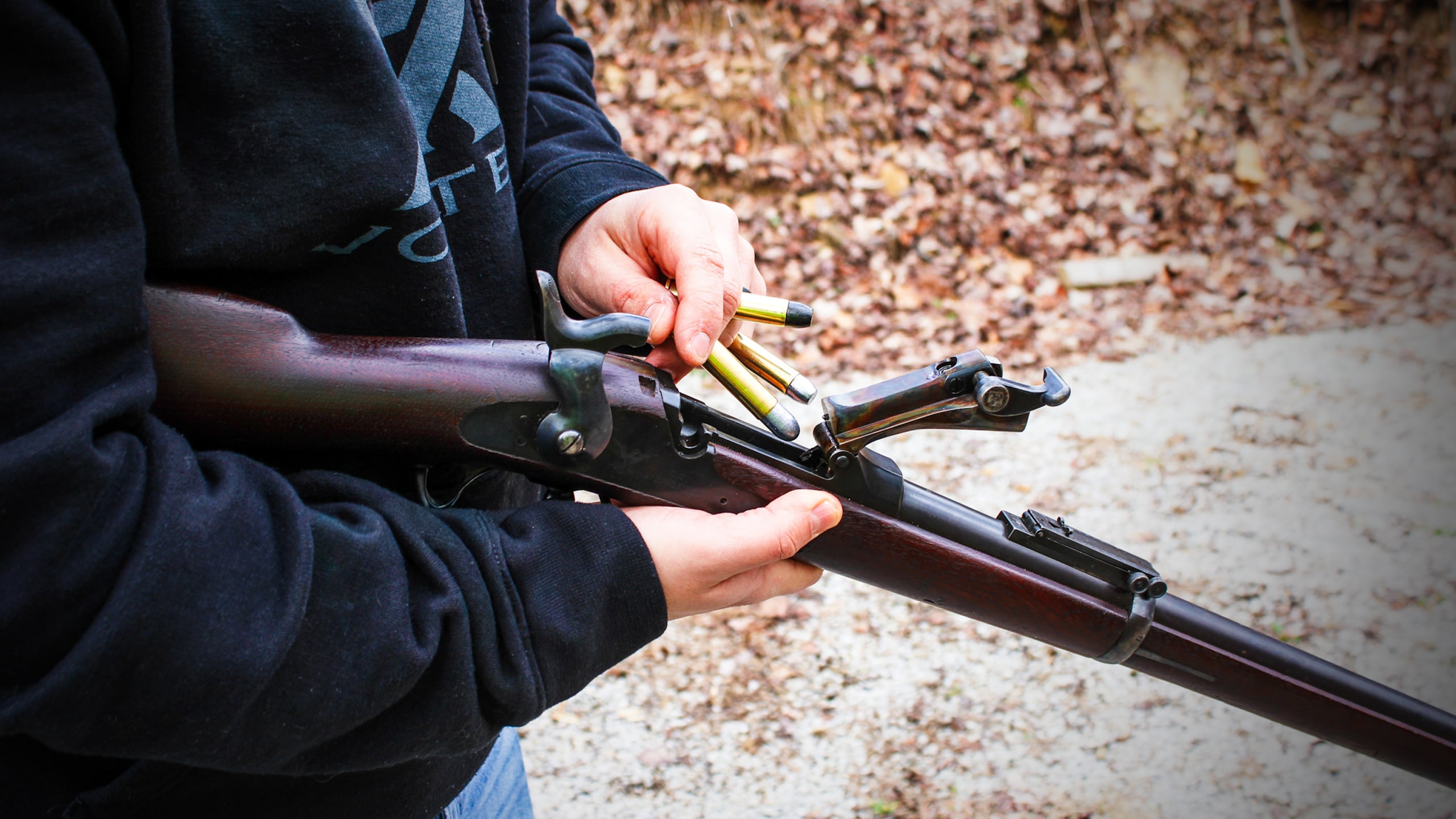
To solve this problem, Allin devised an innovative conversion system. He milled away part of the top rear of the barrel and installed a hinged breechblock equipped with a firing pin and extractor-ejector mechanism, transforming outdated muzzleloaders into practical breechloaders. Similar hinged breechblock mechanisms had been made by both foreign and domestic gunmakers with varying success. Although other gunmakers had attempted similar hinged-breech designs, Allin’s approach proved successful. The resulting Model 1865 Springfield was widely nicknamed the “Trapdoor Springfield.”
Early Models: 1865, 1866, 1868 & 1870
The early models weren’t as refined as later versions, but they are important to the Trapdoor’s development. The first pattern, the Model 1865, or the “Allin Conversion,” saw 5,000 units produced. These took the Model 1861 .58-cal. rifle muskets and converted them to breech loaders using Allin’s design. The guns kept their original 40” barrels and were chambered for a .58-cal. rimfire metallic cartridge, but were otherwise mostly unchanged from the original Civil War muzzleloaders.
But, like many first-generation models, there were challenges. The breechblock mechanism and rimfire cartridge of the Model 1865 proved to be less than ideal, so the Model 1866, sometimes called the “Second Allin Conversion,” was developed and adopted. The new version kept the original 40” barrel but reamed it out and brazed a .50-cal. sleeve in place to accommodate a new cartridge.

The complicated “First Allin” breechblock was replaced with a simpler, stronger breechblock assembly. Additionally, a significantly improved .50-caliber centerfire cartridge, the .50-70 Government (or, as I like to call it, the “Big Fifty”), was developed for the new design. This marked a major step toward what we now recognize as the “Trapdoor.”
The Model 1868 replaced the Model 1866. It used the same .50-70 Gov’t cartridge but had a new receiver. It also featured the same .50-cal. sleeved barrel, but it was shortened to 32½”. This made the rifle much more handy. While a longer barrel improved accuracy and ensured that all the powder burned, it was also bulky.

Live The Armory Life. The latest content straight to your inbox plus an automatic entry to each of our monthly gun giveaways!
The final version of the .50-70 Gov’t Trapdoor Springfield was the Model 1870. While it closely resembled the earlier .50-70 Model 1868, it incorporated several refinements, such as a shorter receiver and a newly manufactured 32½” .50-cal. barrel. Unlike earlier conversions that involved modifying Civil War–era muskets, the Model 1870 was built with new major components rather than repurposed ones.
In many ways, it marked the culmination of earlier conversion efforts and signaled a shift toward a purpose-built breechloading service rifle.
The 1873 & 45-70 Gov’t
The Model 1870 rifle and carbine proved to be improvements over the previous Trapdoor Springfield models, but the .50-70 Gov’t cartridge was found to be less than ideal. A trial was held in 1872 to decide which rifle and carbine would be standardized for the U.S. Army’s infantry and cavalry units.

In 1873, slightly modified versions of the Model 1870 rifle and carbine, chambered for the newly developed .45-70 Gov’t cartridge, which was ballistically superior to the .50-70 Gov’t, were approved for adoption. The .45-70 Gov’t cartridge was loaded with 70 grains of black powder and a 405-grain lead bullet. A cartridge for the carbine was also developed that used the same 405-grain bullet, but contained only 55 grains of powder to reduce recoil (how thoughtful).
While 1873 marked a significant improvement in performance, another round of upgrades occurred in 1877. The stock, with the new .45-70 Gov’t cartridge, was prone to breaking. To address this, it was redesigned with a thicker wrist for added durability. Additionally, a recess for a three-piece, jointed cleaning rod was carved into the buttstock to hold it and other tools; this could be accessed through a buttplate with a hinged door. The updated version was called the “Model 1877,” but the breechblocks still bore the “1873” marking.
The Final Trapdoor
In 1884, the Model 1884 “Buffington” rear sight was designed for use with the Trapdoor Springfield rifle, carbine, and Cadet Rifle. Unlike earlier rear sights that were only adjustable for elevation, this new sight was fully adjustable for windage as well. Apart from that, no significant changes were made. The new version was designated the “Model 1884,” and the breechblock markings were updated accordingly. About 20,003 Model 1884 carbines were produced, along with 148,796 rifles and 13,500 Cadet Rifles. Production ended in 1893.
Trapdoor Ammunition
While learning the history of the Trapdoor is one thing, actually owning and shooting one is a completely different experience. Before discussing what it’s like to shoot a Trapdoor, however, it’s important to briefly discuss ammunition.

The Trapdoor rifle was designed, built, and issued during the black powder era, a distinction that is quite significant. The easiest way to understand the difference is to think of black powder as an explosive, while smokeless powder acts more like a propellant. Because of this fundamental difference, the two types of powder behave very differently in terms of burn rate, pressure levels, and overall performance inside a firearm.
Things become even more complicated when looking at the .45-70 Government cartridge. This round, now over a century and a half old, remarkably continues to survive in the modern era. In fact, it ranks among the oldest metallic cartridges still in continuous production, with new rifles manufactured and chambered for it today (its popularity coincides with the rise of “tactical” lever-action rifles and the adoption of straight-wall cartridges in previous “shotgun-only” states for deer hunting).
At first glance, this might seem like good news for shooters, since it means a wide variety of .45-70 ammunition is readily available. However, the reality is more complex, and some caution is needed when selecting ammunition for older rifles.

A good illustration of this appears in my Hornady Handbook of Cartridge Reloading, Vol. 11. In it, .45-70 load data is divided into three separate rifle categories: Trapdoor, Marlin 1895, and Ruger No. 1. In addition to those, there is also a section covering handgun ammunition for the T/C line of single-shot pistols. The reason for this separation is that the .45-70 Government cartridge offers exceptional versatility for shooters and hunters alike.
That flexibility becomes even more pronounced for reloaders, who can tailor loads using a wide variety of bullet weights and powder charges depending on the intended purpose, whether it be historical shooting, hunting, or modern high-performance applications. That said, modern .45-70 loads are not suitable for historic .45-70 rifles like the Trapdoor.

Fortunately, there are companies that produce historically appropriate ammunition for collectors and enthusiasts who shoot vintage firearms. In a recent article, I discussed Steinel Ammunition, a company that specializes in exactly this.
Steinel offers several .45-70 loads specifically designed for Trapdoor rifles. Among these is a 405-grain RNFP load that averages around 1,300 fps, depending on barrel length. They also offer a 500-grain RN load that runs at approximately 1,320 fps. These cartridges use Starline brass and cast projectiles, and they are intentionally loaded to remain within safe pressure levels for Trapdoor rifles.
As a reloader myself, I have developed a similar load using a 405-grain cast bullet, Starline brass, and Trail Boss powder — although that powder has unfortunately become difficult to find in recent years. All this to say, when shooting a historic rifle like the Trapdoor, make sure you are using “Trapdoor-safe” ammunition.
Shooting a Trapdoor Today
Shooting a historical rifle truly brings history to life. That’s the joy of collecting historical firearms. When shooting the Trapdoor, history feels tangible. There’s a romanticized view that harkens back to the late 1800’s and the Wild West — a different era when things were done with purpose.

That’s the best way to describe shooting my Model 1884 Trapdoor. It transports me to a different time. While I don’t shoot it very often, I do shoot it. Before it was history, it was a tool and a battle implement. Shooting this rifle is a connection to that past.
Conclusion
The Trapdoor Springfield was manufactured from 1865 (Alin Conversion) to 1893 (Model 1884) before being replaced by the repeating bolt-action Model 1892 Krag-Jørgensen, which entered production at the Massachusetts-based Springfield Armory in 1894 and was chambered for the smokeless .30-40 Krag cartridge. Its service life marked the end of the U.S. Army’s black powder era and the beginning of a new age of modern military firearms.
Yet the Trapdoor remains a fascinating bridge between two periods of technological change. It reflects a nation balancing innovation with practicality in the years following the Civil War. Today, whether studied as a historical artifact or fired on the range, the Trapdoor continues to tell the story of that transition.
Editor’s Note: Please be sure to check out The Armory Life Forum, where you can comment about our daily articles, as well as just talk guns and gear. Click the “Go To Forum Thread” link below to jump in and discuss this article and much more!
Read the full article here
