

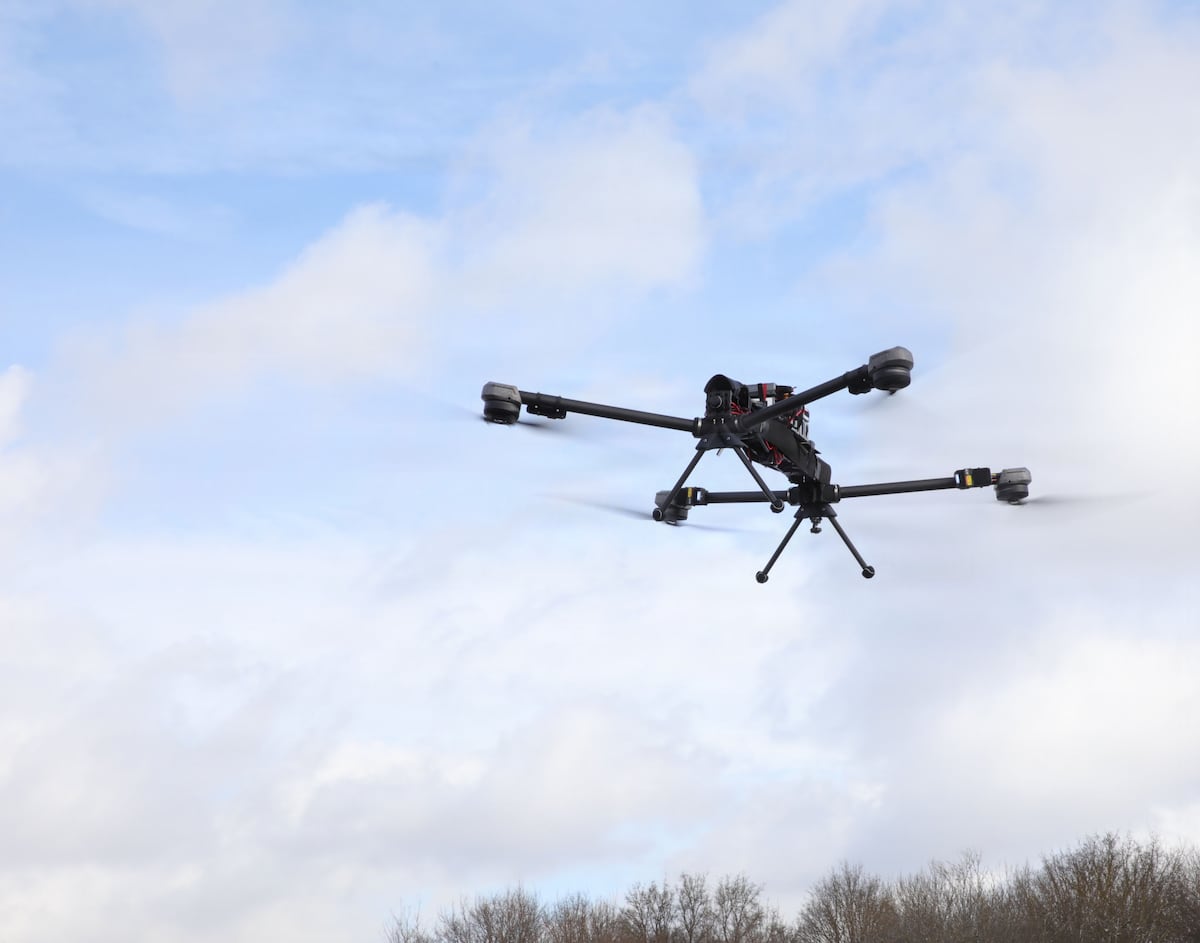
The Defense Advanced Research Projects Agency next week will kick off its inaugural Lift Challenge, a weeklong competition that aims to “revolutionize heavy vertical-lift aviation” by finding a drone capable of lifting and transporting a payload four times its own weight. The agency will award $6.5 million in prizes to the winners.
Phillip “Donna” Smith, the Lift Challenge program manager and a lieutenant colonel in the Marine Corps Reserve, said that multirotor drones are limited in their usability because of their low payload-to-weight ratios, meaning they can only transport a payload equal to or less than their own weight.
“This means as payload requirements increase, so does the size and the cost of the drone,” he said. “With the Lift Challenge, our goal is to dramatically increase the useful load, which will then drive down the cost per pound of transported cargo.”
He described heavy vertical flight as the “next great technological inflection point that is economical for widespread adoption,” comparing its potential impact to the assembly line for automobiles and reusable rockets for spaceflight. He added that it could revolutionize industries like agriculture, logistics, construction, and more.
The competition aligns with the Defense Department’s Drone Dominance initiative, which aims to accelerate drone technology and reduce costs.
While Drone Dominance challenges a company’s ability to scale production, DARPA is open to anyone who can build a drone that meets the minimum standards.
The Lift Challenge has attracted more than 100 competitors for attack drones, ranging from drone manufacturers to engineers to academics to hobbyists.
One participant, YouTuber Hoarder Sam, who documents his DIY drone projects, said the challenge appealed to him because of its ambitious goal.
Sam recalled watching DARPA’s self-driving car challenge years before autonomous vehicles became commercially viable and said the Lift Challenge struck him in much the same way.
Competitors must build a drone capable of non-assisted vertical takeoff that weighs less than 55 pounds. During the competition, the drones will have to pick up a minimum payload of 110 pounds and move it back and forth on a 1,000-foot course 30 times, or five nautical miles, in less than 30 minutes.
“Carrying this much weight for that far of a distance isn’t going to be easy, and honestly, I think it might be almost impossible. That’s because DARPA is famous for setting the bar extremely high,” Sam said.
He added that when DARPA first held its self-driving car challenge, no team completed the course. “They had to run the challenge again the next year, and even then, only four cars finished the challenge,” he said.
Others see the challenge as a chance to advance research.
Hao Xu, an associate professor at the University of Nevada, Reno who is leading a team of five engineering students, called the challenge an “interesting opportunity” that will result in a “fruitful discussion among national partners for us to boost Nevada drone R&D and workforce development.”
Some have commercial goals. The Colorado-based company Alpine Combat Systems has been showcasing its design on social media as a way to highlight its products.
In an introduction video, Amanda Barron, who runs the business with her husband Jesus Barron, an Army veteran, said they entered the competition because they want to “network with DARPA and other agencies.”
Jesus Barron added that their “experimental” Samson drone was their “first drone build and it shows what Alpine Combat Systems can do when we put our minds to it.”
The competition begins Aug. 2 at the National Museum of the U.S. Air Force in Dayton, Ohio, and the final four days will open to the public. DARPA will also livestream the event on YouTube beginning Aug. 3.
Daniel Terrill is a contributor to Military Times. He’s been reporting on military issues, the gun industry, and the outdoors for nearly two decades. Although writing is his passion, he’s been a Marine, police officer, and, perhaps the most dangerous job of his career, a substitute teacher.
Read the full article here
