

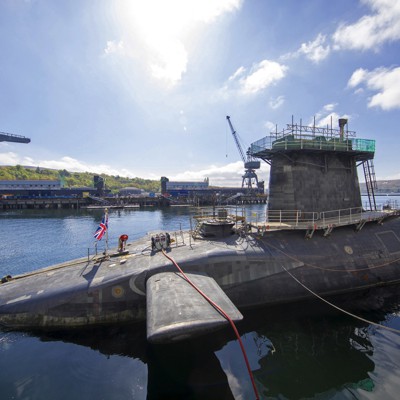
The United Kingdom will have a new prime minister by the end of summer. While sure to inherit a host of challenges at home, Downing Street’s newest occupant will also have to contend with a troubling reality across the Atlantic: Britain’s special relationship with the United States is on shaky ground. These brewing tensions raise the question of whether London should—and if it could—reduce its reliance on Washington. And perhaps nowhere is this reliance heavier than nuclear deterrence, as Britain depends on American Trident missiles to equip its nuclear-armed submarines.
An underexamined—and underappreciated—aspect of this nuclear relationship, however, is how the United States benefits, too. For over 65 years, Washington has made technical, operational, and strategic gains for its own deterrent through cooperation with London. America, too, would lose out from a rupture.
Preserving and protecting the nuclear relationship therefore remains firmly in the interest of both countries.
The benefits of the nuclear relationship to Britain are clear. The UK nuclear force is often characterized as technically dependent on the United States, even while the British prime minister maintains operational independence over its use. London’s nuclear collaboration with Washington has proven an efficient way for the UK to remain a nuclear weapons power. Without it, London would have been forced to bear significantly greater, and plausibly unsustainable, costs to stay in the nuclear business. Moreover, the linkages that this nuclear collaboration has created across the states’ nuclear enterprises have kept Washington engaged in the most crucial aspects of British security for decades.
Less understood are the benefits that the United States accrues. Although Washington does not rely on nuclear collaboration with London to the same extent that London does with Washington, research and interviews with current and former officials and experts in both countries highlight Washington’s gains. Those benefits are only likely to become more important as the United States contends with a rapidly evolving strategic landscape and the growing technical challenges faced by its own nuclear weapons modernization programs.
To start, Britain pays a hefty cost for its access to U.S. technologies. Take Trident, for which the U.K. government paid initial procurement fees, makes annual maintenance contributions, and contributes to life extension costs. These expenses total well into the many billions of dollars.
Yet the benefits to the United States are not purely—or even primarily—financial. The UK maintains top-notch scientific and technical nuclear expertise. Through regular exchanges, British experts work closely with their American counterparts, providing peer review, red-teaming, and other input that improves the work taking place at U.S. nuclear laboratories. London’s technical contributions to the U.S. nuclear navy also now have room to grow following a 2024 amendment to the Mutual Defense Agreement that allows for two-way exchanges on naval nuclear propulsion, including the enriched uranium needed to fuel seagoing reactors.
Of course, the British nuclear weapons enterprise is not without its problems. There are concerns, for example, about the UK’s capacity to deliver its new warhead program. But such challenges are hardly unique to Britain. The United States also confronts aging systems and atrophied infrastructure, and as noted by John Foster, the former head of a U.S. nuclear weapons lab, it has historically benefited from Britain’s “clever ways to get the job done more efficiently.”
Beyond these programmatic considerations, Washington benefits from London’s nuclear role in Europe. The UK provides an additional deterrent capability committed to defending the Euro-Atlantic. In fact, the original U.S.-UK missile sales agreement was negotiated on the premise that Britain assigns these weapons to the defense of NATO. Washington assessed then, as it should now, that these forces “strengthen the nuclear defense of the Western Alliance.”
A core tenant of NATO nuclear policy holds that since the UK deterrent is operationally independent, London acts as a second center of decision-making, complicating Moscow’s threat calculus and thus contributing to the deterrence of Russia. Moscow must weigh the possibility that, even without a collective NATO or U.S. decision to use nuclear weapons, the UK could independently decide to employ its nuclear force. There are some doubts about whether Russia actually believes London would carry out a nuclear strike without Washington’s involvement or even explicit approval. But Russia does seem to perceive the UK deterrent as credible, suggesting that it affects Moscow’s threat calculus regardless.
Washington has also found it politically and strategically valuable to have a European nuclear ally in lockstep on deterrence and broader nuclear issues and who can facilitate consensus-building within the alliance. This role will likely only be more important as U.S. defense priorities increasingly shift away from Europe but while effective deterrence on the continent remains in U.S. interests. Washington will need to rely more on London to help shoulder the European deterrence burden, both to help meet allied assurance demands and ensure that any reconfiguration of U.S. assets, even if only conventional, does not degrade regional deterrence.
London has a way to go in developing the necessary capabilities besides its strategic deterrent. But it is working on them, while promoting an approach to make Europe a stronger security partner for, rather than strategically autonomous from, Washington.
Finally, the nuclear relationship, as well as the two countries’ intelligence ties, has fostered a deep closeness on defense issues far beyond the European theater. Washington has benefited from such cooperation for decades. Were there a rupture in the relationship, it is probable that Britain would limit or entirely cut off its defense support—including access to bases such as Fairford or Diego Garcia, which have played important roles in the Iran conflict—and reduce its altogether high degree of support for U.S. foreign policy.
British dependencies on an, at minimum, increasingly unpredictable and, at worst, increasingly unreliable United States are a genuine concern. They raise serious and difficult questions about whether London should remain technically dependent on Washington for nuclear deterrence or whether it needs to explore alternative, or at least supplementary, arrangements. The new prime minister will have to tackle these questions head on.
Yet cooperation is not zero-sum. While the UK may benefit more, the United States also benefits in significant ways. As officials and experts in Washington chart the course ahead for the transatlantic partnership, they would do well to remember this.
Jamie Kwong is a fellow in the Nuclear Policy Program at the Carnegie Endowment for International Peace. This piece reflects preliminary findings from a project on the implications of the changing security environment for UK-U.S. nuclear deterrence collaboration.
Read the full article here
