

Whether you are a professional gunsmith, an armorer, a firearms instructor, a collector, a gun shop owner, or simply a firearm enthusiast who enjoys cleaning, maintaining, restoring, repairing, or understanding firearms, having access to accurate technical documentation is essential. Every firearm owner eventually reaches a point where they need to identify a small part, understand a mechanism, replace a worn component, troubleshoot a malfunction, or safely reassemble a firearm after cleaning.
That is exactly where FirearmsGuide.com stands apart.
For thousands of professionals and firearm enthusiasts worldwide, FirearmsGuide.com has become one of the most comprehensive online firearms reference resources available, offering an unmatched collection of high-resolution printable gun schematics, exploded views, original factory manuals, blueprints, parts lists, armorer’s manuals, military technical manuals, and historical firearm catalogs covering both antique and modern firearms.
According to FirearmsGuide, its current library includes more than 27,650 printable gunsmithing documents alongside a searchable database of over 84,000 firearms and ammunition entries from 1,820 manufacturers across 62 countries.
Professional gunsmithing is far more than replacing broken parts.
Every repair, restoration, inspection, cleaning, trigger adjustment, stock replacement, barrel installation, optic mounting, or complete firearm rebuild requires detailed knowledge of the firearm’s design.
Without accurate documentation, even experienced gunsmiths can spend unnecessary time searching for:
-
exploded gun parts diagrams
-
firearm schematics
-
gun blueprints
-
original factory parts lists
-
armorer’s manuals
-
military technical manuals
-
repair instructions
-
assembly sequences
-
disassembly procedures
-
component identification
-
original part numbers
-
cross-sectional views
-
gun dimensions
-
tolerances
-
historical factory catalogs
Instead of searching dozens of websites, forums, PDFs, auction listings, or manufacturer archives, professionals often prefer having a single searchable reference library.
FirearmsGuide.com is designed to serve exactly that role.
Professional gunsmiths need information quickly.
When a customer brings in a firearm that needs repair, waiting hours searching the internet is simply not practical.
FirearmsGuide.com allows gunsmiths to search by manufacturer, model, caliber, year, action type, country of origin, and numerous additional search filters to locate technical documentation efficiently. The platform also supports zooming into high-resolution documents and printing them for workshop reference. (Firearms Guide)
Professional gunsmiths frequently use documentation when:
-
replacing springs
-
replacing firing pins
-
replacing extractors
-
replacing ejectors
-
replacing safeties
-
replacing triggers
-
diagnosing feeding issues
-
diagnosing extraction problems
-
rebuilding older firearms
-
restoring collectible firearms
-
identifying obsolete components
-
confirming factory configurations
-
verifying original parts numbers
You do not need to be a licensed gunsmith to appreciate detailed firearm documentation.
Many firearm owners enjoy:
-
field stripping firearms
-
routine cleaning
-
preventative maintenance
-
replacing worn components
-
installing factory replacement parts
-
understanding firearm mechanics
-
collecting historical firearms
-
researching military firearms
-
comparing firearm designs
Firearms enthusiasts often want to know:
-
How does this pistol come apart?
-
Where does this spring belong?
-
Which pin secures this component?
-
What is this small part called?
-
Is this the correct factory configuration?
-
Which parts fit this model?
High-resolution exploded diagrams and parts lists can make identifying components significantly easier. FirearmsGuide emphasizes that users can zoom into diagrams to inspect even very small components and print documents for workshop use. (Firearms Guide)
One of the biggest strengths of FirearmsGuide.com is its enormous digital gunsmithing library.
According to the publisher, the library includes over:
-
27,650 printable schematics
-
exploded gun parts diagrams
-
gun blueprints
-
factory manuals
-
armorer’s manuals
-
military manuals
-
parts catalogs
-
antique firearms catalogs
-
ammunition catalogs
-
historical factory documentation
The collection spans antique firearms through modern sporting rifles, handguns, revolvers, shotguns, military firearms, black powder firearms, airguns, and more. (Firearms Guide)
One major frustration among firearm owners is finding blurry, unreadable diagrams online.
Many free images found through search engines are:
-
low resolution
-
incomplete
-
cropped
-
missing part numbers
-
impossible to enlarge
FirearmsGuide.com focuses on providing high-resolution printable documents that users can zoom into on-screen to inspect small details before printing if desired. (Firearms Guide)
This is especially valuable when identifying:
-
tiny springs
-
detents
-
plungers
-
pins
-
locking blocks
-
sears
-
disconnectors
-
extractors
-
ejectors
-
firing pin assemblies
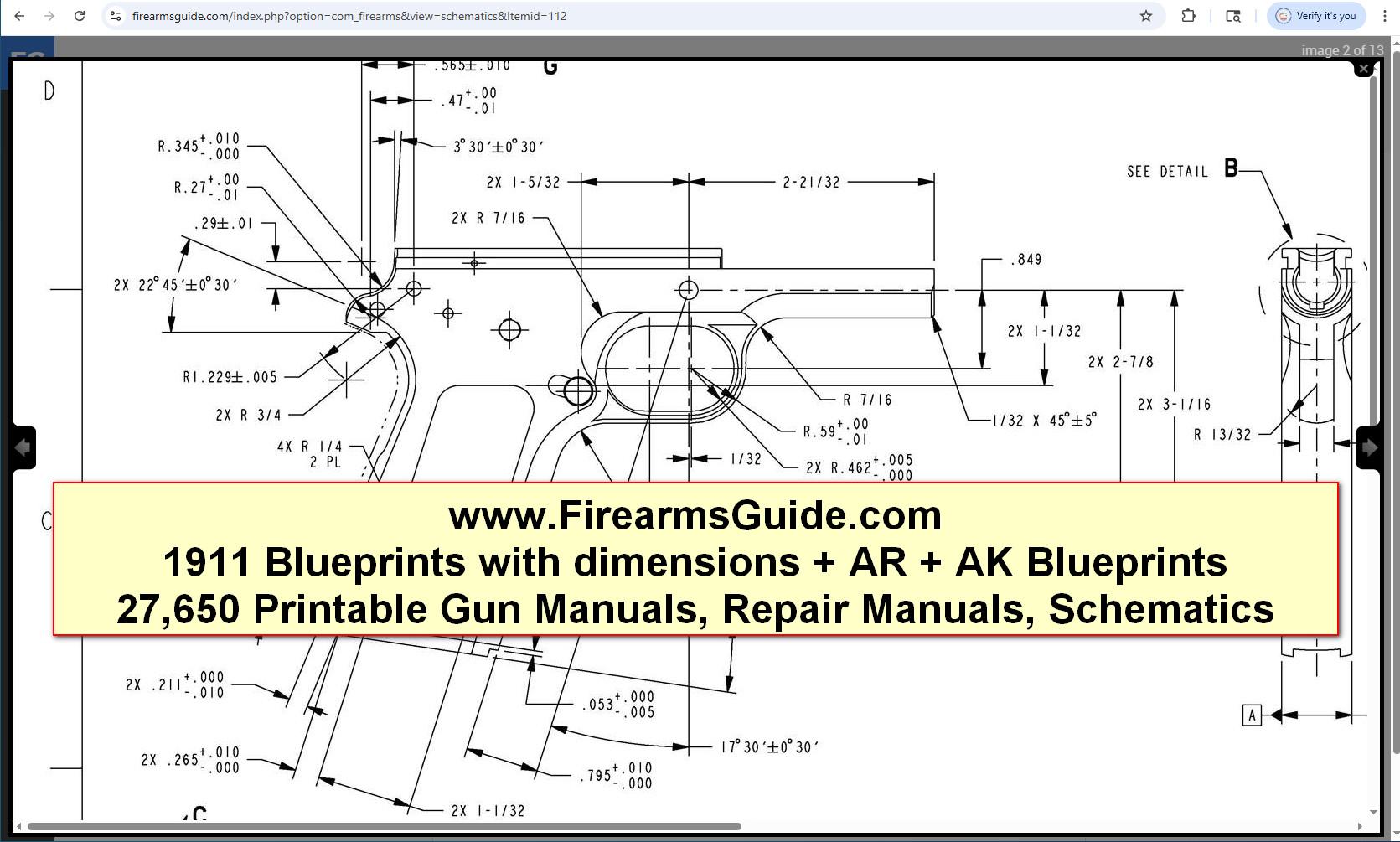
Blueprints remain among the most valuable resources for advanced restoration and technical research.
Factory blueprints often include:
-
dimensions
-
measurements
-
tolerances
-
machining references
-
component relationships
-
engineering details
FirearmsGuide states that its collection includes original blueprints for many well-known firearm platforms alongside exploded schematics and manuals. (Firearms Guide)
Original factory manuals provide information that generic instruction sheets often do not.
Depending on the firearm, manuals may include:
-
maintenance procedures
-
lubrication points
-
inspection guidelines
-
troubleshooting
-
disassembly
-
assembly
-
component replacement
-
adjustment procedures
-
safety information
The library includes many original armorer’s manuals and manufacturer documentation covering numerous firearm brands and historical periods.
Exploded views remain one of the most valuable visual references in gunsmithing.
They allow users to understand:
Combined with original parts lists, these diagrams simplify component identification during maintenance and repair.
Instead of manually browsing hundreds of PDFs, FirearmsGuide offers advanced search capabilities across its firearms database. Users can filter by numerous criteria and compare firearms side by side, making research more efficient for collectors, dealers, enthusiasts, and professionals.
Collectors frequently research:
Historical manuals and catalogs can provide useful context for identifying or restoring collectible firearms.
Gun shops regularly answer customer questions regarding:
-
replacement parts
-
discontinued models
-
firearm identification
-
compatibility
-
maintenance
-
service
Having an extensive technical reference library can reduce time spent searching multiple sources.
The collection includes documentation covering many categories of firearms, including:
-
pistols
-
revolvers
-
rifles
-
shotguns
-
military firearms
-
sporting rifles
-
tactical firearms
-
black powder firearms
-
antique firearms
-
air rifles
-
air pistols
Coverage spans numerous manufacturers and historical eras according to FirearmsGuide’s published information.
For anyone who regularly researches firearms, technical documentation can become one of the most valuable resources in the workshop.
Instead of relying on scattered internet searches, FirearmsGuide.com brings together firearm schematics, exploded views, manuals, blueprints, parts lists, catalogs, ammunition references, firearm specifications, and search tools into a single searchable library. According to the company, users can zoom into high-resolution documents, print reference material, and access a large database covering tens of thousands of technical documents and over 84,000 firearms and ammunition records. (Firearms Guide)
For professional gunsmiths, armorers, firearm collectors, gun dealers, shooting instructors, competitive shooters, hunters, and firearm enthusiasts who enjoy maintaining and understanding their firearms, FirearmsGuide.com aims to serve as a comprehensive reference resource. Whether the task is identifying a small replacement part, studying an exploded parts diagram, consulting an original armorer’s manual, researching a historic firearm, or printing a schematic for the workbench, the platform is designed to provide a centralized technical library for firearm research and maintenance. (Firearms Guide)
Read the full article here
