
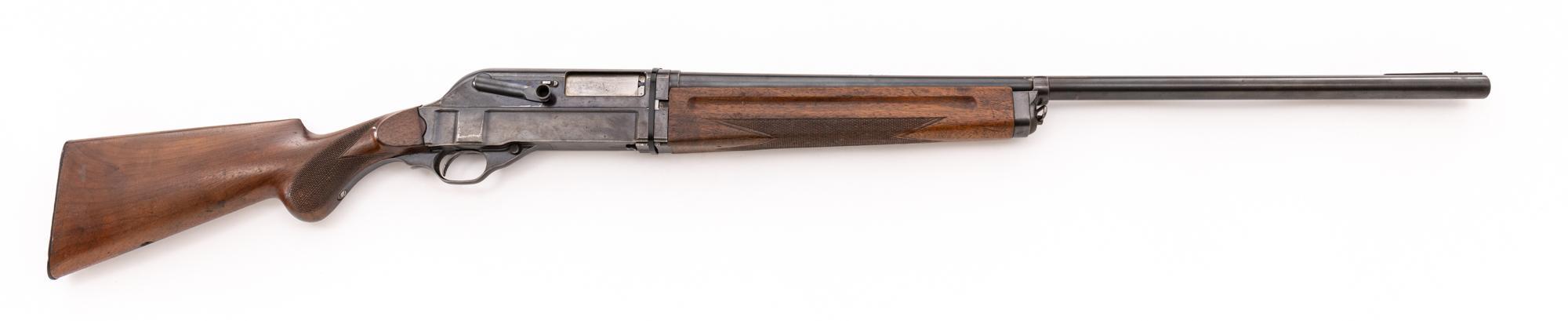
Among early 20th-century firearm innovations, the Walther toggle-action semi-automatic shotgun stands out as an unusual and technically distinctive design. Characterized by its unconventional mechanism and limited production, it remains one of the lesser-documented self-loading shotguns of its era. This article consolidates known historical, technical, and production-related information to provide a structured reference overview.
THE World’s Largest Gunsmithing Library for antique and modern guns with 27,600 printable gun manuals, user manuals, gunsmith manuals, factory repair manuals, blueprints for gun parts with dimensions, schematics, parts lists and old catalogs: https://www.firearmsguide.com/index.php?option=com_firearms&view=schematics&Itemid=112
2. Origins of the Toggle-Action Shotgun
The toggle-action system predates the Walther design and can be traced to several earlier inventors.
The earliest known example is attributed to Hiram Maxim, who patented a toggle-action shotgun in 1886 (U.S. Patent No. 447,836; granted 1891). This design may represent the first conceptual automatic shotgun, predating later commercial developments. However, no confirmed production models or prototypes are known.
A subsequent development came from John Moses Browning, who filed U.S. Patent No. 730,870 in 1899 (granted 1903). Unlike Maxim’s design, a prototype of Browning’s toggle-action shotgun survives and is preserved at the Browning Museum.
In Germany, Carl Hoffmann patented a similarly unconventional toggle-action shotgun (German Patents No. 153025 and 211229, filed between 1903 and 1906). Little is known about Hoffmann or whether a working prototype was ever produced.
None of these early designs entered series production, leaving the Walther system as the only known toggle-action shotgun to reach the commercial market.
3. Development of the Walther Shotgun
The Walther shotgun was developed by the brothers Fritz Walther, Georg Walther, and Erich Walther, owners of the Carl Walther GmbH in Zella-Mehlis.
A total of ten German patents were filed for the design between 1918 and 1921, with the earliest applications submitted in November 1918 and the final patent filed in November 1921. Additional patents were registered internationally, including in the United States.
Although all three brothers were named in various filings, Fritz Walther is generally regarded as the principal designer. Development of the system appears to have required approximately three years before reaching a finalized configuration.
4. Production History
4.1 Manufacturing by Deutsche Werke
Production of the Walther shotgun was not carried out by Walther itself initially. Instead, manufacturing was licensed to Deutsche Werke AG, specifically at its Erfurt facility.
Deutsche Werke was a state-controlled conglomerate formed after World War I, incorporating former imperial armories such as the Erfurt and Spandau rifle factories. Prior to 1918, these facilities produced standard military arms, including Mauser rifles and Luger pistols.
Following the war, military production ceased under the terms of the Treaty of Versailles. Deutsche Werke attempted to transition to civilian products, including firearms such as the Ortgies pistol and the Walther shotgun.
However, production was curtailed by the Military Inter-Allied Commission of Control, which ordered the cessation of arms manufacturing by March 31, 1922. By 1923, firearm production at Erfurt had effectively ended.
4.2 Production Timeline
Although some sources suggest a production period beginning in 1921, evidence indicates that commercial availability likely did not begin before 1922. References from 1921–1922 describe the Walther shotgun as not yet on the market, while contemporary sources identify the Rheinmetall shotgun as the first German semi-automatic shotgun to reach commercial sale.
Production appears to have continued in some form until approximately 1930–1931, after which the model disappears from catalogs.
4.3 Walther’s Role
Period literature suggests that Walther later assumed responsibility for distribution—and possibly assembly or finishing—of the shotgun. However, the exact division of manufacturing responsibilities between Walther and Deutsche Werke remains unclear.
Evidence such as manuals bearing Deutsche Werke markings as late as 1926 suggests that production involvement by Deutsche Werke may have continued beyond the official cessation date, possibly in an unofficial or subcontracted capacity.
5. Production Volume
Serial number data provides the only basis for estimating production. Known examples range approximately from serial number 1043 to 5751. Based on this range, total production is generally estimated at fewer than 6,000 units.
It remains uncertain whether numbering began at 1 or at a higher baseline (e.g., 1000), leaving total production figures approximate.
6. Variants and Design Evolution
6.1 Mechanical Variants
At least three structural variations are documented:
- Standard model – the most common configuration
- Reinforced receiver variant – featuring an additional reinforcing rib (rare)
- Late-pattern variant – illustrated in period literature with refined contours, though physical examples remain unconfirmed
Additionally, Walther introduced an improved version designated “Model Ia,” incorporating upgraded internal components to address reliability issues reported in earlier production.
7. Receiver Markings
Three primary receiver markings have been observed:
- “DEUTSCHE WERKE ERFURT / WALTHER’S PATENT”
- “WALTHER’S PATENT”
- “Automat Cal. 12” (in recessed panel)
- Applied over earlier markings in some cases
Additional reported markings (“Automatische Flinte” and “Waltherflinte”) remain unverified.
8. Barrel and Proof Markings
All known examples feature standard German proof marks of the period, including:
- Imperial eagle
- Crown/W (choked barrels)
- Crown/S (smooth bore)
- Crown/U (inspection mark)
- “Nitro” marking for smokeless powder
Post-1923 barrels include date codes and additional inspection markings.
Barrels are typically marked:
- “Cal. 12 – 65 mm (2½”) KRUPPSTAHL” (earlier)
- “Cal. 12 – 65 mm (2½”) SPEZIALSTAHL” (later)
All barrels are 70 cm (27½ inches) in length with full choke (0.8 mm constriction).
9. Additional Features
- Safety markings: “S” (safe) and “F” (fire)
- Some examples include “GERMANY” export markings
- Chambering: predominantly 12 gauge, 65 mm
Although no confirmed production models exist, at least one contemporary reference mentions a 16-gauge prototype.
10. Conclusion
The Walther toggle-action shotgun represents a rare instance of an unconventional mechanical system reaching limited commercial production. Despite earlier conceptual designs by Maxim, Browning, and Hoffmann, Walther’s version appears to be the only toggle-action semi-automatic shotgun manufactured in quantity.
Its production history remains partially unresolved, particularly regarding the roles of Walther and Deutsche Werke. With fewer than 6,000 units likely produced and limited surviving documentation, the Walther shotgun continues to be a subject of interest for collectors and researchers alike.
Read the full article here
