

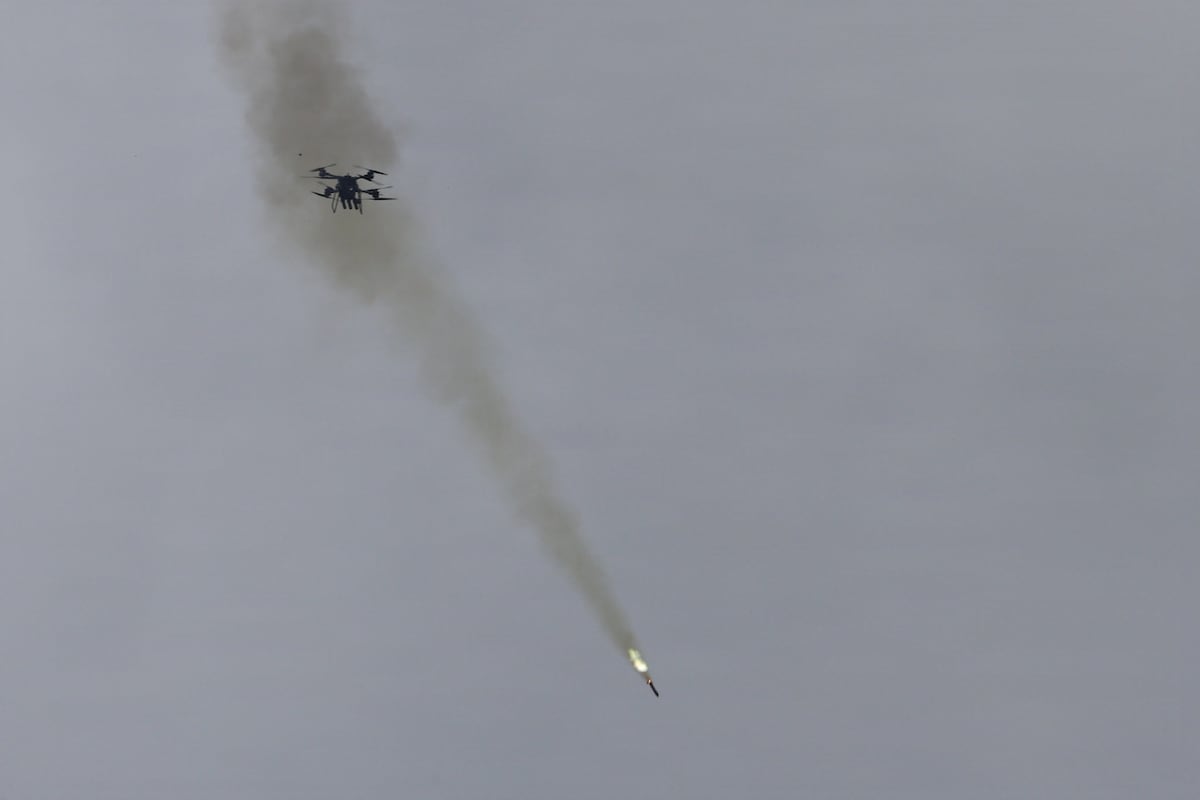
Though the drone was designed to haul supplies across the battlefield, the Army recently tried adding a new capability to its body to see if it could do something else entirely: fire rockets.
During an experiment at Fort Rucker, Alabama, defense industry partners successfully attached a three-shot weapon system on a Tactical Resupply Vehicle, or TRV 150 drone, in an attempt to fire 70 millimeter rockets, according to an Tuesday Army release. The move is aimed at bringing more capabilities to lower echelons of command.
“Normally, industry waits for requirements to come out of the government, and they meet that requirement,” said Clark Dutterer, the vice president of business development for Survice Engineering, the company that manufactures the drone. “In this case, we saw that there was something that we could prove out, a new capability, and we didn’t want to wait for a requirement. We self-funded this to go ahead and do that.”
The TRV 150 is a logistics drone, capable of carrying 150 lbs, and fielded to the Army and Marine Corps. Rob Baltrusch, the company’s chief engineer, called the drone the sky’s “pickup truck,” in the release, adding that the system is heavily dependent on autonomous calculations that he said removes “a lot of the pilot duties away from the soldier.”
“They can literally give it a grid coordinate, wait, and it tells you if it can make it there, delivers the payload, and calculates the route,” he said.
The Advanced Precision Kill Weapon System, or APKWS, which is the platform that fires the munitions, is currently able to be mounted on Apache helicopters, but if it can be successfully used on drones, the system can be used across more formations.
The Army said the project has been in development since January 2025 and last May, the system successfully fired with a single-shot launcher.
The new testing comes as military officials push to speed up drone development and streamline the fielding process.
In an attempt to keep up with ever-evolving autonomous aircraft technology, the Pentagon in 2025 established the Joint Interagency Task Force 401, which consolidates the acquisition process across the services. The Pentagon has also begun the process of building a drone testing ground in Mississippi.
It also introduced a counter-drone marketplace, where the U.S. and its allies can connect to purchase interoperable technology.
Eve Sampson is a reporter and former Army officer. She has covered conflict across the world, writing for The New York Times, The Washington Post and The Associated Press.
Read the full article here
