

MANILA — Australian defense leaders have pledged to spend big money on drone defenses, as unmanned technology has exposed a new Achilles’ heel in militaries around the world.
Minister for Defence Industry Pat Conroy said the plan is to “more than double the funding that we’re allocating to counter-drone defenses,” to the tune of A$7 billion.
These figures – $5 billion in U.S. dollars – emanate from the Integrated Investment Program (IIP) released by Canberra on Apr. 16.
As the Australian Defence Force (ADF) seeks weapons able to count medium-sized drones and small-drone swarms when deploying overseas or to protect domestic infrastructure, Conroy touted two development contracts on Apr. 21.
AIM Defence was awarded an A$21.3 million contract for its Fractl laser system, whilst Sypaq Systems received a A$10.4 million deal to develop an interceptor drone.
The fourth-generation Fractl is a portable, high-energy laser system able to track a dime-sized object at speeds exceeding 100km/h, and powerful enough to burn through steel.
The funding will enable AIM Defence to enhance Fractl’s capability and combat readiness to counter individual and swarms of drones.
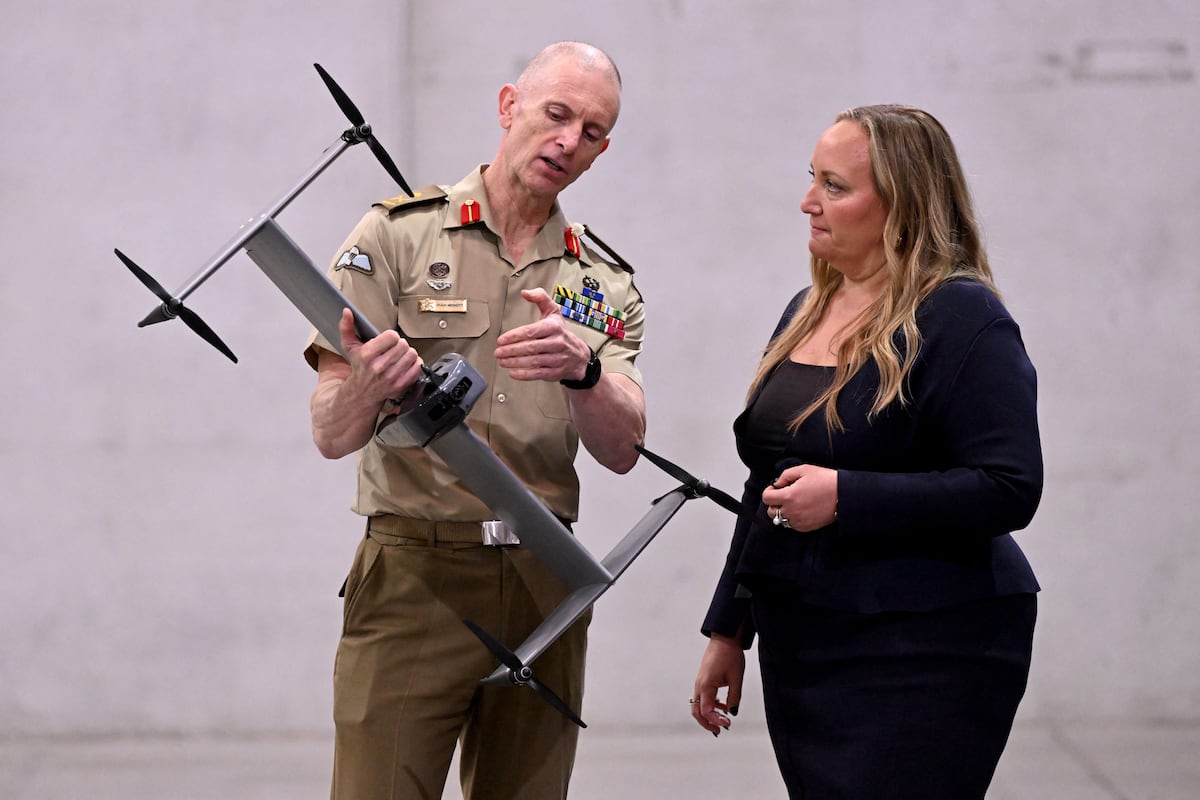
As for Sypaq, the Department of Defence said it will “develop the Corvo Strike, an interceptor drone designed to track, target and destroy larger drones now commonly employed on battlefields.” This winged interceptor powered by four propellers is also a loitering munition.
Both products will eventually integrate into a command-and-control system being developed under the Army’s umbrella Land 156 counter-unmanned aerial system (C-UAS) program.
Conroy’s A$7 billion “for drone defenses” also includes diverse capabilities like naval missiles, the NASAMS air defense system, a new medium-range air defense system and upgrades to fighters, for example.
Dedicated counter-drone systems are just one of seven categories listed in the IIP. That document mentioned the “acquisition and introduction of dismounted and vehicle-mounted systems to protect deployed forces from low-altitude aerial threats, including uncrewed air systems and helicopters.”
The two contracts worth a combined A$31.7 million pale in comparison to the A$3.9 billion going toward AUKUS submarines this year alone. Furthermore, they are only development contracts, so the Fractl and Corvo Strike are not yet ready for widespread fielding.
“With the war in Ukraine and conflicts in the Middle East showing how uncrewed aerial systems are increasingly being employed in conflict, the development of sovereign counter-drone solutions is essential to ensure the ADF can detect, assess and respond to these threats,” Conroy stated.
Ukraine is expected to produce an estimated 4.5 million drones and counter-drone systems in 2026.
Gordon Arthur is an Asia correspondent for Defense News. After a 20-year stint working in Hong Kong, he now resides in New Zealand. He has attended military exercises and defense exhibitions in about 20 countries around the Asia-Pacific region.
Read the full article here
