

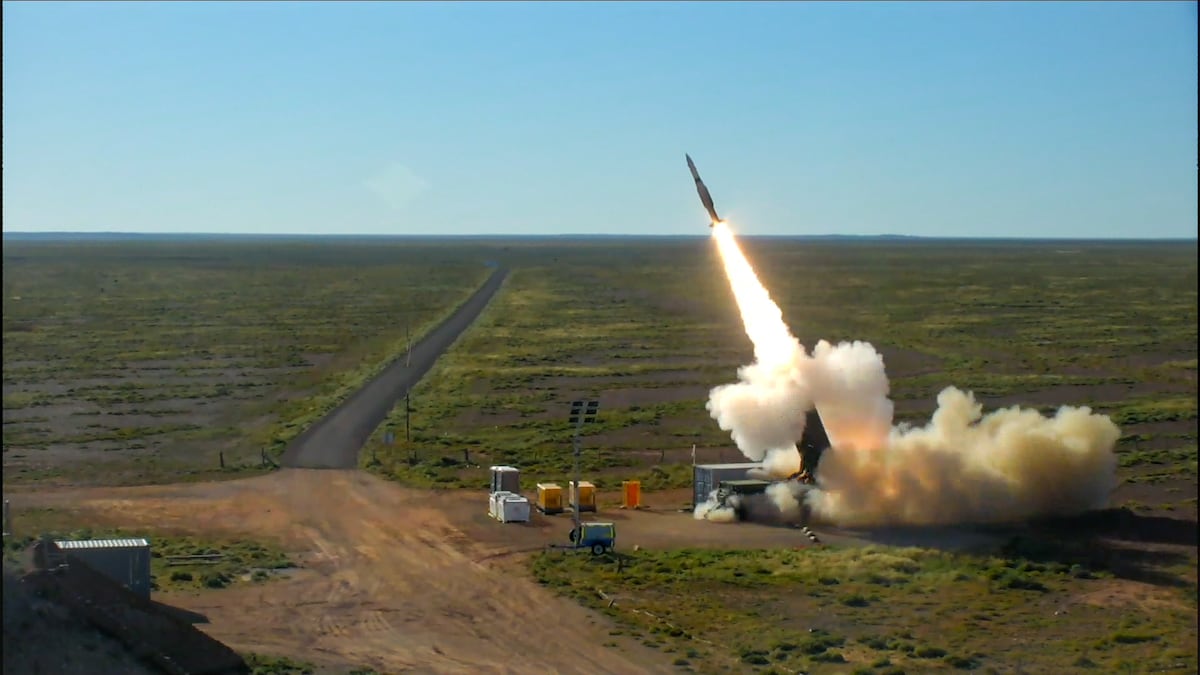
CHRISTCHURCH, New Zealand — Australia successfully tested a “Frankenstein” medium-range air defense system last month, harnessing existing and new capabilities in a way nobody has tried before.
After dawdling over the need to improve its ground-based air defense (GBAD) capabilities, Australia — with American assistance — is prioritizing a hybrid solution that takes sensors, software and weapons already in the Australian inventory.
This first-of-type integration, which successfully fired an SM-2 interceptor missile, offers an alternative to buying expensive Patriot-type air defense systems, for example.
A Department of Defence press statement said the SM-2 test “followed a period of close collaboration, innovation and engineering to produce this successful prototype.”
Lockheed Martin and the U.S. Navy were heavily involved, for example.
Piece of the puzzle
During Exercise Taipan Strike 2026, an SM-2 was launched from a Derringer trailer-mounted launcher – also called the Expeditionary Launch System – at the Woomera test range in the south of Australia.
To shoot down a BQM-74E target drone, the SM-2 was controlled by a virtualized Lockheed Martin Aegis combat system, and guided by a phased-array radar from Australian firm CEA Technologies.
RELATED
Aegis, normally utilized aboard warships, was deployed in a small-scale, expeditionary form factor. The Aegis test setup was based on the baseline version found on the Australian navy’s Hunter-class frigates and Hobart-class destroyers.
In a statement to Defense News, Lockheed Martin said this approach “unlocks cross-service integration and interoperability, delivering greater capability and value.”
Jeremy King, chief executive of Lockheed Martin Australia and New Zealand, also remarked that “this prototype system leverages existing weapons, launchers and command and control. It can fire any of the weapons currently fielded on the Hobart-class destroyers or future Hunter-class frigates.”
This is an important revelation for the Royal Australian Navy, as the service has the SM-2 Block IIIB and Block IIIC missiles in its inventory, as well as the SM-6.
The SM-6 could now be considered a candidate for an Australian defense against ballistic missiles. However, this would require a strike-length variant of the Mk 41 Vertical Launching System on the mobile Derringer launcher.
Taking aiming at GBAD
The novel Australian air-defense technology pairing appears to have been on the drawing board for a while, at least conceptually.
“When you have a limited [missile] inventory, you want to be able to be as flexible as possible, so that might be using maritime stocks on land, it might be using land stocks in the maritime domain,” Air Vice-Marshal Nick Hogan, head of Air Force Capability told Defense News last year. “There are many options to go forward. What we’re trying to do is make sure, where possible, we can get the biggest return on investment using sovereign capabilities.”
Australia’s 2023 Defence Strategic Review urged, instead of “pursuing a long-term, near-perfect solution at unaffordable cost,” that Canberra should allocate sufficient resources “to deliver the initial capability in a timely way”.
Later, the 2026 National Defence Strategy called for “accelerated introduction of medium-range, ground-based, active missile defense through investment in missile launchers and munitions and integrating them with … command-and-control systems.”
Missile threats
The same document identified missile defense as a priority, with a need to protect critical defense infrastructure from long-range and high-speed missile threats.
In fact, the July 9 timing of Australia’s announcement of the SM-2 test was significant. The test had actually been conducted a month earlier, but Canberra publicized it just three days after a Chinese submarine hurled a nuclear-capable ballistic missile deep into the South Pacific.
After the Chinese launch, Australia’s opposition party warned how “dangerously exposed” military bases are and the country’s insufficient ability to counter ballistic or cruise missiles.
Australian defense officials stress that the new air-defense weapon is still a work in progress. However, the test reduces technical risk and validates the prototype system’s performance, as Australia weighs cost-effective medium-range GBAD options.
Lockheed Martin added that this hybrid solution represents a “robust air defense capability option paving the way for continued integration efforts.”
The significance of this demonstration extends beyond Australia, as Lockheed Martin said “it demonstrates the potential for enhanced air defense capabilities that can be tailored to meet the specific needs of countries and regions.”
Gordon Arthur is an Asia correspondent for Defense News. After a 20-year stint working in Hong Kong, he now resides in New Zealand. He has attended military exercises and defense exhibitions in about 20 countries around the Asia-Pacific region.
Read the full article here
