

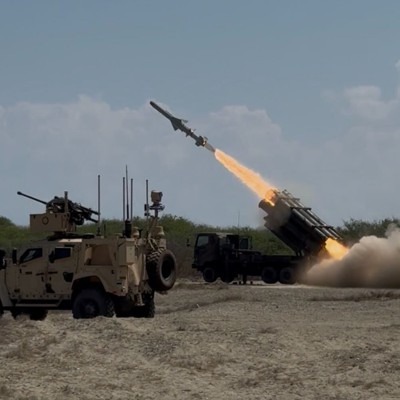
PAOAY, Philippines—Right on cue, the missiles blazed from their launcher, kicking up sand behind them. A few minutes later, cheers from the VIP pavilion confirmed that the Japanese Type 88s had hit their target, sinking a decommissioned Philippine ship about 46 miles away.
Last week’s mock attack marked the first time Japan has fired the missile outside its own borders. Part of the annual Balikatan exercise, it came just two days after Japanese infantry troops participated in a live-fire counter-landing wargame on a nearby beach, practicing to defend a shore against invasion from the sea. And it was just one day after the U.S. Army fired a Tomahawk long-range missile from the service’s Typhon launcher in a different part of the country.
“Balikatan 2026 marked a strategic evolution from a bilateral exercise to a full-scale, multinational mission rehearsal for the defense of the Philippines,” U.S. Indo-Pacific Command boss Adm. Samuel Paparo said Friday at the closing ceremony. “That growth reflects the security environment. It reflects the sovereign choices of free nations.”
The firing was an important step for the Japanese self-defense forces and part of the “continuing march of Japan into a more high-profile status within the region,” said Brad Glosserman, senior advisor for Pacific Forum.
Even before 2014, when Japan’s cabinet lifted the self-imposed prohibition on collective self-defense, the country has been making a “slow,” even “subterranean” creep toward action by Japan’s military, Glosserman said. Shinzo Abe made it a key part of his agenda as prime minister, and the shift has accelerated in recent years. Now Japan is acquiring the capabilities and reorganizing the national security infrastructure to make it happen.
“It’s one thing to say you’re going to do it, and then it’s another thing to be able to do it,” he said. “And they’re doing—they’re both showing the intent and demonstrating the capacity to do that.”
Standing in the sweltering sun in front of the Japanese missile launcher after the exercise, Philippine defense secretary Gilberto Teodoro Jr. told reporters that now that his country’s military has seen how the Type 88 works, “it is something that we can interoperate with in the future.”
“I’m very, very proud and happy that we were able to pull this off for the first time, and it will only get larger in scope, with more partners,” Teodoro told a group of international journalists. “You can see this is a very complicated area to operate in. But can you imagine if there’s a, God forbid, a natural calamity, we will know how to help each other in this area. It also upgrades the skills and the awareness of our troops, in the capabilities that our allies have, and in coordination mechanisms with the different participants. So it’s a complex exercise. The culmination was simple, initial firing, but to get there was very difficult, and we surmounted the obstacle.”
Japanese Defense Minister Shinjiro Koizumi watched the exercise but did not speak to reporters afterward.
Lt. Col. Ishikawa Daisuke, a public affairs officer with the Japanese joint staff, said in a written release that firing the surface-to-ship missile in the exercise “allowed us to validate our tactical integration with the U.S. and Philippine forces…sequencing our capabilities provides that our defense systems can operate seamlessly together, which is essential for defense of the maritime domain.”
Not everyone saw the demonstration as a step forward. Sarang Shidore, who leads director of the Global South Program at the Quincy Institute for Responsible Statecraft, said firing missiles like the Type 88 and the Tomahawk in the Philippines, and deploying weapons like the Marine Corps’ NMESIS—a shore-to-ship anti-missile system that was displayed near the Type 88 during the maritime strike here in Northern Luzon—was overly provocative.
While the U.S. has a role to play in helping the Philippines deter China from continuing its gray-zone tactics in the South China Sea, Shidore told Defense One, “my problem is with these big guns, these big missile systems, which are basically, to me they’re Taiwan-specific weapon systems. They are for a major interstate war between the U.S. and China, and that’s likely to only happen over a Taiwan scenario.”
“My argument is that these missile platforms don’t align, actually, with South China Sea goals, which are separate from the Taiwan question. And do it’s inadvisable for the United States to think of the Philippines as simply an extension of Japan, if you will, to fight the Taiwan contingency.”
Still, Shidore said, “the greatest significance of this Balikatan has been such, such a deep involvement of Japan in the actual combat dimensions of it.”
China, predictably, criticized Japan’s involvement in the largest-ever Balikatan, saying the countries participating were “playing with fire.” Later, the country sent armed anti-ship bombers over the Scarborough Shoal.
But at the maritime strike, Teodoro rejected any characterization of Balikatan as “militarization” instead of “national defense.”
“There’s always a claim of militarization, but it’s under the control of civilian authorities, and these things should have been exercised and done a long time ago, this being an archipelago. …The claims of militarization are totally misplaced at this day and age, when we are open, transparent with the exercises, save for operational security,” he said. “For us, for the Philippines, it’s interoperability for Philippine resilience…. Insofar as we have convergence with our like-minded partners, it’s our share, and helping us to punch with our own weight in defending ourselves and to contribute to regional peace and stability.”
Gen. Romeo Brawner Jr., chief of staff of the Philippines military, said in a written release that the exercise “was never simply about conducting activities.” Instead, he said, “it was about strengthening the ability to respond together in real, complex conditions. And that matters because in today’s security environment, readiness cannot be improvised.”
Read the full article here
