

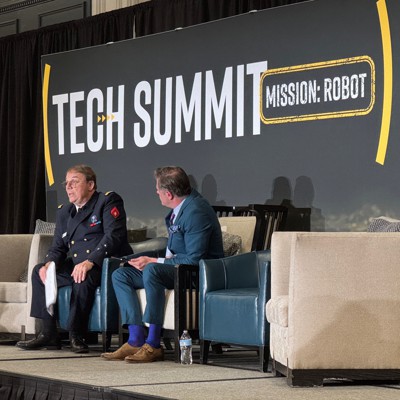
NATO has “really changed a lot in the last three to four years,” since Russia’s invasion of Ukraine forced the alliance to rethink how it learns, experiments, and operates, a top NATO transformation official said.
Now the alliance is moving away from long, platform-centered modernization cycles and toward faster experimentation, interoperability, and “system-of-systems” approaches, said Maj. Gen. Dominique Luzeaux, NATO’s digital transformation champion and special advisor to the Supreme Allied Commander Transformation. He spoke Tuesday at the Defense One Tech Summit in Arlington, Virginia.
Luzeaux pointed to Ukraine’s ever-increasing use of unmanned ground, air, surface, and undersea systems—and how the main lesson is more than just drones are useful.
“What is important is to have an integrated, multi-domain robotic ecosystem,” Luzeaux said. “Because it’s not just one drone making the difference. It’s all the drones being together, the right number, at the right place, at the right time, making a true difference.”
Another major lesson is that war is about ever-shorter innovation cycles.
“If we look at Ukraine in the first year,” he said, they were mostly using Soviet weapons and “more or less losing the battle.” But they learned to evolve, and then Russian forces followed suit. “So after two years, the Russians also had changed their own innovation cycles, and then it was innovation cycle against innovation cycle.
“In order to not lose everything, Ukraine had to go from system-oriented innovation to a much wider innovation—not to innovate [just] on the tactical, or very strict tactical, platform level, but to have a more global [approach] and to be able to do strategic, operational, and tactical levels together.”
That’s what NATO is now trying to do, Luzeaux said.
“So we used to have very long-term programs,” he said. “And now what we do, we always have some long-term programs, of course, for major investments, but we also have much shorter-term cycles, experimentations, exercises.”
Luzeaux pointed to NATO efforts in layered counter-UAS experimentation, which he said tests different approaches every two or three months.
The shift is also architectural. He said NATO is moving “from a platform-centric to a system-of-systems world,” in which the key problem is not any single weapon, sensor, or vehicle, but how those assets are orchestrated.
“What is important is the orchestration between the different assets,” he said.
That means designing architectures that separate functions from platforms—for example, using 5G antennas not just for communications nodes, but also as sensors.
NATO’s Allied Command Transformation, Luzeaux said, is focused on helping the alliance connect national capabilities into coherent, interoperable forces. NATO must be able to make assets from different countries work together, such as pairing a U.S. drone with a German command-and-control system and a French sensor.
“This is where we put the glue between the different things,” he said. “Our role is to design all the things that help put together the various assets which are brought by all the countries in order to have something coherent.”
Asked whether alliance members are learning the lesson quickly enough, Luzeaux said yes, but added that NATO still must learn faster.
“What we need is a continuous learning and adaptation model,” he said. “Continuous experimentation, continuous learning, which is very important.”
The same pressure is changing NATO’s approach to standards. Luzeaux said the alliance has long been known for having “too many” standards and that they often took too much time to implement.
“Part of the new policy in NATO is to take standards—so international standards and standards from the civilian world, from the commercial world—and use them, adopt them, not adapt them,” he said.
Exercises also matter, he said, because they standardize procedures for forces from different countries to fight together.
Asked how quickly NATO can develop standards for threats such as Shahed drones, Luzeaux said the alliance is pursuing both short-term reactive initiatives and longer-term efforts that can be integrated into broader capability programs.
He cited a Baltic Sea effort, launched last year as an experiment and now used by several northern countries, that uses uncrewed surface vehicles to patrol and detect Russia’s shadow fleet.
Read the full article here
