

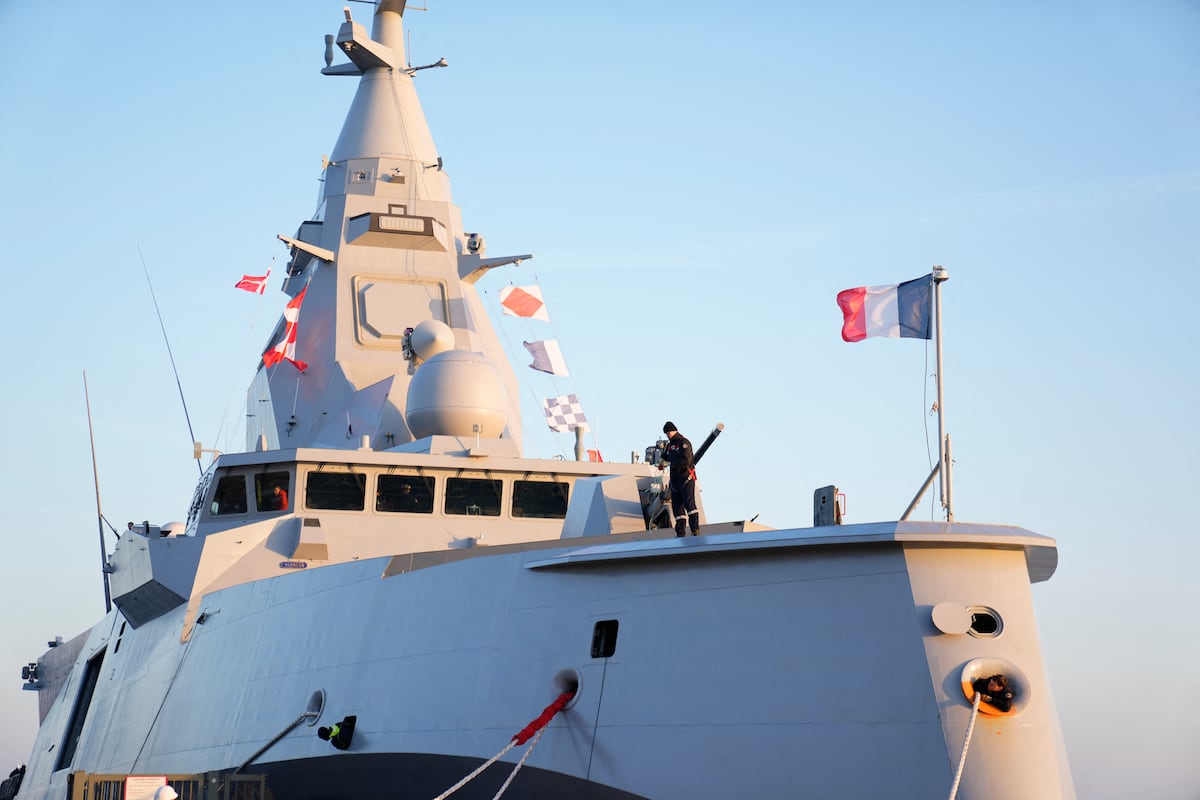
PARIS — Sweden has picked France’s Naval Group to supply four of its FDI frigates in a deal that could be worth more than 40 billion Swedish kroner, or around US$4.2 billion, with the French offer beating proposals from Spain’s Navantia and the United Kingdom’s Babcock International.
The frigates are expected to cost a little over 10 billion Swedish kroner each, with the final price depending on the integrated equipment and systems, Swedish Defence Minister Pål Jonson said in a press conference in Stockholm on Tuesday. The vessels will be equipped with MBDA’s Aster 30 missiles for long-range air defense.
The frigate purchase represents one of Sweden’s biggest defense investments since the Gripen fighter jet in the 1980s and will triple the country’s air-defense capabilities, Prime Minister Ulf Kristersson said. For Naval Group, the selection is a welcome win after Norway in August last year picked the U.K.’s Type 26 frigate, primarily manufactured by BAE Systems, over the smaller French design.
Rapid delivery is “absolutely essential given the very serious security situation we are currently in,” Jonson said. With the FDI, “Sweden is acquiring a highly advanced surface combatant for which an adversary would also need to allocate significant resources to counter,” he said.
Sweden picked the Naval Group vessel, known in French as the Frégate de Défense et d’Intervention, due to a combination of delivery time, an active production line ensuring a “very high degree of delivery reliability,” and an integrated and proven air-defense system, according to Jonson. He also cited the possibility of sharing costs with FDI operators France and Greece as important.
The first frigate in what will be named the Luleå class is expected to be delivered in 2030, based on the bid, with one frigate delivered per year, Jonson said.
France has been ordering Swedish equipment recently, including a contract for two of Saab’s GlobalEye airborne early warning and control aircraft in December, with an option for two more.
Jonson said the time of delivery has been the main consideration for the choice of the French frigate, rather than offset agreements.
The Swedish Defence Materiel Administration will now start negotiations with France and Naval Group. The final price will depend on the subsystems and armament, with the acquisition a “very large deal” that will strengthen ties with France and open the door to further cooperation, according to the defense minister.
Kristersson said he put in a call to French President Emmanuel Macron this morning so the French president wouldn’t learn of the Swedish decision via the media.
The Swedish prime minister said there’s no connection between the frigate pick and discussions around cooperation regarding France’s nuclear capabilities.
The new frigates will make the Swedish Navy and armed forces significantly stronger, also because Sweden plans to continue to use the existing Visby corvettes “for a long time to come,” alongside the future Luleå class, according to Jonson. The corvettes will be upgraded with additional air-defense capabilities, Swedish Chief of Defence Gen. Michael Claesson said.
Kristersson, Jonson and Claesson spoke at a press conference held on the Visby-class corvette Härnösand moored on the historical Skeppsbron quay in Stockholm. The Swedish corvettes are 73 meters long and displace 650 tons.
The new surface combatants are expected to be capable of operating in NATO’s entire area of operations, and that requires larger vessels than the Visby-class corvettes, with improved long-range air defenses, according to Jonson. The FDI is 122 meters long and displaces around 4,500 tons, smaller than many recent frigate designs being built or planned in the U.K., Spain, Italy and Germany.
In addition to the Aster 30, which Jonson described as capable of shooting down ballistic missiles and comparable to the land-based Patriot air-defense system, the frigates will be equipped with the CAMM-ER medium-range air-defense system, also from pan-European missile maker MBDA.
The Aster 30 has a “completely different” range compared to what the Visby corvettes can offer and can be integrated in NATO’s integrated air and missile defense system, said Claesson, who didn’t answer a question about how many vertical launch cells the Swedish frigates will carry.
In the contract talks, Sweden will stipulate inclusion of Swedish components including Saab’s RBS-15 anti-ship missile, Torped 47 lightweight torpedo, Giraffe G1X compact radar and Trackfire remote-weapon station, as well as the BAE Systems Bofors 57mm naval gun and 40mm cannon, Jonson said.
Claesson noted the FDI has an integrated command-and-control system that can interface with NATO systems, and Sweden will be “very careful” about system compatibility.
“The frigates mean that we get a significantly greater freedom of action to be able to participate in a much larger range of the tasks that NATO sets,” Claesson said. He said one reason to move forward with the frigate purchase was because of NATO capability targets.
France had previously touted its ability to supply Sweden with a fully equipped and armed frigate in 2030, and Naval Group said in October it can produce two of the FDI frigates per year.
For the Swedish frigate acquisition, Spain’s Navantia had offered its Alfa 4000 model, with a length of 120 meters and a displacement of 4,300 metric tons, while the United Kingdom’s Babcock had pitched its Arrowhead 120 model for Sweden, with a length of 124 meters and a displacement of 4,650 tons.
France placed an order for its fifth FDI frigate in March, the final vessel currently planned in the class for the French Navy, with delivery planned for 2032. The French budget for five vessels was €4.28 billion ($5 billion), according to the 2019 defense spending plan, putting the price at around €850 million per unit.
Greece in November exercised an option for a fourth FDI frigate, and in March sent the frigate Kimon, its first vessel in the class, to Cyprus.
The FDI is equipped with a Thales Sea Fire radar with four fixed panels, and France describes the frigate as fully digital, equipped with “significant computer power” to process sensor data.
Rudy Ruitenberg is a Europe correspondent for Defense News. He started his career at Bloomberg News and has experience reporting on technology, commodity markets and politics.
Read the full article here
