

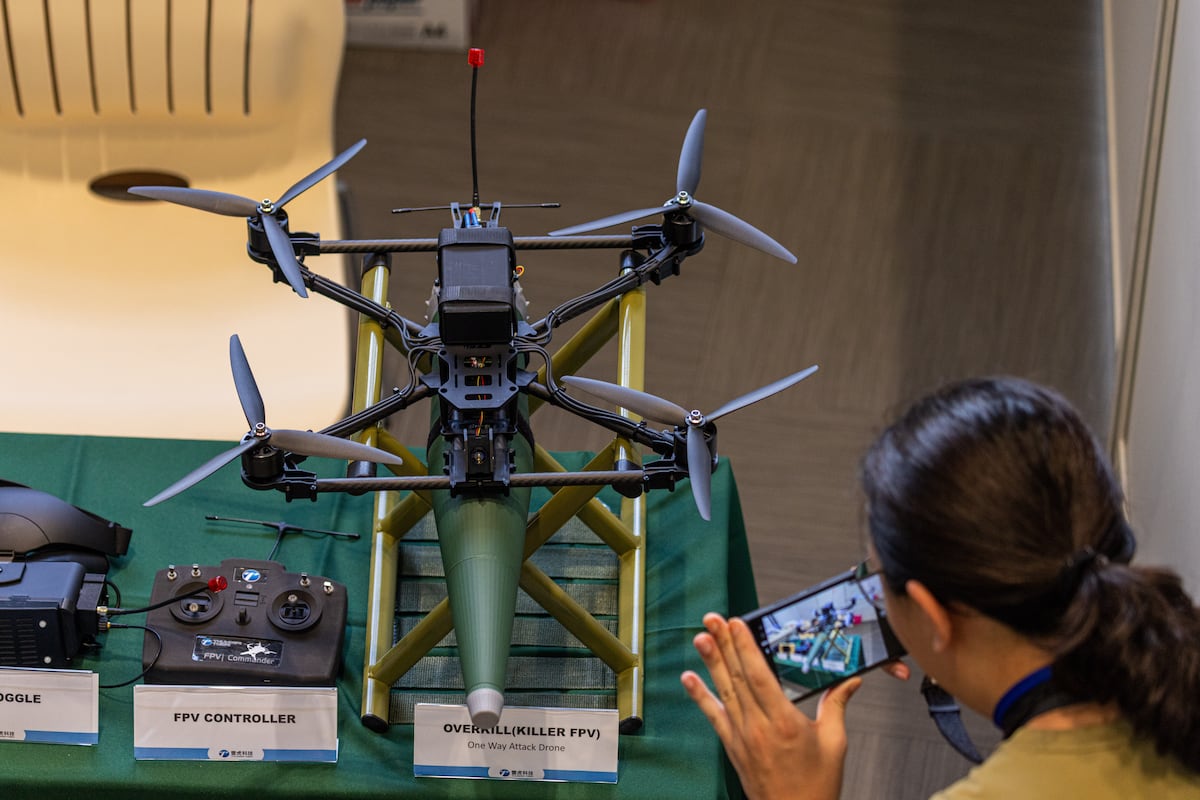
NEW TAIPEI CITY, Taiwan — The United States has been selling advanced weapons to Taiwan for years, with large American contractors churning out more of the higher-end equipment than the island could ever produce alone for its defense against its military rival China.
Now Taiwan, an all-purpose manufacturing hub since the 1980s with an emphasis on high-tech hardware, is positioning to sell homegrown drones to the U.S. military so it can avoid the dominant Chinese supply chain, analysts and recent transactions indicate.
“Foreign governments value Taiwanese drones mainly because of Taiwan’s strong information and communication technologies foundation and its role as a trusted supply chain partner,” said Lee Yi-ching, an analyst with the Market Intelligence & Consulting Institute in Taipei.
“From a supply-chain perspective, Western countries have increasingly prioritized reducing their reliance on Chinese drones and Chinese-made components,” Lee said. “Amid concerns over information security, wartime supply chain resilience and national security, the trustworthiness of component sources has become an important factor for Western governments when evaluating drone suppliers.”
China-headquartered DJI makes at least 70% of the world’s commercial and civilian-use drones, including for American consumers.
On June 4, the de-facto U.S. embassy in Taiwan said the Virginia-based Association for Uncrewed Vehicle Systems International and the Industrial Technology Research Institute in Taiwan were working together on drone technology.
A day earlier, domestic media had reported that Taiwan’s Metal Industries Research & Development Center signed a memorandum to team up with American defense technology company Anduril.
“We recognize that Taiwan’s strengths in advanced manufacturing, electronics, and agile production make it a natural and indispensable partner,” the de-facto embassy’s director, Raymond Greene, said in a June 4 statement.
And last year, Taiwanese manufacturer Thunder Tiger’s Overkill-brand kamikaze drone set a precedent for Asia by meeting the Pentagon’s certification requirements.
The Taiwanese drone industry was worth NT$12.9 billion (US$410 million) last year after growing 2.5 times over 2024, and drone exports racked up NT$2.95 billion, the island’s premier, Cho Jung-tai, said in a statement on April 30. Taiwan has worked on drones of some type since the 1990s.
In the first quarter this year, the United States was the No. 3 importer, with shipments worth $2.58 million, after Poland and the Czech Republic.
Taiwan aims to make NT$40 billion worth of drones by 2030, Cho added, noting that the island has a “complete supply chain.”
The U.S. military is paying special attention to drones in light of their use in the Russia-Ukraine war, analysts said, and U.S. legislators proposed in 2025 expanding domestic drone production to 1 million units per year.
But that ambition would “take some time for the U.S. industry to expand that scale, particularly as they don’t have a strong commercial UAV industry already in place,” said Jeremiah Gertler, senior advisor with the U.S.-based aerospace consulting firm AeroDynamic Advisory.
“It would not be surprising in that case for the U.S. to ask allies to provide production capacity and or finished products to act as a bridge while the U.S. got its production in place,” Gertler said.
Taiwan could offer the United States an “at-scale” solution for situations where swarms of UAVs are needed for air and sea combat and China will watch how well they perform, predicted Doug Barry, an international trade consultant and adjunct professor at George Washington University.
Taiwanese manufacturers can make drones in small or large batches, a possible advantage over other suppliers, said Sean Su, an independent tech analyst in Taiwan.
But its “biggest appeal” is the lack of China in the supply chain, he said. U.S. officials fret over data security, possible espionage and supply chain risks posed by any military gear sourced from China.
“Drones in general are very low cost, so it doesn’t matter if China is much cheaper,” Su said. Taiwan’s drones “are in a range that is already dozens of times cheaper than many other platforms with arguably even more capability,” he added.
Read the full article here
