

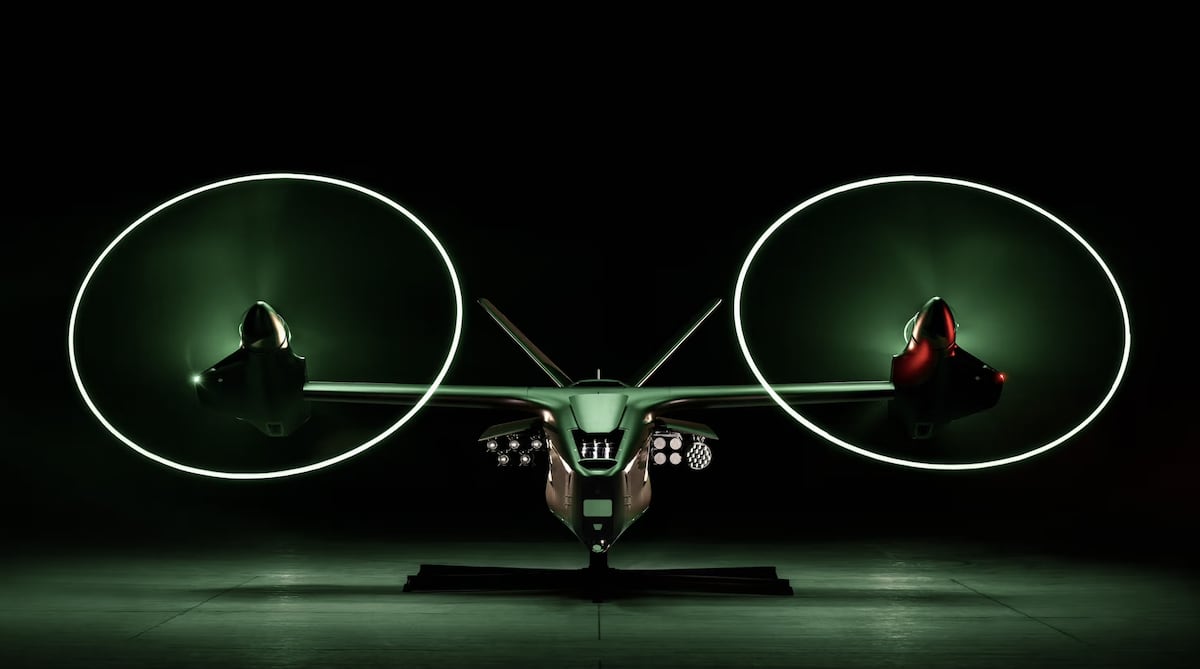
LONDON — The U.S. military will soon field a drone wingman that expands well beyond the fixed wing platforms of the Combat Collaborative Aircraft program.
Anduril started the 2026 Farnborough Airshow with a splash on Monday when it unveiled an autonomous attack rotorcraft, dubbed Thunder, designed to operate with current and next-generation crewed attack helicopter platforms.
Developed in partnership with Archer Aviation as a vertical take-off and landing aircraft, Anduril’s military edition is a Group 5 autonomous attack rotorcraft built with a series hybrid-electric powertrain system and tilt rotors that allow it to operate in any environment while keeping up, when needed, with faster rotary aircraft like the Apache and Cheyenne II.
“The proliferation of drones in land warfare has brought maneuver to a stalemate, extracting a significant toll in terms of both man and machine,” a company release stated. “Attack helicopters and their crews, long the lifeblood of maneuver warfare, are increasingly held at risk by a combination of loitering munitions, cheap air defenses, and ubiquitous persistent ISR platforms that have rendered the near-surface domain one of the most lethal places on the battlefield.”
Anduril officials said the Thunder, which has been in development since 2024, will provide much-needed relief to that toll courtesy of its ability “to fight alongside crewed aircraft, as part of an autonomous formation, or independently across missions.”
The Thunder’s mission suite will include long range mass effects delivery; fire support; intelligence, surveillance and reconnaissance; maritime patrol; anti-submarine warfare; search and rescue; and contested cargo and logistics.
On its weapons side, modular internal main and nose payload module bays will allow the Thunder to be armed with everything from precision munitions and electronic warfare payloads to air-launched effects, rockets and counter-drone munitions.
Citing configurable payload examples, Anduril officials said one Thunder operating on the battlefield could carry 10 air-to-ground missiles, 16 launched effects or 76 70mm rockets, in addition to a dozen counter-UAS munitions.
“Teaming multiplies the mass that Thunder brings to the fight,” the Anduril release stated. “By pairing multiple Thunder aircraft with a single crewed platform, commanders can achieve a step-change in combat mass that enables formations to defeat more targets, sustain operations longer, and keep crews farther from the most lethal threats.”
The Thunder aircraft will operate using Anduril’s core Lattice for Mission Autonomy software to inform flight formation behaviors and separation management for safety around crewed aircraft, the release said, thus eliminating the need for pilot control of the drones and freeing crews to focus solely on the mission.
The aircraft, meanwhile, is also easily transportable, with configuration that allows it to be packed into a standard shipping container.
The company has not yet listed a price point for the Thunder. Anduril is targeting a first flight in 2027.
J.D. Simkins is Editor-in-Chief of Military Times and Defense News, and a Marine Corps veteran of the Iraq War.
Read the full article here
