

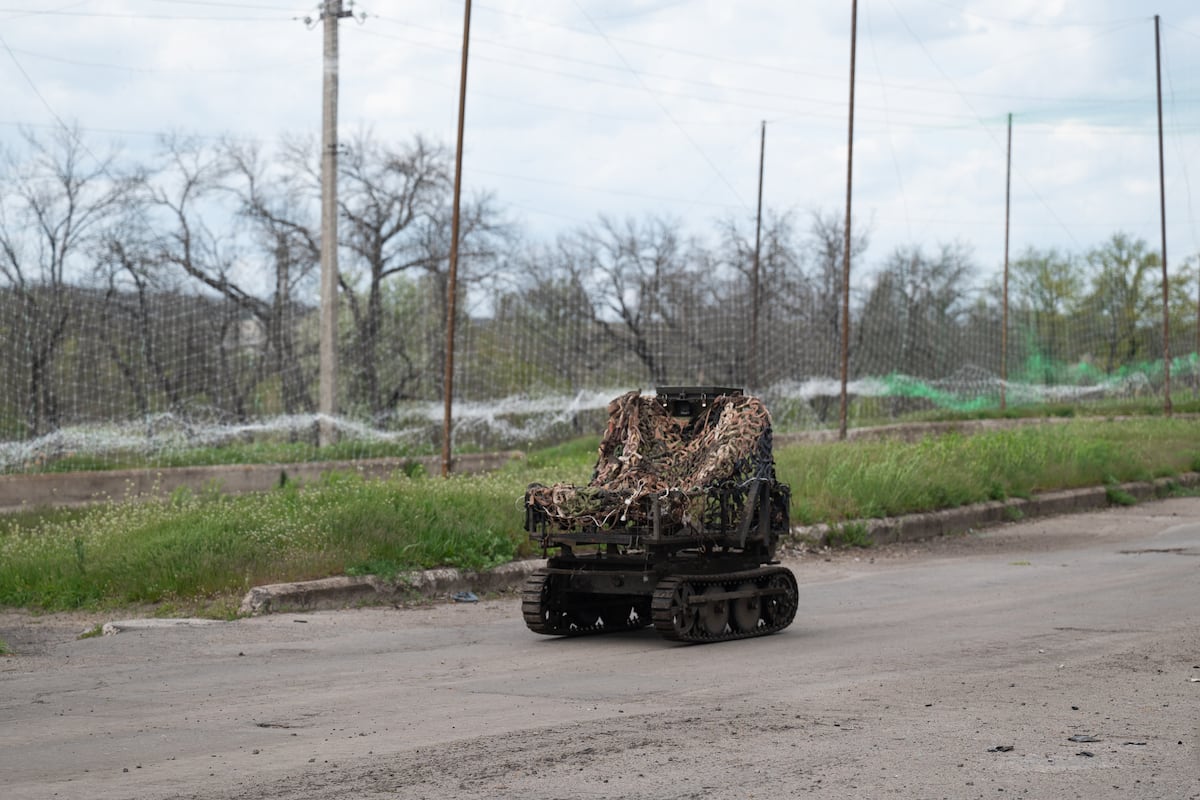
KYIV, Ukraine — She had walked for hours through the Lyman grey zone, past shell craters and the bodies of neighbors who hadn’t made it out, when the robot caught up to her. The 77-year-old saw it first as a blanket, then as the three words painted across it in an operator’s hand: “Grandma, get on!”
Ukraine’s 3rd Army Corps and its Cerberus unmanned ground systems unit ran the April 25 rescue with a reconnaissance drone overhead.
The woman lived in the same house for 53 years before Russian forces destroyed it. Three other civilians from the same area were drone-escorted to a pickup point and handed to a 1st Mechanized Battalion armored vehicle, according to a Telegram post by the 3rd Army Corps.
Recon units said Russian drones saturated the airspace, making a conventional ground evacuation impossible. So Ukraine sent a robot.
The same UGV class that hauls ammunition and evacuates wounded soldiers is now pulling civilians out of contested ground — sometimes inside the same week, sometimes off the same platform.
Ukraine’s ground robots are dual-use by default.
Four years ago, that meant a Kyiv grandmother knocking a Russian drone out of the sky with a jar of pickled tomatoes — a wartime legend recounted by Business Insider.
Today, it means the Cerberus unit running ammunition and casualty evacuations on the same Lyman axis where it pulled the 77-year-old out last month, the 3rd Army Corps said.
Commanders inside Ukraine’s Unmanned Systems Forces (SBS) describe the dual-use stack as a strategic doctrine, not improvisation.
“According to the SBS doctrine, a very large number of tasks fall to SBS. This is fire impact, mine-laying, logistical missions, engineering works, evacuation of the wounded and other measures,” Heorhii Khvystani, chief of staff of the Unmanned Systems Battalion of Ukraine’s 58th Separate Motorized Brigade, said on a panel at the Lviv Drone Autonomy Conference last month.
“UGVs perform important logistics and evacuation tasks on the front line. In March alone, the military carried out more than 9,000 missions using them,” Defense Minister Mykhailo Fedorov said April 18.
“Our goal is for 100 percent of frontline logistics to be performed by robotic systems.”
The Defense Ministry has contracted 25,000 UGVs in the first half of 2026 alone, more than double last year’s total, and Ukrainian President Volodymyr Zelenskyy announced the production of 50,000 ground robots for the year last week — creating a robotic ground force bigger than some allied armies.
“The main purpose of ground robots is to minimize human risk on the battlefield,” he said.
Ukrainian units have been logging dual-use UGV missions for months.
On the same April 25 operation that brought the grandma out of Lyman, the “Lut” Brigade and 100th Brigade used a UGV to extract a wounded “Luhansk” assault brigade soldier after a Russian ambush, according to UNITED24 Media.
Earlier the same month, Ukraine’s 1st Separate Medical Battalion ran six robotic casualty evacuation missions in a single day, with two UGVs covering roughly 185 miles (300 km) combined, according to Defence Blog.
Ukraine’s General Staff has credited robotic platforms with cutting personnel casualties by up to 30%.
Ukrainian commanders frame the doctrine in survivability terms.
“An autonomous solution is a tool designed to lift a human’s burden,” Yevhenii Lesin, deputy commander in Ukraine’s famed 412th Brigade “Nemesis,” said at the same Lviv panel attended by Khvystani last month. “A person can be preserved, their life can be saved, their time resources can be saved so that they can make decisions on how to apply the tool.”
Read the full article here
