

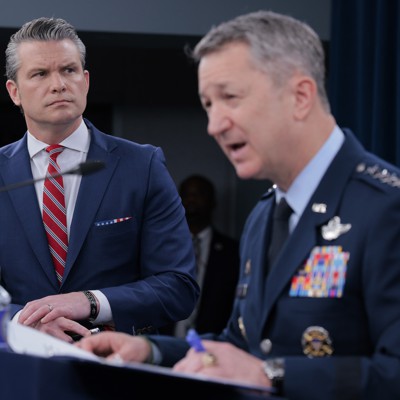
The Trump administration has dubbed its military effort to escort commercial ships through the Strait of Hormuz “Project Freedom,” Defense Secretary Pete Hegseth said Tuesday, calling it “separate and distinct from Operation Epic Fury,” “defensive in nature,” and “temporary.”
Hegseth said that Epic Fury, the war begun in February by the U.S. and Israel against Iran, is on pause during the ongoing ceasefire, erroneously asserting that the “clock stops” on the 60-day limit imposed by the War Powers Resolution on U.S. military campaigns without congressional approval. Even if the U.S. is no longer dropping bombs on Iran, its continued blockade is an act of war on its own.
“As a direct gift from the United States to the world, we have established a powerful red, white and blue dome over the strait,” Hegseth said during a Pentagon press briefing.
Two ships have transited the strait since escorts began Monday, Hegseth said.
There remain more than 1,550 commercial ships trapped in the Arabian Gulf, Gen. Dan Caine, chairman of the Joint Chiefs of Staff, said at the briefing.
On Monday, Iran attacked U.S. forces with cruise missiles, drones, and small boats, which were countered by U.S. Navy and Army attack helicopters, Caine said.
“Thus far, today is quieter,” he said.
Hegseth and President Donald Trump have said multiple times that the rest of the world needs the strait more than the U.S. does, though the international community has deferred to the U.S., which began striking Iranian nuclear and conventional weapons facilities on Feb. 28, to take the lead in confronting Iran’s closing of the strait in response to those attacks.
“As I’ve said before, the world needs this waterway a lot more than we do,” Hegseth said. “We’re stabilizing the situation so commerce can flow again, but we expect the world to step up at the appropriate time, and soon we will hand responsibility back to you.”
Hegseth did not offer a timeline for that transition.
Asked whether Iran’s attacks on U.S. ships in the strait would violate the ceasefire and restart strikes within the country, Hegseth deferred to Trump.
“Ultimately, the president is going to make a decision whether anything were to escalate into a violation of a ceasefire,” he said.
It’s unclear under what legal authority the president would resume strikes against Iran. His administration has offered several rationales for the war, some of which were contradicted by available evidence.
On Friday, the administration gave Congress written notice that hostilities have “terminated,” as the 60-day deadline for Congress to vote on an authorization of military force passed.
“Despite the success of United States operations against the Iranian regime and continued efforts to secure a lasting peace, the threat posed by Iran to the United States and our Armed Forces remains significant,” Trump wrote in the letter, leaving the door open to more strikes.
Read the full article here
