
Traditionally, big handguns were for carrying openly and smaller handguns were for concealment because — well, duh — smaller things are easier to hide (and they’re also less weight and bulk to carry). However, the wise concealed carriers ask themselves, “Why exactly am I carrying a handgun in the first place?” The obvious answer is, “Because I might have to shoot something to stay alive.”
If the purpose of the gun is not only to shoot but to hit the target when it is desperately important to do so — and since we know that, as a general rule, larger handguns are easier to shoot fast and straight — we have a definite collision of needs here.
Which brings us to the question of how to comfortably and discreetly carry larger handguns concealed.
There may be other reasons. In law enforcement, the rookie cop is generally a relatively young adult, often with no firearms experience, now in an occupation where they realize they are expected to take action when violent felonies occur in their presence — even when they happen to be off-duty.

While more police officers are issued compact handguns for off-duty carry today than ever before, the majority of law enforcement agencies still issue only one handgun, normally a full-size service pistol. The entry level officer is at the low end of the pay scale, often with young children and substantial life expenses, and purchasing another firearm and the attendant accessories can be a significant financial burden.
Finding the Balance
In the old days of the service revolver, young cops learned that buying an inside the waistband holster (IWB) allowed them to carry their four-inch barrel .38 or .357 Magnum concealed in ordinary clothing, and to be armed with the very same gun they were most familiar with through department training and qualification.

Let’s fast-forward to the concealed carry world of today. Even if you are at your peak earning years and you can afford a vast array of guns of all sizes and holsters of all types, you have to balance comfort with discreet concealment and, what we’ll call for lack of a better word, shootability.
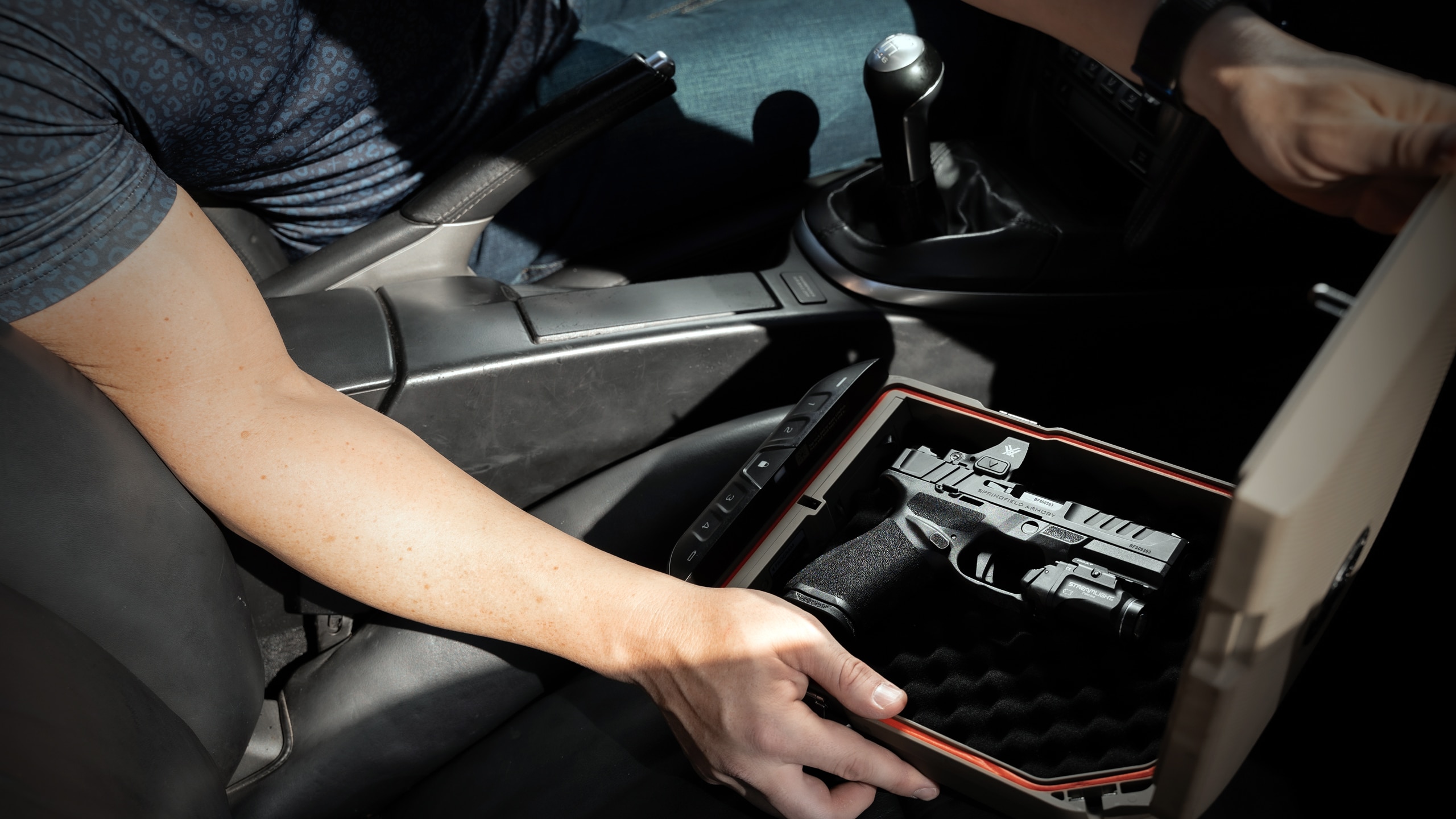
If you shoot a helluva lot better with a bigger gun, perhaps one with an optical sight or even an attached flashlight, concessions are going to have to be made somewhere.

For decades, starting at a very young age before anyone pinned a badge on me, I carried a full-size 1911 .45 auto. I did so during a few decades as an active part-time cop whenever I was allowed by the agency to do so. There were periods when I had to carry a department issue double-action .45, full size, and of course did. For some of those years the mandated service weapon was a .357 Magnum revolver with four-inch barrel. In each case, I learned to carry and be comfortable with the department issue gun on my own time.
Here’s how.
Dressing Around the Gun
If I recall correctly, Detroit Police Lieutenant and gunfight winner Evan Marshall was the first expert to coin the term “dressing around the gun.” Your clothing was designed to fit you and make you look good. Now a couple of pounds of oddly shaped metal have been added. To dress around that requires changes in sizes and styles of clothing.

IWB means that a longer handgun is down inside your pants and you don’t need as long a lower hem on your concealing garment to cover it. There’s a price to pay, though: you bought your pants with a waistband to fit you, and for them now to fit you and the pistol — and probably a spare magazine — it will have to be larger. Figure two inches larger in the waistband dimension.
AIWB. If you want a full-length grip frame to accommodate a higher cartridge capacity magazine, you’ve increased the height of the gun, a measurement that encompasses the butt of the pistol to the top of the pistol. A modern optical sight will significantly increase that height.
This is one reason why appendix inside the waistband carry (AIWB) is now so popular: most people have a broader expanse across the front of their torso than their measurement from belly button to spine. The greater height of the fully equipped modern pistol is now better concealed — but a closed front concealing garment is now required. That means an untucked closed-front shirt, a hoodie, a pullover sweater, or something similar.

An excellent choice is the PHLster Enigma, an ingenious system that can hide a good-size pistol under a shirt.
I’ve had occasion to carry a four-inch barrel .44 Magnum revolver. The big six-shooter concealed well in a Milt Sparks Summer Special inside the waistband holster, with a sport coat or un-tucked open front flannel shirt hiding it. Not the most comfortable carry, but certainly tolerable.
FBI tilt – butt a bit forward, muzzle canted to the rear — is a distinct concealment aid if you carry strong-side hip. It helps keep the butt inside the fabric drape coming down from the lats.

Live The Armory Life. The latest content straight to your inbox plus an automatic entry to each of our monthly gun giveaways!
Pancakes aren’t just for breakfast. Back in the 1960’s, Roy Baker’s patented Pancake holster popularized belt loops fore and aft instead of level with the holstered pistol. It helps to pull the holstered gun’s silhouette tighter into the body for better concealment. One such loop, as on the classic Askins Avenger designed by Richard Nichols, is good; loops front and back work even better.
And for the Distaff Side
For the ladies reading this, there are separate concerns. The average female is smaller than the average male, and a four-inch barrel striker-fired 9mm her big brother considers “compact” becomes more like “huge” for her. Most of the handguns and most of the holsters were designed by and for men. Moreover, your typical female has higher and more prominent hips than a male the same height. A concealment hip holster that puts the gun’s butt in his kidney area will put the same gun up into her floating ribs.

Solution? Instead of awkwardly rocking the shoulders sideways to clear a long-barrel pistol, incorporate hip movement into the draw. If you’re right-handed, drop the hips down and left as you draw, down and right if you’re a southpaw. Now, instead of the draw being all lifting a big gun out of its scabbard, the draw becomes part that and part your lower body pulling the holster down and away from around the gun. It’s also less of a flag movement than the shoulder rock: you don’t want to “telegraph your punch” by allowing an assailant to see you drawing any sooner than he has to.
By the way, this technique also works for males who like a very high-riding hip holster.
General Tips
There are going to be fashion sacrifices. Skin-tight clothing and concealed handguns simply don’t play well together. To conceal a full-size handgun, you want the concealing garment (un-tucked polo shirt, jacket, whatever) to be about one size larger than perfect fit without the gun. That gives you enough fabric drape for better concealment. The Fashion Police will probably only give you a warning instead of dragging you into Fashion Court, but no one is likely to look at you and scream “OMG, they’ve got a gun!”

If you carry on the hip, don’t reach for high shelves in public with the hand on the holster side. That tends to pull up the concealing garment and reveal the pistol. Use the other arm. Bending over at the waist causes “printing” of holstered guns at hip or small of back, so pretend you’re a back patient and kneel or bend the knees to prevent the printing.
Conclusion
My old friend Clint Smith is one of the all-time great instructors in armed self-defense. He’s famous for saying, among other things, “The defensive handgun should be comforting, not necessarily comfortable.” He practices what he preaches. Every time I’ve been with him, he was carrying a full-size 1911 .45, a full-size Springfield Armory XD45, or a large frame big-bore revolver with a four-inch barrel. And, you know something? He never said the gun couldn’t be comfortable as well as comforting.
If a larger pistol gives you more confidence in your ability to hit your target rapidly under stress, and/or a greater power level that you find more reassuring, and/or a larger ammunition reservoir that you think you might need … well, that’s comforting.
Following the above advice, I’ve found that it can be comfortable, too.
Editor’s Note: Please be sure to check out The Armory Life Forum, where you can comment about our daily articles, as well as just talk guns and gear. Click the “Go To Forum Thread” link below to jump in and discuss this article and much more!
Read the full article here
