

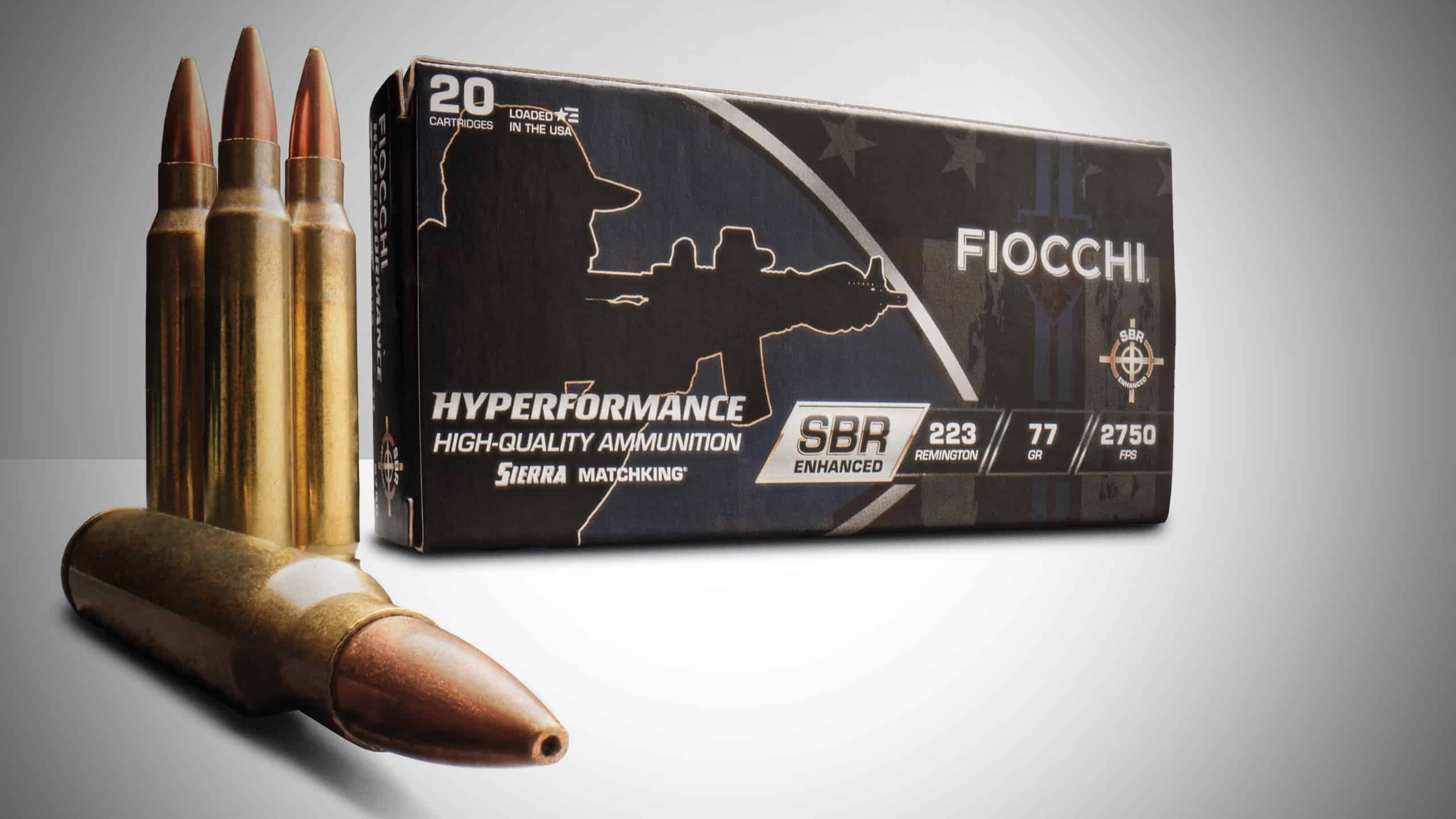
In today’s article, Joe Kurtenbach reviews the Fiocchi Hyperformance SBR Enhanced ammunition. The tested load, the .223 Rem. 77-gr. hollow-point boat tail (HPBT), was provided by the company for this review.
“It’s about the most accurate AR ammo I’ve ever tested,” I said to Matt Gann, manager of 340 Defense near Charles Town, West Virginia, as I walked toward the office from the range. I’d just concluded performance and gel penetration testing on Fiocchi’s Hyperformance SBR (short-barreled rifle) Enhanced 77-gr. hollow-point boat tail (HPBT) .223 Rem. ammunition and he’d just asked how the ammunition test had gone.
“You said it had a match bullet, right? You may not want them for hunting, but I’d always heard those were great for home defense. Less risk of passing through walls.”
And there it was. One of the great debates of Gun-dom.
“It worked on that gel about the same way it would on a deer — it blew up. Tiny bits of frag sent in all direction,” I stated.
“How far did it penetrate? Far enough?”
Core Questions
Just like that, the crux of the question was laid bare. How far is far enough? How much of the bullet needs to survive the journey? And how much penetration is required versus enhanced precision?
I understand why, every season, some hunters enter the game woods packing competition ammunition in pursuit of the perfect shot. I also see the advantages expressed by those who prefer hunting loads with larger, heavier, and often tougher bullets that are sure to leave a big hole. Likewise, I can relate to those who rely on modern bullet designs to maximize expansion or penetration, or both. It’s all a matter of preference.

The first group enjoys the confidence that comes with proven precision ammunition. They may only get one shot; they want the best chance possible of hitting their mark. The second group often represents a dimmer view of reality colored by long years of personal and anecdotal experiences. This is the “never enough gun” crowd that might prefer pass-through shots on game since two holes make for a more reliable blood trail.
Finally, the last subset of hunters pursues a best-of-both worlds solution. Over the past 10 to 15 years, an abundance of new bullets has been introduced that, through material choice and meticulous design, are intended to strike a balance between all-range precision, reliable expansion, and effective penetration. Their real-life performance, however, is sometimes questioned around campfires and gun shop counters (likely by adherents of the former convictions).
Focused Intentions
You may be wondering, “Why all the talk about hunting loads in a defensive ammo article?” Primarily it’s because, in my opinion, the considerations for choosing the right hunting ammunition and the right defensive ammunition are extremely similar.
The accumulated experience of hunters and the study of hunting bullet performance exponentially outpaces the study of real-world ballistic outcomes in defensive shooting scenarios, and it provides a robust analogy for speculating about the theoretical terminal performance of defensive bullet designs.
The various sides of the hunting and defensive ammunition arguments, too, are quite comparable. Take my three groups of hunters, above, and then think about modern debates on the effectiveness of handgun ammunition.

The match-grade crowd is similar to advocates of lower-recoiling cartridges like the .380. They consider shot placement and hit percentage as paramount. The big-bore crowd has obvious proxies among the .45 ACP “because two World Wars” and 10mm “because they don’t make 11mm” proponents. Finally, 9mm practitioners cite the balance of performance, shootability and increased magazine capacity to support their selection.
In every case, there are myriad ammunition options for the intended ballistic pursuits, considerations and constraints associated with each, and the final selection is likely to be highly personal based on experience, research and preference.
My project of evaluating Fiocchi’s Hyperformance SBR Enhanced HPBT .223 Rem. ammunition epitomized the tug-of-war between competing ballistic characteristics and capabilities. Sold under the company’s Hyperformance Defense Rifle ammunition banner, it clearly illustrated the balancing act between precision, penetration, and expansion involved in developing a round like this.
SBR-Enhanced
Before diving into the range results, it is worth describing the ammunition in detail because Fiocchi really set out to serve a niche, but fast-growing, market — short-barreled rifles and AR-style pistols for home and personal defense. By developing ammo designed to maximize performance out of a shorter-length barrel, they are addressing a specific need for these popular firearms.

Tuned for firearms with 7.5” to 11.5” barrels (and offered in .223 Rem., 300 BLK, .308 Win. and 4.6×30), Fiocchi had some performance challenges to overcome. First and foremost, shorter barrels generally mean lower muzzle velocities and reduced energy. The barrel offers a contained space in which a cartridge’s powder can burn and create pressure behind the bullet, and longer barrels allow more powder to be burned — thereby increasing the projectile’s speed.
To a bullet, chopping down the barrel is like shortening the runway for a plane — there’s less room and less time to accelerate for takeoff. Fiocchi’s solution was to pack it’s SBR Enhanced ammunition with rocket fuel — figuratively. The charge and formula of the propellant is designed to achieve complete burn within the confines of the shorter barrel. This is important both to get the bullet moving as fast as possible, but also to prevent launching a fireball of unburnt and still-burning powder out of the muzzle, creating a detrimental visual effect.

Live The Armory Life. The latest content straight to your inbox plus an automatic entry to each of our monthly gun giveaways!
Knowing that velocity and energy would be at a premium, Fiocchi also chose a bullet proven to be aerodynamic and just plain miserly when it comes to giving up foot-pounds downrange — the 77-gr. Sierra MatchKing.
It may seem counterintuitive to use a heavy-for-caliber bullet given the shortened runway, but considering Newton’s laws of motion and Fiocchi’s tuned payload of powder, once the heavier bullet is up to speed, it retains its velocity better than a lighter projectile would. It also helps that the MatchKing is no stranger to military and law enforcement use, particularly among specialized units running short-barreled rifles. That’s a pretty impressive provenance for a defense-oriented round.
Range Performance
To put the ammunition to the test, I reached for the large-format SAINT Victor 5.56 11.5” AR-15 Pistol from Springfield Armory, chambered in 5.56 NATO/.223 Rem. For those not familiar with the SAINT Victor pistol, it features — within the pistol’s M-Lok slot-equipped, free-floated aluminum handguard — an 11.5″ 4150 CMV continuous-taper profile barrel with a nitride finish. Rate of twist is 1:7”, and the 1/2×28 threaded muzzle is topped off with a four-prong, open-tined flash hider.

Weighing in at 5 lbs., 9 oz., the direct-gas-impingement pistol features forged 7075 T6 aluminum upper and lower receivers as well as an enhanced M16 pattern bolt carrier with a 9310 steel bolt. It is high-pressure tested/magnetic particle inspected (HPT/MPI) and features a black nitride finish. At the rear on the buffer tube extension is an adjustable SB Tactical SBA3 brace. An ambidextrous Radian Raptor-LT charging handle, B5 Systems Type 23 P-Grip and 45-degree ambidextrous safety lever round out the package.
The result was an AR-pattern rifle that would provide an ideal test platform for Fiocchi’s specially formulated SBR Enhanced ammunition.
Testing on paper targets, as well as Clear Ballistics 10% gel blocks, gave me an opportunity to dig deeper into the question of what represents the proper balance between accuracy, performance and penetration.

Notably, from the SAINT’s 11.5” barrel, the bullet achieved muzzle velocities greater than 2,200 feet-per-second (fps). Tested for accuracy at 25 yards, according to The Armory Life protocol for large-format pistols, the three, five-shot groups were all essentially clover leaves, with shots stacked on top of one another for an overall average of just 0.29”. That translates to 1.11 MOA, which is outstanding for a production, semi-auto gas gun.
| Velocity | Group (best) | Group (average) | |
|---|---|---|---|
| Fiocchi Hyperformance SBR | 2,228 fps | 0.166″ | 0.291″ |
The gel gave some interesting results. Lining up two 16” blocks for a total depth of 32”, I tested Fiocchi’s ammunition at three yards and 50 yards. At close range, the maximum penetration was right around 15.75”, and there was obviously severe disruption from about the 7.5” mark to around 13.5”. Notably, the bullet was completely obliterated, and the only recoverable portions were a bit of the lead core and some jacket fragments.
At 50 yards, the results were similar. Major disruption from the temporary wound cavity extended from about 5.5” to 10.5” within the gel block, and most of the jacket and core debris came to rest between 13” and 18”. The deepest visible track, though barely visible, seemed to penetrate to 24”. Unlike the three-yard shot, there wasn’t a single piece of frag large enough to recover with forceps.
Conclusion
That brings us back to the original quandary. Clearly, this ammunition can shoot well — in fact, extremely well. The accuracy results were remarkable. This should come as no surprise considering the quality of Fiocchi’s ammunition, as well as the proven track record of the Sierra MatchKing bullet they selected. Additionally, the velocity the heavy 77-gr. bullet managed out of the short 11.5” barrel — above 2,220 fps — showed that Fiocchi’s efforts on tuning this loading for shorter barrels paid off.

If called upon for defensive use, would this round be effective? How would it perform against layered clothing or barriers? That is tough to speculate on, but — as noted by my friend the range manager — many will see the bullet’s performance on impact as a sound quality for home defense, where over-penetration is always a serious concern.
Ultimately, Fiocchi’s Hyperformance SBR Enhanced 77-gr. HPBT .223 Rem. performs exactly as advertised. It fed and fired reliably through the short-barreled test platform and exhibited exceptional accuracy potential. The tuned propellant charge resulted in good velocities, given the abbreviated runway, and none of the expected fireballs — so common with AR pistols — were observed.
Fiocchi has clearly developed a highly capable .223 Rem. round here. So, the crux of the question remains. Does the undeniable performance of a match-grade bullet topping off a soundly developed loading that is designed for shorter barrels like this serve your defensive and shooting needs?
Editor’s Note: Please be sure to check out The Armory Life Forum, where you can comment about our daily articles, as well as just talk guns and gear. Click the “Go To Forum Thread” link below to jump in and discuss this article and much more!
Read the full article here
