

Portfolio Acquisition Executive (PAE) Fires, Capability Portfolio Executive (CPE) Defensive Fires, Counter-Unmanned Aircraft System (C-UAS) Product Office has issued a Sources Sought Notice to industry seeking information on technologies Next Generation C-sUAS Missile (NGCM) solution.
This will inform a requirement for the development, integration, demonstration and production of extended-range, quick-response, missile to defeat group 2 and group 3 small Unmanned Aircraft System (sUAS) threats. The principal objectives for this effort are to develop, produce, and sustain a missile capability at extended ranges with rapid launch and reduced time-to-target over existing effectors.
The Counter – Unmanned Aircraft System (C-UAS) is a capability fielded in response to the rapid proliferation of Unmanned Aircraft Systems (UAS) threat, commonly referred to as drones. Objective capability detects, tracks, identifies, and defeats emitting and non-emitting UAS with radars, kinetic effectors, electronic warfare, and electro-optical/infrared (EO/IR) components to prevent surveillance or attacks against US and coalition forces.
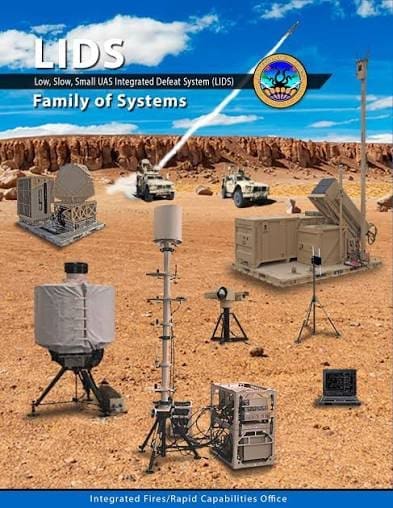
There are two primary configurations: Fixed-Site Low, slow, small UAS Integrated Defeat System (FS-LIDS) and Mobile Low, slow, small UAS Integrated Defeat System (M-LIDS) as well as multiple special systems devices.
The FS-LIDS configuration provides a C-UAS capability with modular, scalable architecture for employment at fixed sites. FS-LIDS incorporates the Forward Area Air Defense (FAAD), Electromagnetic Warfare (EW), Multi-Mission Radar (MMR), EO/IR Cameras, and kinetic options.
The M-LIDS configuration is mounted on tactical vehicles for employment at the halt and on-the-move, providing a scalable capability at the tactical edge. M-LIDS delivers kinetic and non-kinetic effects incorporating many common components with FS-LIDS using the same baselines as the fixed site variant to detect, identify, and defeat small UAS.
The Army is looking for NGCM to be produced and integrated into the existing Coyote Launch System to provide extended range, rapid launch time, and reduced time-to-target over current effectors.
Technologies must be at least TRL 7 following the end of the initial developmental test series that ends in 4QFY27 which supports immediate deployment. The Government requires the missile be ready for ATEC evaluation by 4QFY27. The Government requires 50x missiles to be ready for Operational Assessment (OA) by 1QFY28.
Key Modernization Requirements: The missile must provide the following capabilities (Not Exhaustive/Prioritized):
• Enhanced Range and Altitude: The missile shall be capable of defeating group 2 and group 3 sUAS threats at >16km at 6km altitude (T), >25km at 8km altitude(O).
• Improved Launch Times: Missile shall be capable of leaving the rail within a launch response of <5 seconds from operator initiation.
• Affordability: The missile production cost should be less than $150K per missile in a quantity buy of at least 5,000 missiles.
• Integration: The missile must be compatible with the Coyote Launcher with minimal to no modifications. The missile must be compatible with C-UAS architecture: IBCS-M via the WES ICD, KuRFS (T), radar agnostic: Sentinel A3/A4, LTAMDS, PATRIOT, TPQ-53 (O). The missile should use an all-weather RF seeker.
FYI, the Government will require design documentation for missile components, the integrated missile system, and the All-Up-Round (AUR) configured to integrate with the launch platform.
Interested parties must respond by Aug 20, 2026 4:00 PM EDT.
Full information available at sam.gov.
You can skip to the end and leave a response. Pinging is currently not allowed.
Read the full article here
