

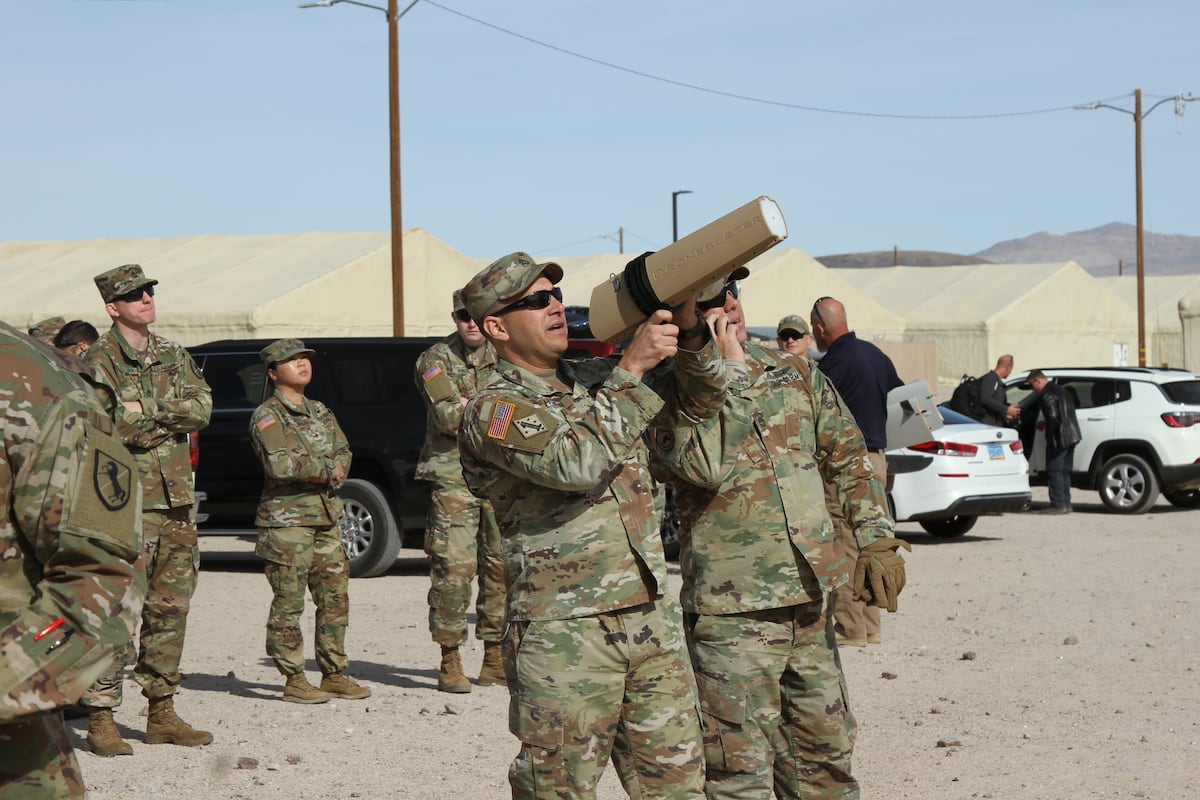
The U.S. task force responsible for countering small, unmanned aircraft chose five military installations to partake in an upcoming anti-drone pilot program.
The U.S. Army-led Joint Interagency Task Force 401, which was stood up in August 2025 and included in the fiscal 2026 National Defense Authorization Act, selected two southern border installations to join and assist the program in advanced directed energy capabilities, according to a May 6 Department of Defense release.
“Countering unlawful and adversarial drone activity is a homeland defense imperative,” Brig. Gen. Matt Ross, JITF 401 director, said in the release.
“There is no ‘silver bullet’ to address this challenge, and this pilot program integrates cutting-edge technology into the department’s broader counter-drone toolkit,” he continued.
The chosen five installations include Fort Huachuca, Arizona, and Fort Bliss, Texas, along the U.S.-Mexico border, as well as: Naval Base Kitsap, Washington; Grand Forks Air Force Base, North Dakota; and Whiteman Air Force Base, Missouri.
The locations were picked to support testing and operational assessments across a variety of mission goals and environments, per the release. The statement did not specify which systems the bases will focus on.
But the announcement does highlight certain counter-unmanned aircraft systems’ tools, such as high-energy lasers and high-powered microwave systems, that can counteract adversarial or unlawful drone activity while diminishing risk to nearby personnel and infrastructure.
The release comes after the Pentagon and the Federal Aviation Administration conducted anti-drone laser tests in New Mexico in March.
Those tests were the result of safety concerns after the Pentagon allowed U.S. Customs and Border Protection to utilize anti-drone lasers in February, causing the Federal Aviation Administration to suddenly close El Paso, Texas, airspace twice in one month.
In April, the DoD and FAA released a joint statement saying that a safety assessment proved the technology does not pose a risk toward passenger aircraft and that the two will work together to implement a safety agreement, according to the April release.
“Our collaboration with the FAA and the successful demonstration at White Sands were pivotal steps forward in our counter-UAS efforts,” Col. Scott McLellan, task force deputy director, said in the release.
“We showed that directed-energy systems can counter drone threats while preserving the safety of air travelers,” McLellan continued. “This pilot program now allows us to translate that progress into evolving operational capability for the homeland.”
Within 180 days, the Defense Department will complete deployment plans with installation commanders, the release states, and operations will commence this year.
The announcement did not specify exactly when operations are slated to begin.
Cristina Stassis is a reporter covering stories surrounding the defense industry, national security, military/veteran affairs and more. She previously worked as an editorial fellow for Defense News in 2024 where she assisted the newsroom in breaking news across Sightline Media Group.
Read the full article here
