

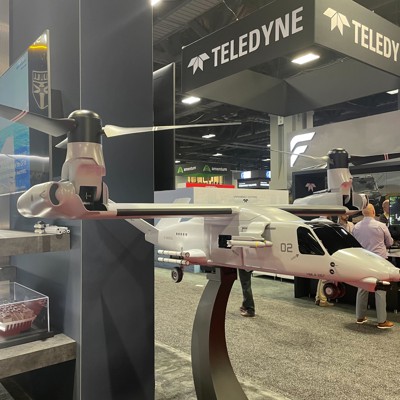
The Marine Corps may take its relationship with tiltrotor aircraft to the next level in the coming years with an attack platform to join the V-22 Osprey transport aircraft it’s been operating for the last two decades.
The service is looking for aircraft to fill gaps as it prepares to retire its AV-8 Harriers and F/A-18A-C variants, then eventually replace UH-1 Venom and AH-1 Viper attack helicopters. The Army-developed MV-75 Cheyenne II is a possibility, the Corps’ assistant deputy commandant for aviation said Wednesday at the Modern Day Marine conference in Washington, D.C.
“So I would say we’re exploring every option when it comes to the [Future Attack Strike] program,” Brig. Gen. Bob Finneran said during an update on the state of Marine Corps aviation. “MV-75, or the like, certainly could be one of the options that we look at.”
With that in mind, Bell-Textron unveiled a miniature model of its tiltrotor aircraft on the conference’s show floor Tuesday, armed with missiles and painted to look like it belongs to Marine Light Attack Squadron 267, which currently flies Venoms and Vipers.
“We’re just solidifying our top-level requirements and finalizing the request for information back from industry,” Finneran said.
The Army selected the MV-75 to be its Future Long-Range Assault Aircraft in 2022, announcing earlier this year that it planned to field prototypes to units for testing by the end of the year.
That timeline is still somewhat flexible, the head of Army aviation told reporters earlier this month, but the service officially brought the airframe into the Army family with a naming ceremony April 17 at the Army Aviation Warfighting Summit in Nashville.
Bell’s offering would take the MV-75 from a transport platform—designed to take over troop transport missions from the UH-60 Black Hawk helicopter—to a first-of-its-kind attack tiltrotor that would provide close-air support or launch drones to protect troops on the ground or in the air.
The Future Attack Strike program will also explore what comes after the Osprey, Col. Richard Rusnok, who heads Marine aviation’s Cunningham Group, said Wednesday.
“The V-22 as I said, will remain a relevant platform into the 2050s and then, as we start to complete the FASt program, we will look at the next-generation assault support platform to replace the V-22, that will have many of the same attributes, as far as size as the current V-22 fleet with, obviously, advanced capabilities, to include potential advances in propulsion, sensors and things like that.”
Read the full article here
