

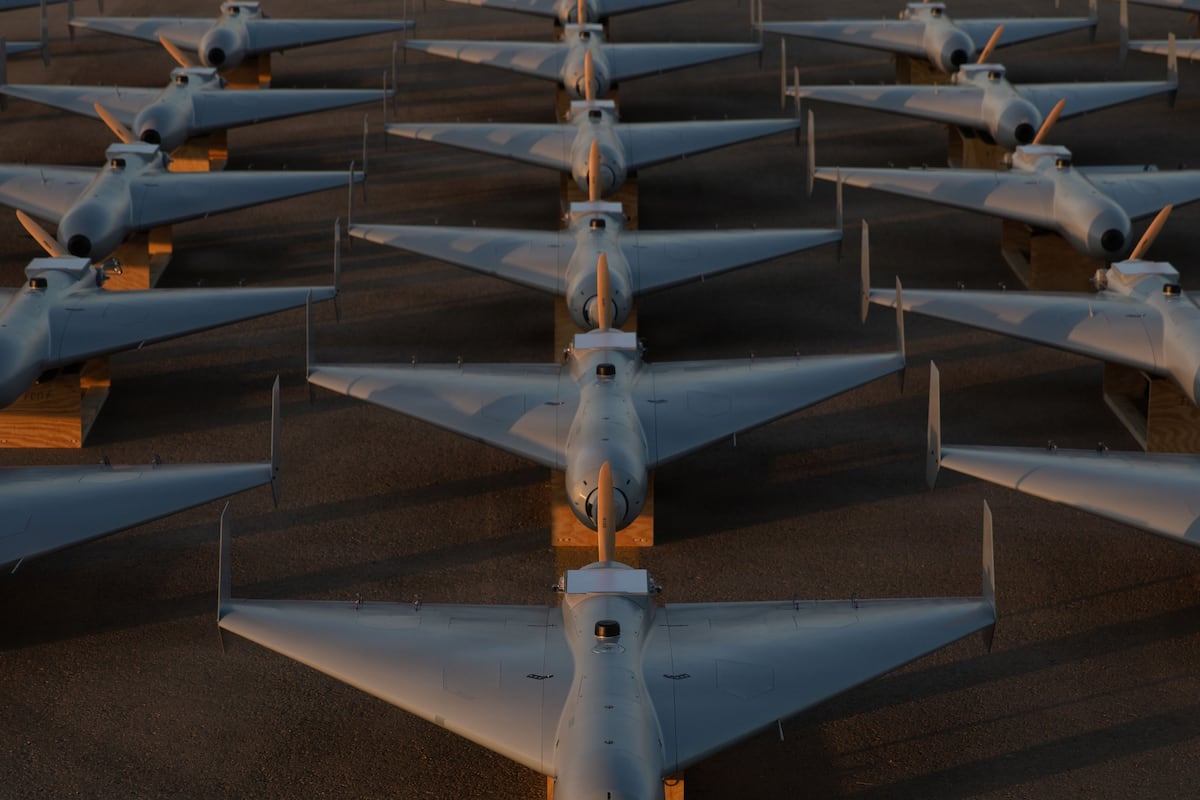
The U.S. Army is moving beyond battling individual drone threats as it experiments with tactics to combat — and attack with — throngs of unmanned aircraft in saturated skies.
The latest iteration of Project Flytrap, a multinational exercise to test new drone technologies in a realistic conflict setting, pitted U.S. and allied forces against each other in scenarios that featured drone swarms, jamming systems and counter-UAS defenses that continue to redefine modern warfare.
Army leaders have emphasized the need to integrate drones into doctrine and tactics, as they say the rise of inexpensive, mass-produced drones have forced the service to rethink everything from aviation to infantry patrols.
Project Flytrap took place in Lithuania, involved nearly 1,000 personnel and centered around pushing the Army’s technology to its limits amid variable weather and terrain.
Exercise leaders speaking during a Thursday roundtable said soldiers practiced massing unmanned platforms to test the limits of their systems and practice pinning down enemy forces, sometimes using tens of drones at a time.
Sgt. 1st Class Tyler Harrington, a platoon sergeant for Eagle Troop, 2nd Cavalry Regiment, led soldiers in developing counter-UAS tactics during the exercise. The proliferation of drones has changed the basics of soldiering, modifying even the way units conduct basic patrols.
“I’m out there doing my patrols and all of a sudden you hear buzzing. No longer am I just scanning to my 12:00 and around me at ground level,” he said. Now, his troops must look up.
They must also learn to listen.
“You have to now learn the sounds of the drones,” Harrington said, adding a chilling and provocative question, “does it sound like one of the one-way attack drones coming in our potential direction?”
During the roundtable, leaders also highlighted how units used additive manufacturing — like 3-D printing — to quickly create replacement parts and modifications for drone systems in the field.
For the first time, the Army applied testing standards established by Joint Interagency Task Force 401, or JIATF 401, as troops trialed and collected data on over 20 different systems, including drones not yet fielded to the ranks.
The task force, which was established by the Pentagon in 2025, consolidates drone-related acquisition and standards across the country in an attempt to contend with the rapid evolution of unmanned aerial technology in conflicts across the world.
Warfare — from Eastern Europe to the Middle East — has shifted as both state and nonstate actors have begun to attack with hordes of drones that are cheap yet advanced.
The Army is grappling with how to defend its soldiers against these new air threats and also procure and use similar weapons advantageously.
The U.S. and its allies in the Middle East have sought Ukraine’s advice in defending against Iran’s Shahed drones, weapons that the eastern European country has ample experience countering in its war with Russia.
The lessons gleaned from exercises like Project Flytrap tie into broader modernization discussions in Washington.
In a Friday House Armed Services Committee hearing, Army Secretary Dan Driscoll said the service was racing to restructure how it fights in a drone-flooded battlefield, “where swarms of drones are going to be attacking an Apache.”
Discussing aviation modernization during budget testimony, Driscoll added, “if you look all over the world, there are not good solutions for that.”
Eve Sampson is a reporter and former Army officer. She has covered conflict across the world, writing for The New York Times, The Washington Post and The Associated Press.
Read the full article here
