
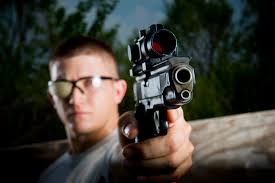
I recently heard someone say that handguns have no place in military combat. History shows us otherwise. For the tanker, artilleryman, radio operator or medic whose hands are too busy at designated tasks to hold a rifle, the pistol makes enormous sense. Behind the lines when unpleasant surprises come, the handgun is just as much an emergency rescue tool as an armed citizen’s carry gun in civilian society.
My older daughter owns a .38 Special revolver bought from the heirs of a Navy cook who took it with him to the Pacific in World War II and used it to kill two Japanese sappers who had attacked the cook’s base camp.
We’ll look here at the single service handgun that served America’s military longest — the 1911/1911A1 .45. No American fighting man ever earned more respect than Audie Murphy, the Medal of Honor winner and most highly decorated soldier of WWII. In his autobiography “To Hell and Back,” here’s what he had to say about his issue .45 auto, speaking of a time behind the lines:

“Turning to my pack in search of a necktie, I spy my service pistol. I pick it up, remove the clip, and check the mechanism. It works with buttered smoothness. I weigh the weapon in my hand and admire the cold, blue glint of its steel. It is more beautiful than a flower, more faithful than most friends.”
Military history is replete with accounts of this weapon’s spectacular service in combat, and failures with it are notable by their absence. Let’s look at a few examples.
World War I
The first major conflict after the adoption of John Moses Browning’s most copied design was the first world war. The pistol worked so much better than long, clumsy bolt-action rifles when the enemy invaded the trenches that the supreme commander or the American forces, “Black Jack” Pershing, wanted to issue one to every man at the front.

America’s firearms industry couldn’t manufacture 1911’s fast enough to accomplish that, which is why Model 1917 .45 ACP revolvers that used three-shot half-moon clips were supplementally produced.
[Be sure to read Tom Laemlein’s article Hunting Pancho Villa with the 1911 for details on the pistol’s use prior to America’s entry into World War I.]
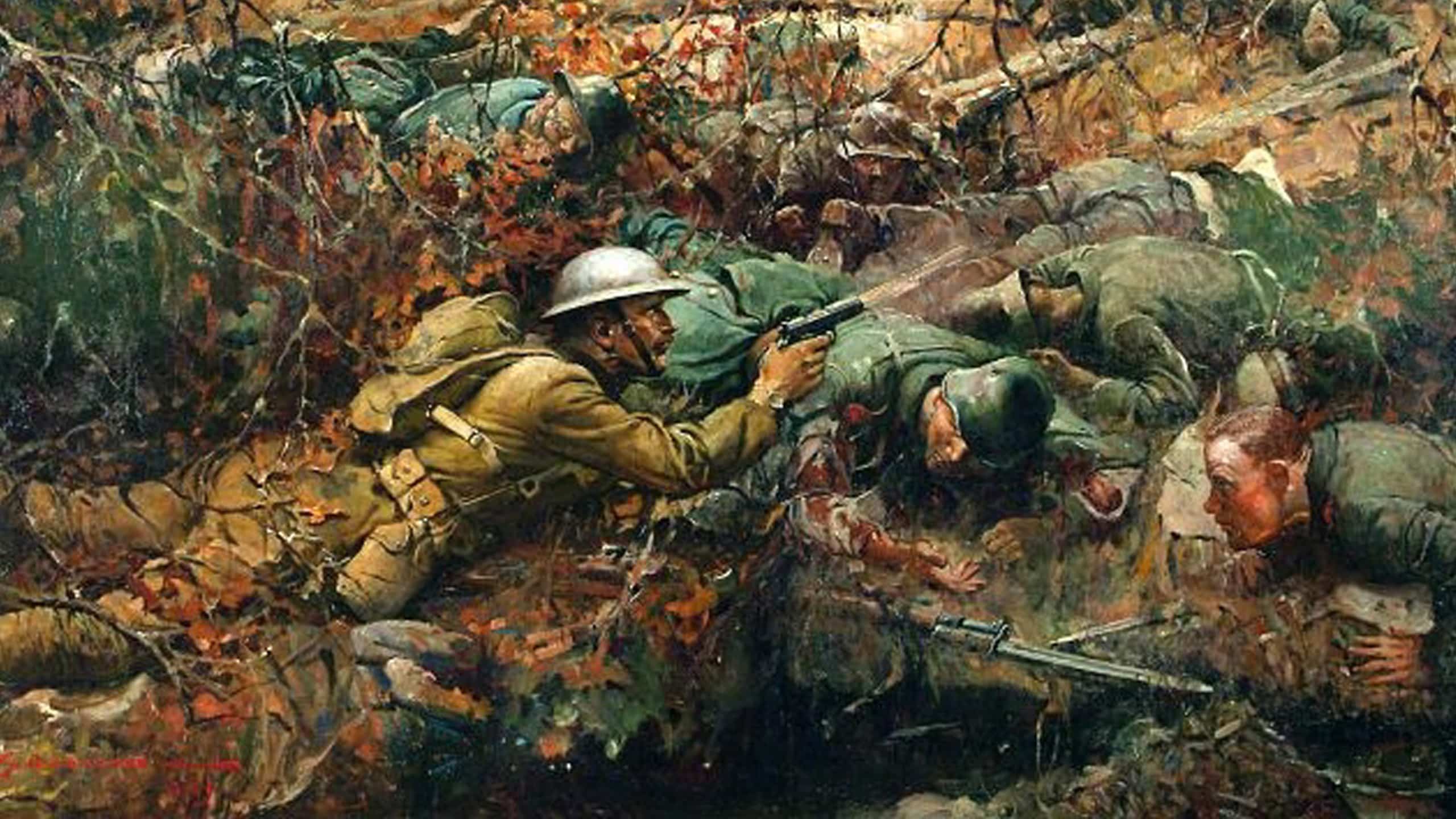
WWI’s most famous use of the .45 auto came in the hands of that war’s most famous American fighter, Alvin York. He was awarded the Congressional Medal of Honor in 1918 when he single-handedly killed or captured a reported 132 German soldiers. In the course of that event, the time came when a German patrol attacked him with bayonets. He set down his five-shot bolt-action .30-06 rifle and with his .45 fired six shots, dropping six attackers and convincing the German officer in charge to surrender the rest of his troops.

The legend of the GI .45 had begun and had a long way to go. Military historian and gun expert in his own right Barrett Tillman wrote for American Rifleman in 2010, “On Oct. 11 the 30th Division’s Sgt. Richmond H. Hilton used his … [1911] to kill six enemy soldiers and capture 10 before losing an arm in a shell blast. Another marksman wielding his sidearm was 1st/Lt. Samuel Woodfill on Oct. 12. Despite being gassed, Woodfill — a superb hunter — made 300-yard head shots with his rifle on Maxim gunners, then closed on the enemy. He carried an M1911 given to him by a French civilian who had found the pistol after doughboys had left the area. Though more familiar with revolvers, Woodfill put the semi-automatic to efficient use in clearing the German trenches.”
Tillman continued, “In all, seven officers, three noncommissioned officers and three enlisted men were presented the pale-blue ribbon with 13 white stars for actions involving the … semi-automatic during September and October 1918. That figure would be eclipsed in the next world war.”
World War II
The 1911 saved American lives in both theaters of the second world war. In 2011, American Rifleman field editor Bruce Canfield shared this: “… the .45 was reliable and possessed potent short-range ‘stopping power.’ One example of this occurred during an incident on Guadalcanal: ‘There was a moment of heart-stopping drama at the division [command post] when a sword-wielding Japanese officer stepped into the open with two riflemen and headed directly for Archer Vandegrift, who was in the open, alone and unarmed. Master Gunnery Sergeant Sheffield Banta, an utterly unflappable old salt, stopped typing a report long enough to unholster his .45-caliber automatic pistol and plug the officer dead in his tracks.’”

In the course of that conflict, a 1911 would be used to shoot down not just one enemy airplane, but two. Lt. Owen Baggett’s B-24 bomber was mortally wounded by ground fire over Burma, and he took to his parachute. As he floated down, he saw to his horror that Japanese fighter pilots were machine-gunning other U.S. personnel as they floated down. Determined to die fighting, Baggett fired four desperate shots into the open cockpit of a Japanese fighter plane as it passed him in the air. The plane spiraled into the ground. It was later learned that the dead pilot had a bullet hole in his head. (To learn more about that, click here.)
During the waning days of the war in Europe in 1945, a German reconnaissance plane was shot down by .45 pistol fire from U.S. counterpart, wounding those on board the German plane and forcing it to land. The German plane spiraled and crashed, and did not return fire. U.S. Army Air Force Lt. Duane Francies was the pilot. His observer was Lt. William S. Martin.
Live The Armory Life. The latest content straight to your inbox plus an automatic entry to each of our monthly gun giveaways!
The pistol was often the best tool for a wounded warrior to continue the fight with. On Iwo Jima, Marine Sergeant William Harrell’s left hand was traumatically amputated and, unable to reload and continue fighting with his M1 carbine, he resorted to his .45 auto to kill two more enemy soldiers before a grenade took off his right hand. He finished the war with hooks instead of hands … and a Medal of Honor.
On Saipan, when Marine private Thomas Baker was too badly wounded to walk and there weren’t enough men to carry him, they promised to come back for him and left him with a .45 fully loaded with eight rounds. They returned to find him dead, his empty 1911 at slide lock in his hand … and eight enemy lying dead in front of him. His valiant last stand earned him a posthumous Medal of Honor.
If Audie Murphy was the most famous Army infantryman to emerge from the war, John Basilone was the most famous Marine. He won the Medal of Honor for awesome machine gun work on Guadalcanal. In the book “Uncommon Valor on Iwo Jima,” James Hallas quotes Basilone as saying, “Some Japs would sneak through the lines and behind us. It got pretty bad because I’d have to stop firing every once in a while and shoot one with my pistol.” Sadly, Basilone did not leave Iwo Jima alive. In addition to his great courage, he had demonstrated why pistols were issued to troops who manned crew-served weapons.

As with the Navy cook mentioned earlier, a sidearm was a lifesaver when surprised in a supposedly safe moment. On Okinawa, Lt. James Young was grateful for his 1911. In “82 Days on Okinawa,” Col. Art Shaw writes, “Young looked over his shoulder. With his bayonet poised to plunge into the lieutenant’s back, a Japanese soldier came running as fast as he could with his head bent down. For a second, Young stared as if he couldn’t believe his eyes The man had to be crazy or at the least out of his mind in some way. By reflex, Young fired his pistol and dropped the man only ten feet away.”
…And Beyond
Space here runs short, but the list of American heroes using the 1911 does not. In Korea, when frigid weather made lubrication sluggish and jammed many small arms, a 1911 .45 tight to the body under the coat in a tanker’s chest holster was less vulnerable to the elements.
In Vietnam, the .45 auto was a favored weapon of the “tunnel rats,” many of whom used it effectively in claustrophobically close quarters. Staff Sergeant John McGinty killed five NVA soldiers with his 1911, Tillman reports.

In the Battle of Mogadishu, Special Forces heroes Gary Gordon and Randy Shugart stacked the enemy like cordwood with their long guns and when their ammo ran out they resorted to their .45’s. All won Medals of Honor posthumously. In the War on Terror, the .45 remained the choice of Special Forces units.
Today, though the 1911 was retired from general issue in the mid-1980s, there may be some still in the holsters of some Special Forces personnel, and the 1911 remains in its last military bastion as a staple of our armed services pistol teams.

The military service pistol has most certainly proven its worth in combat, and none more decisively than the 1911/1911A1 .45.
Editor’s Note: Please be sure to check out The Armory Life Forum, where you can comment about our daily articles, as well as just talk guns and gear. Click the “Go To Forum Thread” link below to jump in and discuss this article and much more!
Read the full article here
